Watch The Kitchen Table
Illustration · An imagined refreshment table in a school cafeteria after an evening meeting in the 1940s: a coffee urn, cups and saucers, a plate of doughnuts, and a woman’s handbag with thick glasses folded beside it. Not drawn from a photograph.

Akron · 1939–1949

The women decided it

Anne helped, by one account, to take Akron’s alcoholics out of the Oxford Group, looked out for newcomers at King School, and kept calling as her eyes failed.

“The women decided it, as was usually the case in things like that. And Doc went along with Annie.”

Bob E., on the Akron group’s break with the Oxford Group in 1939 · Dr. Bob and the Good Oldtimers, 1980

Leaving the Group

In the spring of 1939 the Big Book came out, and the Cleveland alcoholics broke away from the Oxford Group to meet on their own, soon calling themselves Alcoholics Anonymous. Anne and Dr. Bob felt they should leave too, Dorothy S. M. remembered, “but they felt, in loyalty to T. Henry and Clarace, that it was going to be a very difficult thing.” T. Henry and Clarace Williams had opened their home to the Akron meetings for years.

Akron argued about it for a month or more, Elgie R. said. Henrietta Seiberling didn’t like the new book, Bob E. said, and she and Anne fell out over it; Anne and Clarace fell out too, over something no one ever learned. “There were some hot conversations on the telephone,” he said. “It was a three-way thing between Clarace, Henrietta, and Anne.” Late in 1939 Dr. Bob told T. Henry the alcoholics would meet somewhere else. Henrietta, Elgie remembered, told him it was the biggest mistake of his life. “Bob and Annie just went,” Elgie said. The first meetings were in their own living room, with the Christmas tree up. In January 1940 they moved to King School.

At King School, Bob and Anne always sat in the same places, toward the back on one side, Anne next to the aisle. The coffee afterward, downstairs in the school cafeteria, was her part. She went from table to table looking for new faces. “I want to welcome you and your lovely wife to Alcoholics Anonymous,” Dan K. remembered her saying. “We hope you’ll keep coming back.” When a woman alcoholic turned up and Dr. Bob wondered aloud whether he shouldn’t stick to working with men, Elgie said, “Annie would say, ‘Let’s try and see.’”

Her eyes were failing. Cataracts covered them, Good Oldtimers says; she gave up driving and could no longer tell who was across a room. She still knew people by their voices, Dorothy said, and could “recall every single thing about them.” Emma K., a nurse whose husband, Lavelle, had come to Dr. Bob for help in 1941, began minding the house whenever Bob and Anne went away, and in the last years she was with Anne every weekday.

And she kept telephoning. In the year before Anne died, a woman named Peggy remembered, “there was seldom a morning when she didn’t call.”
Listen The women decided it About 1 minute

One stop at a time

The last year

Her last year, from a trip west with Bill and Lois W. to a bed at St. Thomas Hospital.

From Dr. Bob and the Good Oldtimers (1980), Lois Remembers (1979), Sister Ignatia’s letter to Dr. Bob after Anne died, and Mary C. Darrah’s biography of Sister Ignatia (1992). Quotations are short excerpts.

1948

Los Angeles

Anne and Dr. Bob met Bill and Lois in Los Angeles, where some 6,000 people came to hear the two founders. Anne and Lois spoke together at a big meeting for AA families. Lois remembered it as the first and last such trip Anne and Bob made together. (She also remembered Anne dying later that year; it was the next June.)

Lois Remembers, chapters 15 and 17

1948

Detroit

That summer Dr. Bob found out he had cancer. He gave up his practice so the two of them could have their remaining time together in peace. The same year, at his tenth anniversary in Detroit, Archie T. introduced Anne to 1,500 people and told them how she had taken him in. Dr. Bob gave his last major talk.

Good Oldtimers, chapters IX and XXVII

May 1949

Texas

They flew to Texas to visit their son, Smitty, and his family. “You know, Emma, I don’t really care to go,” Anne said, “but Dad wants to. It will make him happy.” Dr. Bob told it the other way round: “I don’t really want to go, but Mama wants it.” The morning they left, she called Peggy to ask why she had missed the meeting the night before.

Good Oldtimers, chapters VII and XXVIII

June 1, 1949

St. Thomas

On the way home their plane was held up by a rainstorm, and Dr. Bob called Sister Ignatia for a bed. Sister Ignatia remembered pneumonia followed by a severe heart attack; her biographer puts the heart attack first. As a patient, Sister Ignatia wrote, Anne “was more concerned about the well-being of her visitors than herself.” She died on June 1.

Next: Legacy

Good Oldtimers, chapter XXVIII; Darrah, chapter 4

Not a burden

“I will miss Anne terribly,” Dr. Bob said. Had she lived, she faced months in the hospital and months more in bed at home. “She would have hated being a burden; she could not have stood it.”

For a closer look

Go deeper

Anne and Sister Ignatia on the telephone, the dresses she wouldn’t wear, and what she asked for in the hospital.

Sister Ignatia’s calls
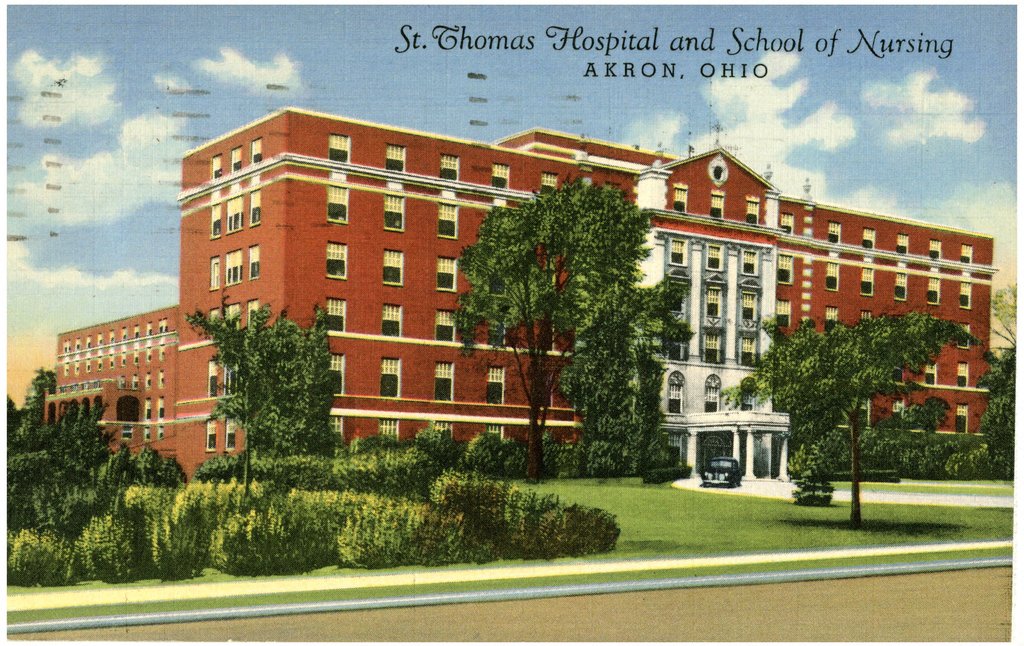
A color postcard of St. Thomas Hospital in Akron, a large brick building.
St. Thomas Hospital and School of Nursing, Akron, on a 1948 postcard. Anne died there the next year.Columbus Metropolitan Library Digital Collections

From 1939 Sister Ignatia admitted Dr. Bob’s alcoholics to St. Thomas Hospital, and when she had a worry about one of them, she often called Anne instead. “I didn’t like to bother Doctor too much,” she said, “so I would call Anne.” Anne, she said, “always found the correct answer,” and in her diplomatic way would take the problem to Dr. Bob and telephone back with his advice.

The two women rarely met. Anne’s daughter, Sue, remembered that it was mostly over the telephone: “I know she talked to Sister Ignatia at least once a day.” Anne worked with the patients’ wives at home while their husbands were in the ward.

One black dress

Before an Akron New Year’s party, someone gave Anne three new dresses. Dorothy S. M. asked which one she would wear. Anne said she couldn’t bear to wear any of them, because some of the new people had nothing, and she came to the party in the same black dress Dorothy had always seen her in.

She gathered clothes for anyone who needed them. When Dorothy had only a summer coat, Anne took the fur collar from someone’s old suit, and together they stitched it onto the coat for winter. And once, when Dorothy was busy chatting with her own friends after a meeting, Anne called her over: “There’s a new woman sitting over there in the corner, and nobody’s talking to her.”

Her only request

Good Oldtimers says she had an operation to remove one of the cataracts. Pass It On says she had three, and then refused any more.

All she asked, going into the hospital, was that someone keep Bob company. She was afraid he would fret and feel alone without his friends.

Emma K., who nursed her, never could bring herself to use her first name. “I sometimes think everybody called her Anne but me,” she said. “I couldn’t do it. I called her Mrs. [S.]”

Sources
  • Dr. Bob and the Good Oldtimers. AA World Services, 1980. Chapter VII, “A.A. number three arrives” (Peggy), chapter IX, “Twelfth Step approaches evolve” (Archie T. in Detroit), chapter XII, “Cleveland A.A.s leave the Oxford Group” (Dorothy S. M.), chapter XIV, “A.A. and St. Thomas Hospital” (Sister Ignatia on Anne), chapter XVI, “Split between Akron A.A. and the Oxford Group” (Bob E.; Elgie and John R.), chapter XVII, “‘As Dr. Bob said …’” (the regular seats), chapter XVIII, “The wives’ role in early A.A.” (Dan K.; Dorothy S. M.; the cafeteria), chapter XIX, “Minorities within A.A. gain acceptance” (Elgie on women alcoholics), chapter XXVII, “Shadows—illness and dissension” (her eyes; Emma K.), and chapter XXVIII, “Without Anne, but with loving friends” (the last trip; Sister Ignatia’s letter; Dr. Bob).
  • Pass It On. AA World Services, 1984. Chapter Twenty (the cataract operations).
  • Lois Remembers. Al-Anon Family Group Headquarters, 1979. Chapters 15 and 17 (Los Angeles, 1948).
  • Mary C. Darrah, Sister Ignatia: Angel of Alcoholics Anonymous. Loyola University Press, 1992. Chapter 4, “Akron’s Magic Blend” (Sue on her mother and Sister Ignatia; Anne’s last illness). Quotations are from the scanned text, checked against the page images.
  • St. Thomas Hospital and School of Nursing, Akron, Ohio (postcard), 1948, Columbus Metropolitan Library. No known copyright.