Watch The Kitchen Table
Illustration · An imagined dining room at 855 Ardmore Avenue just after lunch broke off: tuna fish sandwiches on the table, a cup knocked over and a chair shoved back, and the stairs Anne ran up. Not drawn from a photograph.

Akron · Summer 1935

Tuna fish sandwiches

Anne took a drunk and his whole family into her house, and one day at lunch he chased her upstairs with a butcher knife.

“I kept my voice low, in a monotone. I figured sooner or later it was going to bore him.”

Anne S., telling the story in later years, as Elgie R. remembered it · Dr. Bob and the Good Oldtimers, 1980

The man down the block

In the summer of 1935, Bill W. was living at 855 Ardmore Avenue in Akron, at Anne’s invitation, and he and her husband, Dr. Bob S., were looking for another alcoholic to help. (The gate lodge, in I Just Work Here, tells how Bill came to them.) A minister sent them Eddie R., who lived down the block. He came from a prominent Youngstown family. His wife had made her “surrender” in the Oxford Group, the Christian movement Bob and Anne belonged to. Eddie, Pass It On says, was still holding out, though Bill wrote home at the time that both of them had surrendered.

They got him sober. Within a week, Bill wrote to his wife, Lois W., Eddie phoned from Cleveland to say he had found a dock to jump from, and Bill and Dr. Bob drove there in the middle of the night to bring him back to the hospital. A few days later he was drunk again. Eddie could produce “a major crisis of some sort about every other day,” Bill said at the time. Then he lost his rented house, and Anne invited the whole family to live with them: Eddie, his wife and their two small children.

The house had three bedrooms. Sue, their daughter, gave up her room to Eddie and his wife, and as the house filled up, she and her brother, Smitty, slept in the attic.

One day at lunch, over tuna fish sandwiches and coffee, Eddie leapt up from the table, seized a butcher knife and went after Anne, who fled up the stairs. At a loss, she said later, she knelt and prayed: the Lord’s Prayer first, then whatever verses came to her, keeping her voice low and even. At last Eddie quieted, and Bill came upstairs and took the knife from him. No one could work out what had set him off. Dr. Bob had a theory: Eddie “must have been allergic to tuna fish.”

It became, AA’s history of Akron says, the favorite story about Eddie, and one Anne loved to tell. Elgie R. and her husband, John R., who joined AA in 1939, heard it from her. Bill, who was living in the house, and Lois, who visited that summer, remembered it differently. The four tellings are set side by side below.

Bob and Anne kept trying. They did all they could for him short of signing over the house, Pass It On says, and Anne’s patience had nearly run out by the time his family moved away. His wife went home to her parents, Bill wrote, and Eddie disappeared. They gave him up.
Listen Tuna fish sandwiches About 1 minute

Compare the accounts

Who took the knife?

Three people set the story down, in four tellings, years apart. They don’t agree on where it happened, what knife it was, who was in danger or how it ended, and they may not all be about the same day. Here they are in the order they were printed.

Only the last is in Anne’s own words, and someone else wrote it down, some thirty years after she died. Bill W. was living in the house; Lois W. visited that summer while Eddie’s family was there. Pass It On (1984) adds only that Eddie once threatened Bill and Anne with a knife. Quotations are short excerpts, shown side by side for comparison.

1951

Bill W.

16 years after · Anne had died in 1949

“One afternoon Anne sat at her kitchen table, calmly regarding him as he fingered a carving knife.”

Then, he wrote, “under her steady gaze, his hand dropped.”

“Dr. Bob: A Tribute,” his memorial to Dr. Bob in the AA Grapevine, January 1951, now in The Language of the Heart (1988).

1957

Bill W.

22 years after

“Once when angered he had tried to emphasize a point by waving a knife at Anne and me.”

This time Bill puts himself at the end of the knife too, beside Anne, and doesn’t say how it ended.

Alcoholics Anonymous Comes of Age (1957), Bill’s own history of AA.

1979

Lois W.

44 years after · she visited that summer

“…Bill had to take a carving knife away from Ed, who, in a drunken rage, was flourishing it around the heads of Annie and Ruth.”

Ruth was Eddie’s wife. In Lois’s telling two women were in danger, and Bill ended it.

Lois Remembers (1979), her memoir.

1980

Anne, as Elgie R. remembered it

Told between 1939 and 1949 · set down 45 years after

“I didn’t know what to do, so I got down on my knees and started praying.”

She went on praying until he calmed down, “and Bill came up and got the knife.”

Dr. Bob and the Good Oldtimers (1980), AA’s history of Dr. Bob and the Akron pioneers, from Elgie and John R.’s memory of her account.

Where they differ

Where it happened

  • 1951 At her kitchen table, one afternoon
  • 1957 Not said
  • 1979 Not said
  • 1980 At lunch, then upstairs

The knife

  • 1951 A carving knife
  • 1957 A knife
  • 1979 A carving knife
  • 1980 A butcher knife

Who was in danger

  • 1951 Anne
  • 1957 Anne and Bill
  • 1979 Anne and Ruth, Eddie’s wife
  • 1980 Anne

How it ended

  • 1951 She looked at him until he lowered his hand
  • 1957 Not said
  • 1979 Bill took the knife away
  • 1980 She prayed until he calmed down; then Bill took the knife

Her own version

In Bill’s first telling, Anne stares Eddie down at her own table. In Lois’s, Bill has to take the knife away. Only the version Anne told herself has her on her knees, praying in a monotone to bore him, and only hers ends with a joke.

For a closer look

Go deeper

What they tried on Eddie, what his wife went through, and where he turned up years later.

Baking soda and sauerkraut
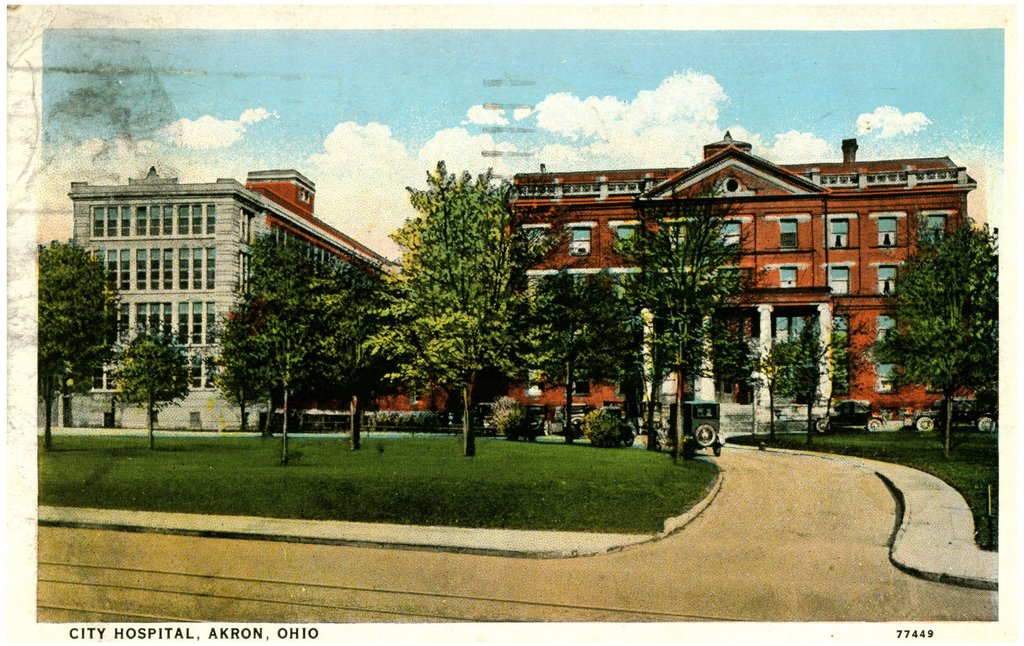
A color postcard of City Hospital in Akron, showing its two large buildings.
City Hospital, Akron, on a postcard from 1935, the summer Bill W. and Dr. Bob brought Eddie there.Columbus Metropolitan Library Digital Collections

Bill and Dr. Bob learned a good deal about what to do, and what not to do, from Eddie, AA’s history of Akron says. After the night at the Cleveland dock, they took him to Akron’s City Hospital and gave him what Bill called “the Towns treatment,” after the New York hospital where Bill had dried out. The doctors there, he wrote to Lois, were “all agog.”

Smitty remembered that they locked Eddie in an upstairs room of his own house to keep him sober, and that he slid down the drainpipe and set off up the street, with Dr. Bob after him in the car and Bill on foot. People fed him baking soda, which seemed to bring him to his senses until his next meal, Smitty said. They tried sauerkraut too, but it upset his ulcers.

Years later, Ernie G., AA’s fourth member in Akron, named Eddie and another early failure as proof that “wet-nursing,” looking after a drunk around the clock, didn’t work. It was given up, he said.

Ruth

Lois W. is the one who gives Eddie’s wife a name: Ruth. Sue remembered her coming down in the mornings looking “all messed up.” Talking with Sue in the 1950s, Bill remembered why. Eddie was pleasant to his wife in front of people, but when they were alone he beat her.

A stormy weekend that summer, which Bill called “a frightful explosion,” may have begun when Ruth, in the Oxford Group way, openly confessed something Eddie didn’t approve of and made amends for it, AA’s history of Akron suggests. Anne’s own notebook from those years weighed the dangers of sharing and found only one that counted: “The only danger really is when people live a half truth and begin to compromise.” AA’s Ninth Step, on making amends, has a limit the Oxford Group’s practice didn’t, and the book says it “didn’t get in by mistake.”

Holy Moses!

Elgie R. remembered going to Youngstown years later, to a big AA meeting at a country club. The first thing Dr. Bob said when they got there was “Holy Moses!” There was Eddie.

He turned up again at Dr. Bob’s funeral, in November 1950. He asked Smitty whether he remembered him, and said he had been dry about a year, in the Youngstown group. In 1957 Bill wrote that Eddie had lately written to say he had been sober seven years: “our first ‘failure,’ so-called, is today a success.”

Sources
  • Dr. Bob and the Good Oldtimers. AA World Services, 1980. Chapter VII, “A.A. number three arrives” (Eddie R.; Anne’s account as Elgie and John R. remembered it; Smitty and Sue), and chapter VIII, “The first group forms, in Akron” (Ernie G. on wet-nursing).
  • Pass It On. AA World Services, 1984. Chapter 8 (Bill’s letter to Lois about Eddie; Eddie’s family on Ardmore Avenue; the attic).
  • Alcoholics Anonymous Comes of Age. Alcoholics Anonymous Publishing, 1957. “Recovery: The First Legacy.”
  • Lois Remembers. Al-Anon Family Group Headquarters, 1979. Chapter 8, “Damn Your Old Meetings.”
  • The Language of the Heart. AA Grapevine, 1988. Bill W., “Dr. Bob: A Tribute” (January 1951), first printed in the AA Grapevine.
  • Alcoholics Anonymous (the Big Book), first edition. Works Publishing, 1939. “How It Works” (the Ninth Step).
  • Dick B., Anne Smith’s Journal, 1933–1939: A.A.’s Principles of Success. Revised edition, Paradise Research Publications, 1994. Chapter 2, “The Elements of the Twelve Steps” (page 34 of Anne’s notebook, on the dangers of sharing). Quotations are from the scanned text.
  • City Hospital, Akron, Ohio (postcard), 1935, Columbus Metropolitan Library. No known copyright.