Watch The Kitchen Table
Illustration · An office with a huge desk, an overstuffed chair and a wall map full of pins. Not drawn from a photograph.

New York · 1940 and after

Legacy

The book’s homemade publishing company was bought back a third at a time, the last third for a desk and a chair. Then the fellowship owned its book.

“That is how the society of Alcoholics Anonymous, through its Trustees, came to own the Big Book.”

Bill W., on the last of the shares · Alcoholics Anonymous Comes of Age, 1957

Vesey Street

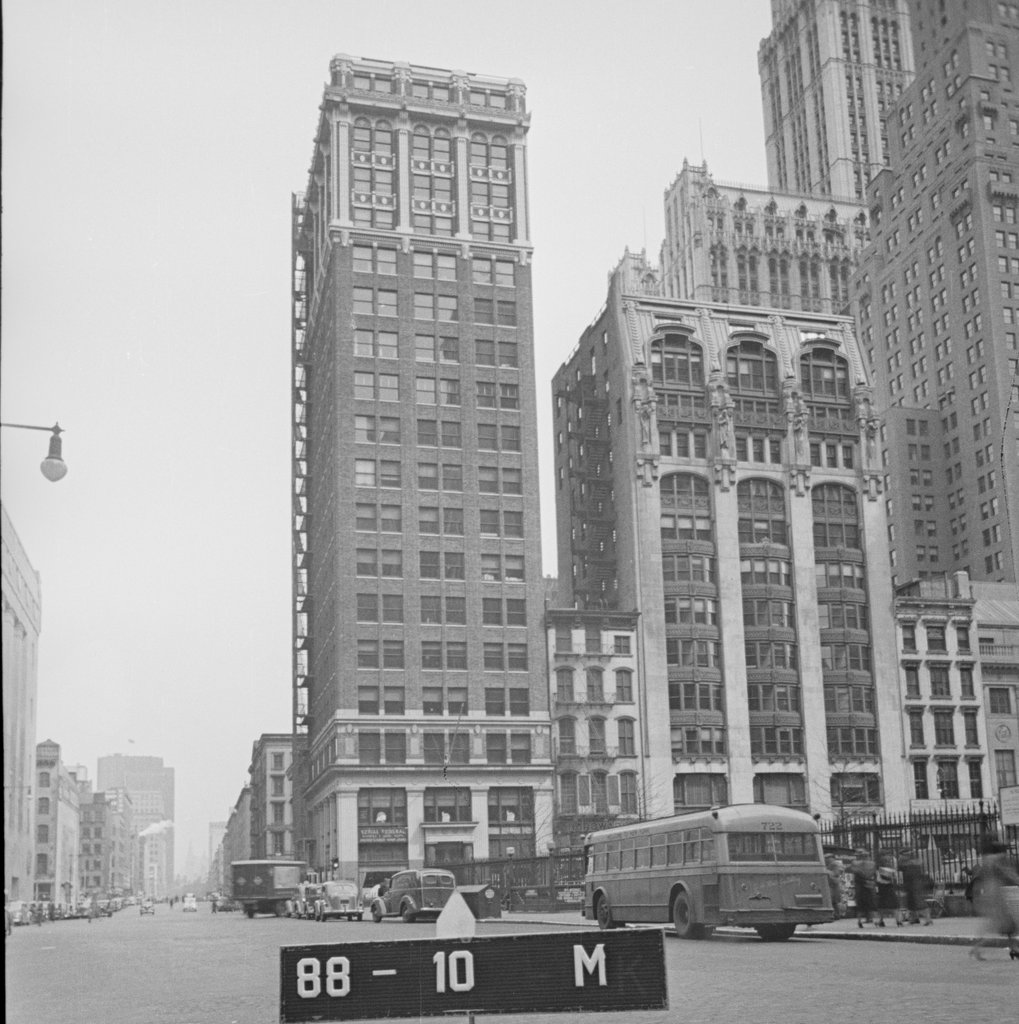
In the spring of 1940, over Hank P.’s strong objections, the book company and the Alcoholic Foundation moved out of Newark to a slightly larger office at 30 Vesey Street in lower Manhattan, next door to their post office box. John D. Rockefeller Jr.’s dinner for AA in February had brought a flood of letters, and the book was at last selling well enough to pay the rent, the postage and a fair salary for Ruth Hock.

A tall, narrow office tower on a street corner in lower Manhattan, with older buildings and skyscrapers beside it and a board in the street giving the block and lot.
30 Vesey Street, the tall building on the corner of Church Street, in the city’s tax photograph of about 1940, the year the office moved in.28 Vesey Street, Manhattan. 1940s Tax Department photographs. Courtesy Municipal Archives, City of New York.

Works Publishing was another matter. It had never been incorporated. All it had to show it existed, Bill W. wrote, were the homemade stock certificates, the books in the warehouse and the canceled checks. When some of the cash subscribers, Charles B. Towns among them, heard the book was making money, they wanted to know why the profits were paying for an AA office. A few wanted their money back.

Bill and Ruth pieced together a first report to the stockholders: a profit of about $3,000, all of it spent on AA work. Then Bill took the old pad of blank certificates to Washington, wrote “Preferred Stock, par value $100” on some of them, and sold about $3,000 worth to well-to-do members of the new group there. That paid off the grumblers, and Towns got back everything he had advanced.

By then Bill was sure the book should belong to AA itself. A trustee, A. LeRoy Chipman, borrowed $8,000 from Rockefeller, two of his sons and the dinner guests, and the Foundation bought out the cash subscribers at par. Bill agreed to hand over his own 200 shares. Hank, drinking again, held out until the day he turned up at Vesey Street broke and pointed out that most of the office furniture was still his, “particularly the huge desk and the overstuffed chair.” The trustees bought it for $200, and he turned in his stock.

The book has been revised three times since, in 1955, 1976 and 2001, and a fifth edition is due in February 2027. AA counts more than 35 million copies of the first four editions in English.

Listen Legacy About 1 minute

A third at a time

Buying back the book

Hank’s prospectus split Works Publishing into 600 shares. In 1940 AA’s trustees took back every one.

From Bill W.’s account in Alcoholics Anonymous Comes of Age, 1957, and Lois W.’s memoir, Lois Remembers, 1979. Hank’s and Bill’s shares had been promised but never issued.

600 shares, as planned in 1938

  • 200sold for cash, to members and friends
  • 200for Hank P.
  • 200for Bill W.

1940

Chipman’s $8,000

A. LeRoy Chipman borrowed $8,000 from Rockefeller, two of his sons and the dinner guests, to be repaid from the book’s profits. The cash subscribers were happy to get out even, and some sent half or all of their money back as gifts.

The Foundation holds a third

Bill W., 1957

1940

Bill’s 200 shares

Bill agreed to turn his shares over to the Foundation. Lois W. remembered a condition: a 10 percent royalty on the book for Dr. Bob and Anne, for life.

The Foundation holds two-thirds

Bill W., 1957; Lois W., 1979

1940

A desk and a chair

Hank, still drinking, held out longest. Broke and shaky, he claimed the office furniture as his own. The trustees paid him $200 for it, and he turned in his stock.

AA owns its book

Bill W., 1957

Whose book

Hank’s prospectus promised profits on a million books. The profits went instead to the fellowship, which has owned the book, through its trustees, ever since.

For a closer look

Go deeper

What became of Hank, and of Ruth; how the founders came to take royalties; and the editions since 1939.

Hank and Ruth

Lois W. gave three reasons for Hank’s growing grudge against Bill: the move to Vesey Street, when he wanted the office kept in New Jersey; being talked into giving up his stock; and Ruth Hock. His marriage was failing, and he wanted to marry Ruth. She wasn’t interested, and went with the office to New York.

Soon he was drinking and blaming Bill. Dr. Silkworth warned Bill that Hank could be dangerous when drunk. He came back to AA for a short time later on, but his drinking grew worse, and he died in January 1954.

Ruth stayed until early 1942, when she left to marry an AA member from Ohio. Bill called her “that sturdy little pioneer.” Bobbie B. took her place, the first alcoholic to hold the job.

Royalties

From the start, to soothe the trustees, the author’s royalty that would ordinarily have been Bill’s was promised to the Foundation. When the shares were handed over, Lois remembered, Dr. Bob and Anne were to get a 10 percent royalty for life. Dr. Bob drew none of it at first, Bill wrote; the money was needed for the office.

Whether the founders should take royalties at all troubled Bill for years. A Jesuit friend from St. Louis, Father Ed Dowling, settled it. Bill had promised to support Lois when he married her; would leaving her on the charity of friends keep that promise? “I should think the royalties would be the best bet.” Bill and Dr. Bob never took money for Twelfth Step work, but royalties paid them for the book.

At Stepping Stones, their home in Westchester County, New York, a coal furnace Bill bought for ten dollars from a bar that was switching to oil heated the house, sootily, until the royalties came in. Lois wrote that the royalties on Bill’s AA books were “his and my only income,” and that he never would accept them on books sold overseas.

The editions since

The first edition went through sixteen printings and more than 300,000 copies before the second came out in 1955. The third followed in 1976 and the fourth in 2001. Each time the stories were changed to reflect who was in AA. The first part of the book, describing the program, was left largely untouched, and “The Doctor’s Opinion” was kept just as Dr. Silkworth wrote it.

In 2026 AA’s General Service Conference approved a fifth edition, 125 votes to 9, with 26 new stories chosen from nearly 3,000 submitted. The board of AA World Services approved it on July 30, and it is due in February 2027.

The same Conference voted to replace one word in the first 164 pages, the part of the book that sets out the program: “Eskimo,” in the chapter “Working with Others,” is to give way to a neutral term. Otherwise those pages stay as they are, as the Conference asked in 1995.

AA counts more than 35 million copies of the first four editions distributed in English, and the book sells about a million copies a year, in more than 70 languages.

The first edition’s copyright was never renewed, and it has been in the public domain in the United States since the end of 1967, and the second edition since the end of 1983. AA’s own terms of use say so, and ask permission for any posting of any edition on the internet.
Sources