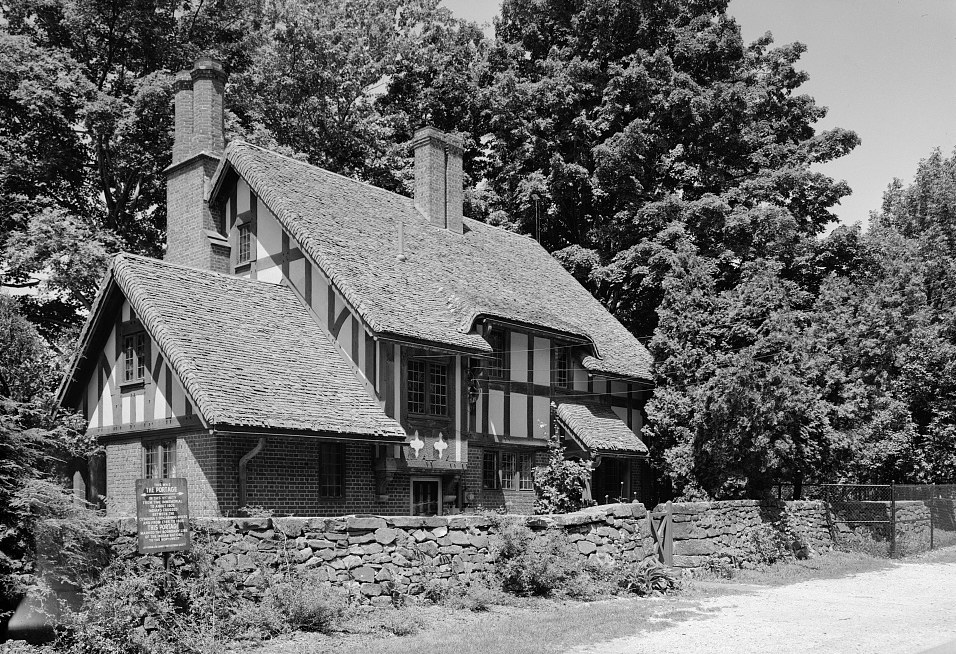
Illustration · The gate lodge at Stan Hywet, the Seiberling estate, on a May evening, drawn from photographs made for the Historic American Buildings Survey in 1982
Akron · Mother’s Day, 1935
The gate lodge
He promised his wife fifteen minutes. He stayed six hours.
“We got there at five o’clock and it was 11:15 when we left.”
Fifteen minutes
On Saturday, May 11, 1935, the day before Mother’s Day, Dr. Bob came home drunk, carrying a big potted plant for his wife, Anne. He set it on the table and passed out, and Anne and the children got him upstairs.
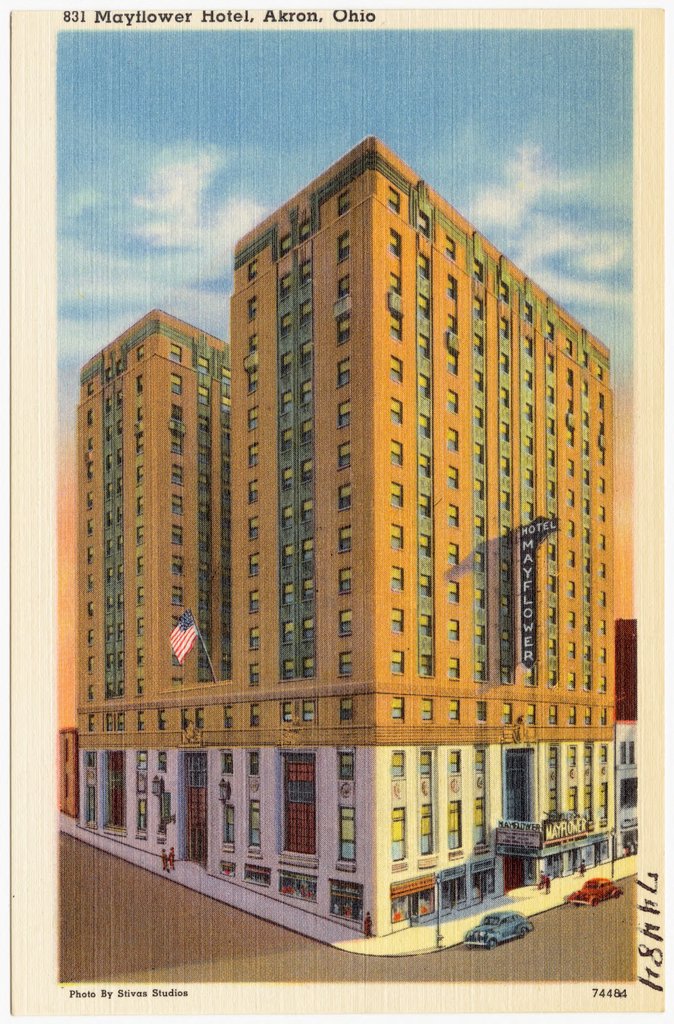
A short drive away, Henrietta Seiberling had a visitor. Bill W., a New York stockbroker, was stranded in Akron after losing a fight for control of a local company. That afternoon, pacing the lobby of the Mayflower Hotel with about ten dollars in his pocket, he had realized that he needed another alcoholic to talk to, or he would drink. A string of phone calls led him to Henrietta, a member of the Oxford Group who had been trying to help Dr. Bob. She phoned Anne. Anne said it would have to wait: Bob was in no condition to listen to anyone.
Henrietta asked them to dinner the next day. Dr. Bob said later that he couldn’t remember ever feeling much worse, but he was fond of Henrietta, and Anne had said they would go. On the way over, he made Anne promise that they would stay fifteen minutes at most. They arrived at five. Bill remembered that he was shaking badly and ate none of his dinner. Afterward, Henrietta put the two men in her little library.
Image to comeThe gate lodge at Stan Hywet, from the south, 1982
Bill didn’t preach. He told his own story, and he passed on what Dr. Silkworth had taught him in New York: that alcoholism was an illness of the body and the mind, and that it ended in madness or death. Dr. Bob had read everything he could find on the subject and talked to anyone who seemed to understand it. He had spent two and a half years in the Oxford Group and still got drunk every night. What he had never done was talk with someone who knew alcoholism from the inside. “In other words,” he wrote four years later, “he talked my language.”
Bob and Anne left at a quarter past eleven. Their daughter, Sue, had been expecting them all evening; when they came in near midnight, she thought her father seemed more at ease. He stopped drinking at once. Within two weeks or so, he and Bill were trying to help another drunk together. It would take one more binge, a few weeks later, before it held.
ListenThe gate lodgeAbout 1 minute
It’s Mother’s Day, 1935, in Akron, Ohio. At five o’clock, a doctor and his wife arrive at the gate lodge of the Seiberling estate. He is shaking. He has made her promise they will stay fifteen minutes.
Waiting inside is Bill W., a broke stockbroker from New York. He has been sober for five months, and he’s afraid he won’t stay sober unless he talks to another drunk.
Dr. Bob has read the books. He has spent two and a half years in the Oxford Group, praying, going to meetings, and getting drunk every night.
This stranger doesn’t lecture him. He tells his own story, one drunk to another. For the first time, Dr. Bob is talking with someone who knows alcoholism from the inside.
After dinner, Henrietta Seiberling leaves the two men alone in her little library. Fifteen minutes becomes six hours. It’s a quarter past eleven when Dr. Bob and Anne go home.
Compare the accounts
Why did it work?
Everyone agrees the two men talked for hours. They didn’t agree on what made the difference. Here are four accounts, and when each one was set down.
Only the 1939 account is Dr. Bob’s own. The other three were set down after his death. Quotations are short excerpts, shown side by side for comparison.
1939
Dr. Bob
4 years after that evening
“…he was the first living human with whom I had ever talked, who knew what he was talking about in regard to alcoholism from actual experience. In other words, he talked my language.”
He calls the medical information Bill gave him “undoubtedly helpful.”
His own story in Alcoholics Anonymous (1939), the Big Book, published almost four years after that evening.
1954
Sue, his daughter
19 years after · Dr. Bob had died in 1950
“…you seemed to hit it off with him more because you both had the same thing. He realized that it wasn’t just him.”
She remembered him saying that the Oxford Group members “just didn’t have the same type of problem.”
Talking with Bill W. in 1954, in a recorded conversation quoted in Dr. Bob and the Good Oldtimers (1980).
1957
Bill W.
22 years after · Dr. Bob had died in 1950
“What really did hit him hard was the medical business, the verdict of inevitable annihilation.”
Bill adds that Dr. Bob’s own Big Book story made this point “very clear.” Compare the 1939 card.
Alcoholics Anonymous Comes of Age (1957), Bill’s own history of AA.
1980
AA’s history of Akron
45 years after · both founders had died
“Important to him was the fact that another alcoholic was telling him.”
If William James, Carl Jung and Dr. Silkworth had been doing the talking, the book says, “it would have been just another lecture.”
Dr. Bob and the Good Oldtimers (1980), AA’s history of Dr. Bob and the Akron pioneers, weighing both founders’ words.
Who was talking, or what he said?
The founders never fully agreed on what happened in that library. Dr. Bob, and the daughter he talked to about it, put it down to who was talking. Bill put it down to what he said. AA kept both: one alcoholic, giving another the facts.
For a closer look
Go deeper
The versions that don’t agree, and where this story comes from.
The chain of calls
Image to comeThe Mayflower Hotel, Akron, on a postcard
Bill’s own version, told in 1957: he picked a minister at random from the church directory in the Mayflower lobby, the Rev. Walter Tunks. Tunks gave him a list of about ten names. The calls failed one by one until only the last name was left: Henrietta Seiberling.
Henrietta remembered it differently. One name on the list, Norman Sheppard, was a friend of hers and knew what she had been trying to do for Bob. He told Bill, “I have to go to New York tonight, but you call Henrietta Seiberling. She will see you.” She remembered Bill’s first words on the phone: “I’m from the Oxford Group, and I’m a rum hound from New York.” Pass It On combines the two: Bill calls all ten, and Sheppard is the one who points him to Henrietta.
Why Tunks? Nobody knows. Pass It On offers guesses: a Vermont expression, “taking a tunk,” for taking a walk; that he was an Episcopalian, like Sam Shoemaker, the Oxford Group’s leading clergyman in New York; or, as Bill’s wife, Lois, thought, that Bill just liked funny names. By luck, he had picked the strongest Oxford Group man among Akron’s clergy. Fifteen years later, Tunks led Dr. Bob’s funeral.
Good Oldtimers adds that the hotel bar was probably busier than usual that night, with guests gathering for the St. Thomas Hospital Guild’s annual May Ball.
The Mother’s Day plant
“…so potted that he couldn’t get up.”
Bill W.’s version, 1957. He wasn’t in the house.
Three tellings, three tables.
Dr. Bob, 1939: he came home “plastered,” set the plant “down on the table and forthwith went upstairs and passed out.”
The family, in Good Oldtimers, 1980: he put it on the kitchen table and collapsed on the floor. “It had been all Anne and the children could do to get him upstairs.”
Bill, 1957: “the plant was on a table and that Bob was under the table, so potted that he couldn’t get up.”
Bill wasn’t at the house, and he told his version as a joke, twenty-two years later.
Bill’s letters home
Bill’s wife, Lois, kept his letters from that summer; he didn’t keep hers.
May 1935, written from Dr. Bob’s office: “He had my trouble and is getting to be an ardent Grouper.” The same letter says the two of them were trying to help a once-prominent surgeon who had become “a terrific rake and drunk.” Nothing came of it, but it shows they started carrying the message almost at once.
June: Bob and Anne were “people 10 or 12 years older than ourselves” (Bill was 39; Dr. Bob was 55). “You will like them immensely.”
After Anne wrote to Lois: “They didn’t have anyone who really understood alcoholics. And I was used to help him a lot, I think.”
Henrietta had a neighbor, John Gammeter, put Bill up at the Portage Country Club for about two weeks. Then Anne asked him to move into their house at 855 Ardmore Avenue, where he stayed for three months. That house is section 6.
Sources
Alcoholics Anonymous. Works Publishing, 1939. Dr. Bob’s story, “Doctor Bob’s Nightmare.”
Alcoholics Anonymous Comes of Age. AA World Services, 1957. “Recovery: The First Legacy.”
Dr. Bob and the Good Oldtimers. AA World Services, 1980. Chapters V and VI.
Pass It On. AA World Services, 1984. Chapters 6 and 7.