Illustration · Cellar stairs in an empty house, with a bare bulb and a case of ale at the bottom. Not drawn from a photograph.
Manchester and Bennington, Vermont · Summer 1934
The ale in the cellar
He was due back in court on Monday, sober. On Saturday he found ale in the cellar, and carried it down the street.
“It wasn’t playing the game square, the way I looked at it.”
Three or four bottles
In the summer of 1934, Ebby T. was thirty-eight, broke, and living alone in his family’s empty summer house in Manchester, Vermont. Two friends from old Manchester summers, Cebra G. and Shep C., came to see him. Both had joined the Oxford Group, a Christian movement that asked its members to be honest, make amends and listen for God’s guidance. Cebra remembered finding him on the back veranda among “the usual tin cans the drunkard is always surrounded with,” his head in his arms. They had his suit cleaned, fed him and talked. What they said, Ebby recalled, was “what I had been taught as a child and what I inwardly believed, but had lain aside.” He wasn’t ready yet.
A local painter helped him finish painting the house. Then, he said, “I went right back to the bottle.” One wet day he saw pigeons on the new paint, sat down on the lawn with a double-barreled shotgun and fired away at them. The neighbors complained. The next afternoon the constable, who had been at school with Ebby and Bill W., found him on the steps of the hardware store: “Sorry, Ebby, but I’ve got to take you to Bennington.”
He had two arrests for drunkenness already. Under Vermont’s habitual-drunk law, a third could mean six months in prison. The judge, Cebra’s father, let him go home for the weekend: “I want you back here Monday morning sober.”
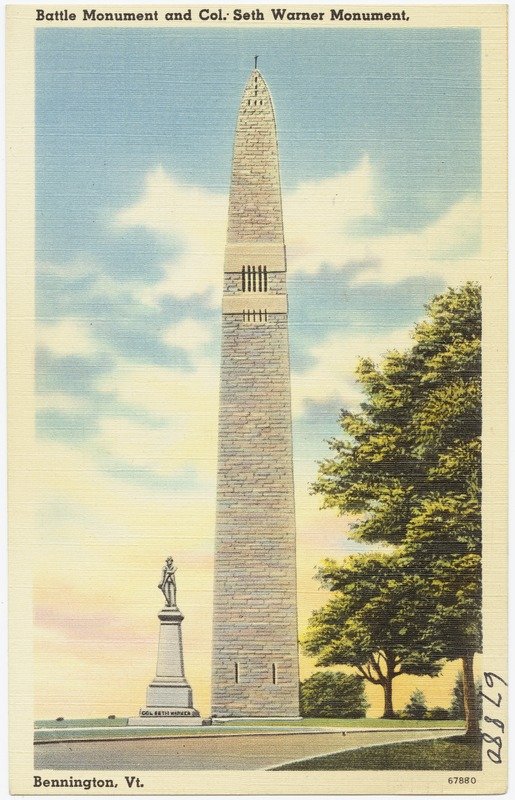
Image to comeThe Battle Monument, Bennington, on a postcard
Bennington, the county seat, about twenty-five miles south of Manchester, on a postcard from about 1930 to 1945. The monument marks the Battle of Bennington, 1777.Tichnor Brothers Collection, Boston Public Library
Back at the house, three or four bottles of Ballantine’s ale were waiting in the cool of the cellar. It was Saturday, and word might have gone around town not to sell him any more. “What harm is it going to do to take a bottle of ale?” He went down, reached for one, and couldn’t take it. “I had said I would be there sober, and this wouldn’t exactly be sobriety.” Upstairs, a voice kept at him: “Oh, don’t be silly. Go down and get that ale. My God, you’re shaking.”
He didn’t. He carried the bottles to a friend three or four houses away. “I felt right then a great release from the whole thing,” he said twenty years later. “And that lasted for me for over two years.”
On Monday a third Oxford Group man, Rowland H., whom Ebby had only just met, was in court. “Rowland H. came to my rescue and said he’d be responsible for me, and the judge released me in his custody.” Ebby shut up the house for the winter, stayed a week or so with Rowland in Shaftsbury, and went on to New York. By November he was living in a mission there, and heard that his old friend Bill was in bad trouble with drink.
ListenThe ale in the cellarAbout 1 minute
It’s the summer of 1934 in Manchester, Vermont. Ebby T. is thirty-eight, broke, and drinking alone in his family’s empty house.
He has just been arrested for the third time, for firing a shotgun at pigeons on the fresh paint. The judge sends him home for the weekend with an order: be back in court on Monday morning, sober.
Down in the cellar are three or four bottles of ale. What harm could one do? He goes down, reaches for a bottle, and can’t take it. He has given his word.
A voice tells him not to be silly. He’s shaking. Instead he carries the bottles to a friend down the street, and feels, he said later, a great release.
On Monday a man named Rowland stands up in court and takes responsibility for him. Ebby stays sober for more than two years. Within a few months, he carries what he found to Bill W.
Compare the accounts
Two men, or one?
Who spoke for Ebby in court, and what was he afraid of? Here are four accounts, and when each one was set down.
Only the 1954 account is Ebby’s own. Bill heard the story from him at the kitchen table that November. Quotations are short excerpts, shown side by side for comparison.
1939
Bill W., in the Big Book
5 years after · as Ebby told it to him
“…two men had appeared in court, persuading the judge to suspend his commitment.”
What Bill had heard before Ebby turned up sober: that he “had been committed for alcoholic insanity.”
“Bill’s Story,” in Alcoholics Anonymous (1939), the Big Book.
1954
Ebby
20 years after · recorded by Bill in Texas
“Rowland H. came to my rescue and said he’d be responsible for me, and the judge released me in his custody.”
What he feared: a third arrest “might go hard on me — six months in Windsor Prison.”
His recorded recollections, as quoted in Mel B.’s Ebby (1998). The Windsor Prison line is as Pass It On (1984) quotes the same tape.
1957
Bill W.
23 years after
“I had heard in fact that they were going to put him away because of alcoholic insanity.”
This telling leaves out the court. Ebby simply phones: “Even over the phone I somehow knew that he was sober.”
Alcoholics Anonymous Comes of Age (1957), Bill’s own history of AA.
1984
AA’s biography of Bill
50 years after · both men had died
“It was at this point that Rowland H. interceded and told the judge that he, Rowland, would be responsible for Ebby.”
What Bill had heard: that Ebby was “about to be committed to the state asylum at Brattleboro.”
Pass It On (1984), AA’s biography of Bill W., drawing on Ebby’s 1954 tape.
One rescuer or two, prison or the asylum?
The man who was there named one rescuer, and feared prison: Vermont’s habitual-drunk law could mean six months after a third arrest. The version Bill wrote down in 1939, from what Ebby told him at the kitchen table, has two men and an asylum. None of the three AA books tells of the ale in the cellar. It survives because Bill recorded Ebby in 1954.
For a closer look
Go deeper
The dates that don’t agree, the man who stood up in court, and the feeling Ebby spent years trying to get back.
When did it begin?
“…two years and approximately seven months…”
Ebby in 1954, counting his sobriety back from his first slip in April 1937.
Four dates, and none of them certain.
July 1934:Pass It On dates the Oxford Groupers’ visit to July, while Ebby was still painting the house. The arrest and the ale came later.
Late August or early September: Ebby said his first slip, in late April 1937, came “after two years and approximately seven months of sobriety.” Counting back from that, Mel B. puts the start in late August or early September.
Late September: Bill’s story in the Big Book says the court was “two months ago” when Ebby came to see him, near the end of November. Mel B. thinks Bill got it wrong, as he sometimes did with dates.
November 1: the mission in New York where Ebby was living recorded his surrender on November 1, 1934. Mel B. adds: “AA members believe that Ebby’s more important surrender occurred in the cellar in Manchester.”
Who was Rowland H.?
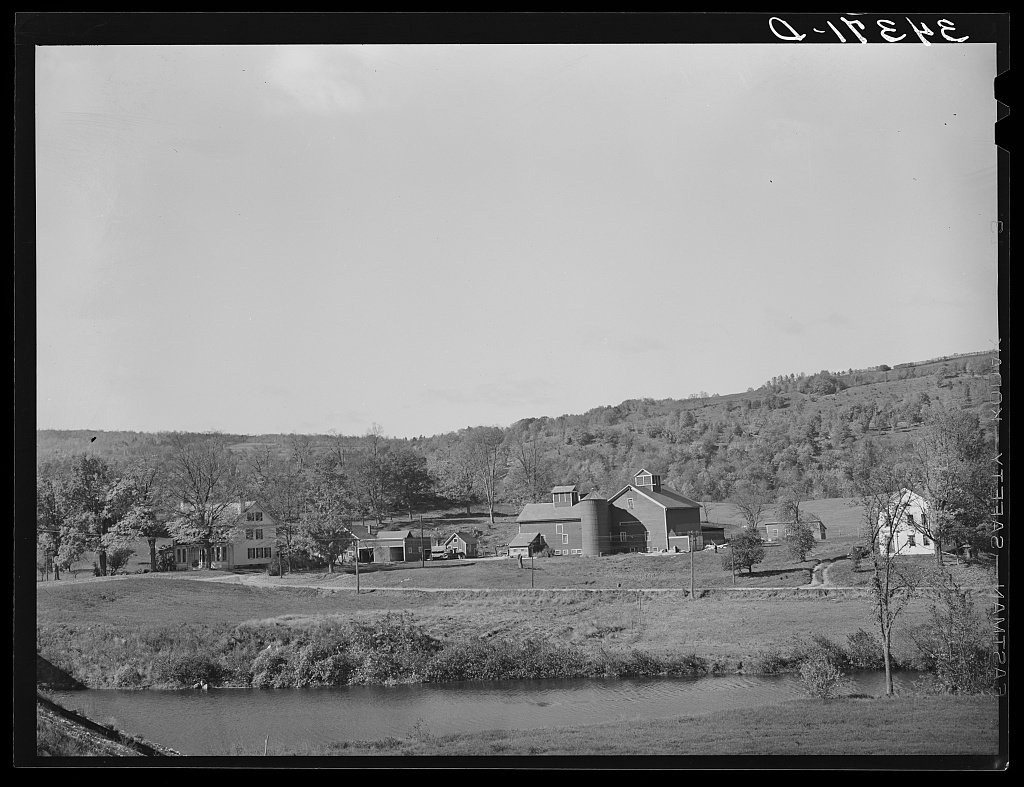
Image to comeA farmstead near Shaftsbury, Vermont, 1939
Rowland H. was a Yale man from an old Rhode Island family, and a drinker who had gone to Switzerland to be treated by the psychiatrist Carl Jung. When he drank again, Jung told him the only thing that could help him now was a spiritual awakening. He found one in the Oxford Group. The Big Book tells his story, without his name, in the chapter “There Is a Solution.”
He did more for Ebby than stand up in court. “The first day he came to see me, he helped me clean up the place,” Ebby remembered, “and he stuck by me from beginning to end.” He pressed the Oxford Group’s four absolutes on him, honesty above all: “honesty with yourself, honesty with your fellow man, honesty with God.” In the summer of 1935 he took Ebby to his ranch in New Mexico.
Rowland apparently never took part in AA’s early work. He died in 1945.
The pink cloud
Ebby never forgot the feeling of that Saturday. He called it a “pink cloud,” and a “more mature outlook.”
He didn’t coin the phrase; it was already AA slang. At AA’s St. Louis convention in 1955, with Ebby in the audience, the psychiatrist Harry Tiebout spoke of the member who “falls from his pink cloud, a state of mind familiar to you all.”
In 1961, after years of drinking again, he said: “I’ve often thought about it, for many years, when I started drinking again, why I couldn’t recapture that feeling I had then.”
Mel B. thought Ebby came to believe he needed that same feeling before he could get sober again. His first slip, and the years that followed, are section 5.
Sources
Mel B. Ebby: The Man Who Sponsored Bill W. Hazelden, 1998. Chapters 5–8, quoting Ebby’s 1954 and 1961 recollections and Cebra G.’s 1954 recording.
Alcoholics Anonymous. Works Publishing, 1939. “Bill’s Story.”
Alcoholics Anonymous Comes of Age. AA World Services, 1957. “Recovery: The First Legacy.”
Pass It On. AA World Services, 1984. Chapters 5 and 9.