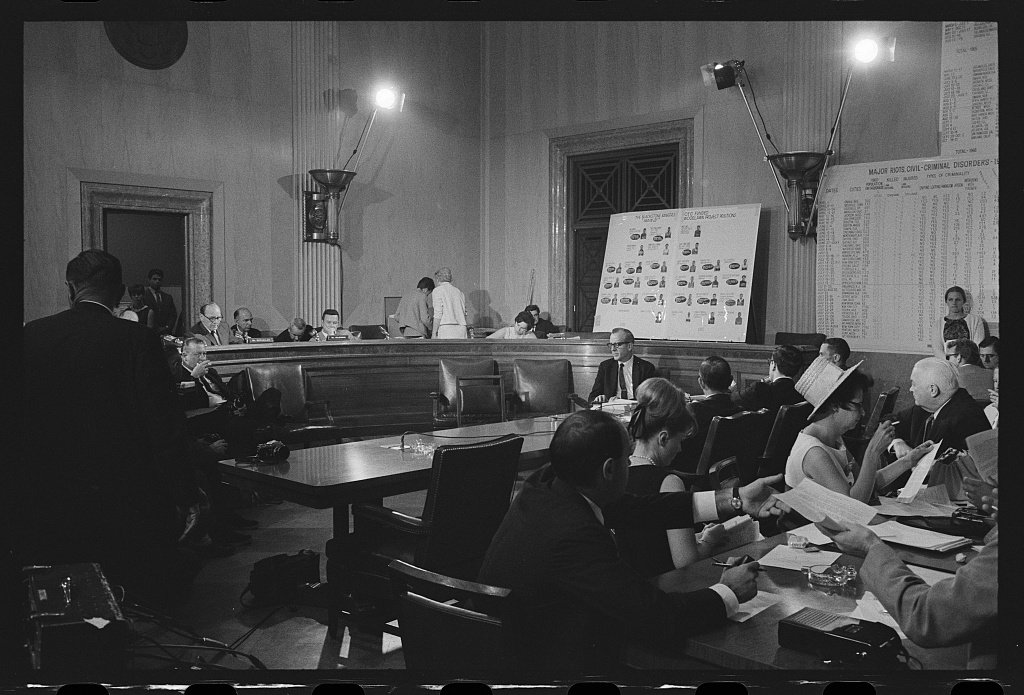
Illustration · A Senate hearing room in 1969, seen from where the senators sit: two microphones, a carafe of water and a glass, and a typed statement in front of an empty witness chair. Not drawn from a photograph.
New York, Easton and Washington · 1950–1970
Built-in forgetters
Her book sold, a rich drunk rescued her council, and in 1969 she told the Senate she had stopped drinking and stayed stopped. About 1960, in secret, she had drunk again.
“One drink—that’s all we need to start down that spiral into that lonely glass box again.”
A rich drunk out there somewhere
Her book came out in 1950, Primer on Alcoholism, dedicated to “Priscilla, who made me write it all down.” It sold about eighty thousand copies in eight years, just in time to help keep her and the council afloat. Some AA members objected all over again: her full name was on a book about alcoholism that recommended AA at length. The early 1950s were lean. Seventeen local committees had collapsed, she and her colleague Yev G. went for stretches without pay, and friends tided her over. For a year or more in those years she had a love affair with the writer Jane Bowles, an affair that strained her life with Priscilla; it was Marty who ended it, by the middle of 1954.
That year she and Priscilla sold their house at Cherry Grove and bought one in Easton, Connecticut, an hour from New York, for weekends and, one day, retirement. That summer the council owed everyone, and even Yev was discouraged. She cheered him up: “Yev, there is a rich drunk out there somewhere who will get sober and help us.” Soon afterward Yev was called to Towns Hospital to see a patient who had been in hospitals more than fifty times. Brinkley S., the son of a founder of IBM, got sober, joined her board that year, and became the largest single benefactor the field of alcoholism has had. They sometimes disagreed sharply. As he put it, “She’s the queen, and I’m the king. So I won half the time.”
Depression, which had hit her hard in her first year sober, came back again and again for the rest of her life. Priscilla, who wasn’t prone to it, found it hard to understand. Marty believed it could have a physical cause, and held on: “God didn’t save us in order to throw us into the jaws of Hell.” In a bad spell in 1967 she went to an AA conference in Kansas and to meetings morning, noon and night, until it lifted. She seldom spoke of it in public.
Sometime between 1959 and 1964, probably about 1960, she drank again. It began with bitters, which are about 45 percent alcohol, and she seems to have told herself that a little wouldn’t count. A young woman from AA in Bronxville, about a year sober, came down to New York unannounced, hoping to meet her idol. She found Marty drunk, the apartment a mess and the dogs needing care. She cleaned up, loaded Marty and the dogs into her station wagon, and took them home with her. A Bronxville member with nearly ten years sober told her to keep Marty there until she was through withdrawal, and Marty stayed several days. She wouldn’t go to an AA meeting, saying she had to keep it confidential. Those who knew at the time kept it to themselves for decades.
Afterward she went to more meetings, and tried to listen more. People who met her from the mid-1960s on remembered her kindness. When a friend with an important job confided that she had slipped after ten years sober, and asked whether she should tell her group or resign, Marty said no: “Given your public position as a role model, you can’t afford to do any of those things.” Then she asked, “What are you doing to help other alcoholics?” In 1965 she spoke at AA’s convention in Toronto, and for years afterward quoted the line written as its theme: “I am responsible when anyone anywhere reaches out for help.”
In 1968 a successor took over the council, and she became its founder-consultant, in an office she carpeted in red. On the morning of July 24, 1969, she was the first witness before Senator Harold Hughes’s new subcommittee on alcoholism, in Room 4232 of the New Senate Office Building in Washington. She was sixty-four. “I am a recovered alcoholic. I was fortunate to have started my recovery in 1939.” She had learned the word alcoholism only that year, she said, and since then, “I was able to stop drinking and to stay stopped.” She didn’t mention the relapse. On the evening of December 31, 1970, after a last-minute campaign by her friends, President Nixon signed the Hughes Act, which set up a federal institute on alcoholism.
It’s July 24, 1969, in a Senate hearing room in Washington. The first witness of the morning is Marty M. She is sixty-four.
She tells the senators she is a recovered alcoholic, and that she started her recovery in 1939. Changing the country’s mind, the scientists told her, would take fifty years. We are half way there, she says.
She doesn’t tell them that around 1960 she drank again. A young woman from AA found her at home, drunk, and took her and her dogs home with her until she was sober. Hardly anyone knew.
A few years later, another woman confides in her that she has slipped too.
Marty tells her, We all have built-in forgetters. The way we remember is working with others.
One card per claim
How we know
The claims about her sobriety, from her first year to the Senate, each with who says so and how they knew.
Three labels. Her own words: her talks, and her testimony. AA’s books: the histories AA published, and Lois W.’s memoir. Biographers: Sally and David R. Brown (2001), from interviews with people who knew her, and from her papers.
Her own words
Three slips in her first two years.
Who says so
She did. She spoke of them openly in her talks, and her biographers retell them from her tapes.
How they knew
Her own account: a ten-day binge just before Christmas 1939; a mild, brief one in the middle of 1940; and a third at Christmas 1940, cut short at High Watch Farm. Part 5 tells them.
Her own words
Sober from Christmas 1940.
Who says so
She did, as the closest date she would give. She preferred to count from her first AA meeting, April 11, 1939.
How they knew
It was her own reckoning. Because of the slips, her biographers write, she never set an exact date.
AA’s books
The “longest sobriety record in A.A. for her sex.”
Who says so
Bill W., in AA Comes of Age (1957). Lois W., in 1979, wrote that Marty had “by far the longest sobriety among A.A. women.”
How they knew
They had known her since 1939. Bill wrote before the relapse; Lois wrote in 1979, after it.
AA’s books
The “first woman to achieve lasting sobriety in Alcoholics Anonymous.”
Who says so
Pass It On (1984), AA’s biography of Bill W.
How they knew
It was published four years after her death, and says nothing of the relapse.
Biographers
A relapse, about 1960.
Who says so
Three people told her biographers of it, for their book of 2001, among them Lila R., who had worked for her in the early 1950s. The historian Ernest Kurtz had heard of it too; when he asked her, she changed the subject.
How they knew
None of them could fix the year. A pharmacy label for Antabuse dated October 13, 1964, prescribed by Dr. Ruth Fox, survives in her papers; her biographers say it proves nothing by itself. In Not-God (1979) Kurtz wrote only: “Because of a later ‘slip’ by Marty, there was at the time of this research at least one woman claiming longer continuous sobriety in A.A.”
Her own words
“I was able to stop drinking and to stay stopped.”
Who says so
She did, to the Senate subcommittee on alcoholism, on July 24, 1969.
How they knew
It is in the printed record of the hearing. She was speaking of 1939, and of the years since; she didn’t mention the relapse.
Two records
The record AA printed and the record her friends kept were different, and both are part of her story. What she seems to have learned from the second, she passed on: “We all have built-in forgetters. The way we remember is working with others.”
For a closer look
Go deeper
Her morning before the Senate, the rich drunk she had hoped for, and the house in Easton.
Before the Senate
“We are half way there.”
Marty M., to the Senate subcommittee on alcoholism, July 24, 1969, on changing the country’s mind.
The subcommittee met at 9:30 in the morning, with Senator Harold Hughes of Iowa, himself a recovered alcoholic, in the chair. She was the first witness. She had been there the day before and heard all of the testimony.
She told them of her last five years of drinking, much of it in England, and of the doctors there who called it a nervous breakdown or a character disorder, while she was sure she was going insane. Of blackouts, when an alcoholic can lose hours or days, she said, “I know of no greater terror than this.” “In those days the word ‘alcoholism’ was not in use by anyone, medical or otherwise.” In 1944, she said, public attitudes were “compounded of ignorance, apathy, indifference, prejudice” and hostility.
The scientists at Yale had told her it would take fifty years. “Like many alcoholics, I am impatient. I wanted to do it by Thursday.” Thirty years before, at her first AA meeting, Bill W. had laughed and told her, “you can’t do it all by Thursday.”
The council’s main aim, she said, had been to split the word “hopelessdrunk” and get rid of the hopeless part. Most alcoholics were not on skid row: “they are people like all of us here.” When Hughes asked whether women had been left out, she said they had been, for a long while. “She is now fighting for her rights to be an alcoholic who has a chance to get well.” Hughes hoped that the first twenty-five years had been “the roughest part.”
A rich drunk
Brinkley S. was forty-seven when Yev G. found him at Towns Hospital. As Yev told him about the council, he asked why it hadn’t made more progress in ten years. “We’re trying, but we’ve never had enough money to do the job.” “Now you do.”
He had once quit IBM, he said, because it “interfered with his drinking.” His family foundation’s first grant in the field was $10,000 to her council, and he went on to help move Yale’s center of alcohol studies to Rutgers and to endow a treatment center at Roosevelt Hospital in New York.
He liked to be in control, and so did she. He was on her board for most of his sober life, for long stretches as treasurer, president or chairman. For many years they lunched together twice a week.
Easton
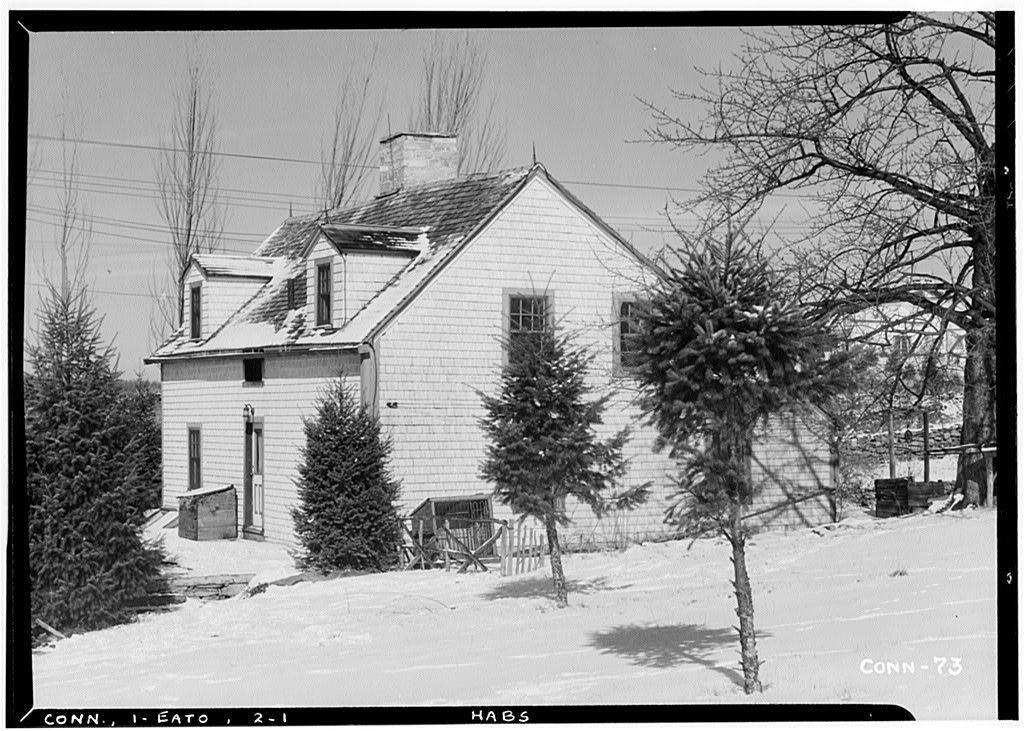
The house stood on a low rise in the country, set back from a winding road, with more than six acres of woods and fields. A great old maple stood in the circle at the top of the drive, and a Concord grape arbor gave enough grapes for quantities of jelly. Out in the fields was a pool. When visitors turned up without warning, whoever was in the house rang a big bell by the door, to warn the swimmers.
For fifteen years it was their place for weekends, and they lived in the New York apartment during the week. When they retired, Easton became home. Felicia G. lived nearby, in New Canaan, and often came to cook for Priscilla when Marty was away.
Sources
Sally Brown and David R. Brown, A Biography of Mrs. Marty Mann. Hazelden, 2001. Chapters 14 and 22–26. Its unattributed quotes of her come from fifty-one tapes of her talks or from her writings. It quotes Ernest Kurtz’s Not-God: A History of Alcoholics Anonymous (Hazelden, 1979) on the relapse.
Alcoholics Anonymous Comes of Age. AA World Services, 1957. “When A.A. Came of Age.”
Pass It On. AA World Services, 1984. Chapter 12, quoting Marty’s recollections.
Lois Remembers. Al-Anon Family Groups, 1979. Chapter 11, “The Clinton Street Boys.”
The Impact of Alcoholism. Hearings before the Special Subcommittee on Alcoholism and Narcotics, U.S. Senate, July 23–25, 1969. Her testimony and answers, July 24, pp. 107–129.