Illustration · Three in the morning on a February night in 1944: a typewriter on a small desk under a frosted window, a page of typing in the carriage, a lamp on, and an alarm clock at a few minutes past three. Not drawn from a photograph.
New York and New Haven · 1944–1950
Something useful
One sleepless night she typed out a plan to teach America that alcoholism is a disease. Within months she had an office, Yale behind her, and her own name in the papers, to AA’s alarm.
“Give me something useful to do, something that’s really needed, truly helpful.”
A plan at three in the morning
In 1942 she left Macy’s for the American Society of Composers, Authors and Publishers, writing radio scripts and then directing research. She wanted to be more broadly useful. Walking up Fifth Avenue one day, she looked at the windows of the grand apartment houses and wondered how many people like her were suffering behind them. During those years she read an article by Dwight Anderson, a publicist who had got sober with a psychiatrist’s help before AA began. He set out four statements about the problem drinker. She took them as her own, and cut them to three.
One cold night in February 1944 she couldn’t sleep. At about two in the morning she prayed, and then said the Serenity Prayer. At three she got up, went to her typewriter, and in what seemed almost automatic writing typed out a full plan: teach everyone the facts about alcoholism, and so take away its stigma. There would be committees in towns across the country, information centers, and hospital beds and clinics for alcoholics, whom most hospitals turned away.
Bill W. doubted that anyone would listen, and told her bluntly that she lacked scientific credibility. She gathered a small planning group, and her friend Dr. Ruth Fox, a psychiatrist, wrote to E. M. Jellinek at Yale’s Center of Alcohol Studies. Jellinek met her the next evening, and within forty-eight hours of getting her plan he had her on Yale’s staff. For six months she spent her working weeks in New Haven, living with the Jellineks and learning the science. On October 2, 1944, the National Committee for Education on Alcoholism opened a tiny office in New York, in the Academy of Medicine’s building on East 103rd Street. The staff was Marty and a secretary, and the first year’s budget was $13,000.
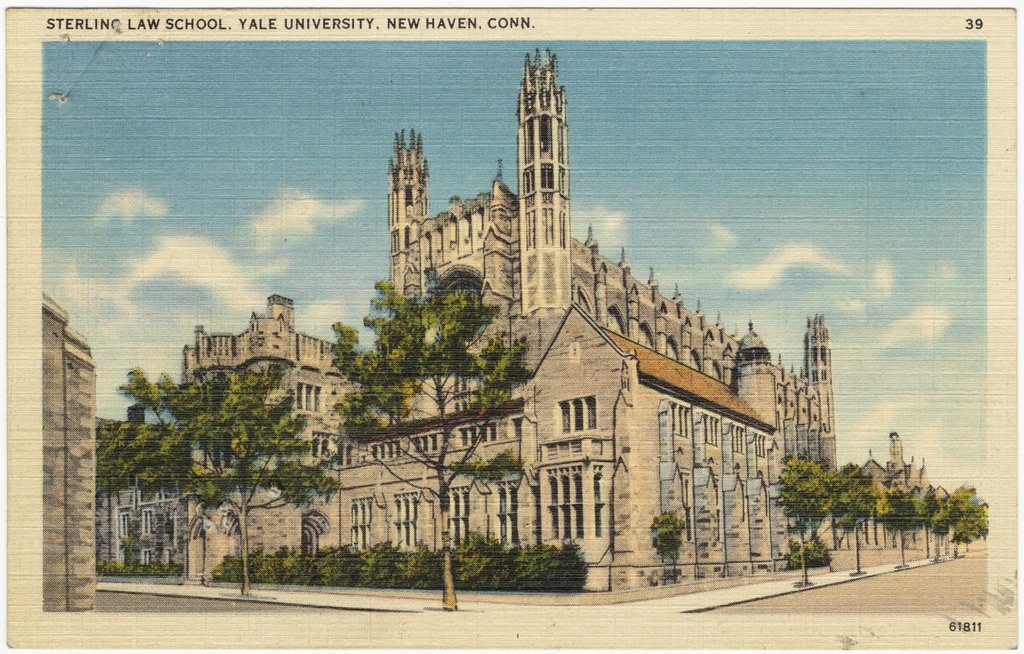
Image to comeYale University, New Haven, postcard, 1930–1945
The Sterling Law School at Yale, New Haven, on a postcard from between 1930 and 1945. For six months in 1944 she spent her working weeks in New Haven.Tichnor Brothers Collection, Boston Public Library
She called a press conference at once, and newspapers across the country ran it on the front page. On October 9 the New York Herald Tribune, on page 9, used her full name in its headline: “Mrs. Marty Mann, Ex-Alcoholic, Explains How She Was Cured.” In her first year she gave 106 talks, traveled 36,000 miles and spoke in 45 cities to more than 34,000 people. She got New York’s buses and subway trains to carry a plain statement: “Alcoholism is a disease.”
Many in AA were alarmed. With Yale in favor and Bill urging her on, and after six months of holding back for fear of losing her sobriety, she had decided to say in public both that she was an alcoholic and that AA had got her sober. She was photographed full face and named as a member, and Bill W. and Dr. Bob had lent their names to her letterhead. Some members thought she was on an ego trip, or would drink and disgrace them all, and letters attacked Bill for not stopping her. But wherever she spoke, AA groups filled with newcomers, and, for the first time in AA’s history, with women in numbers. Then in 1946 a fund-raising letter went out that mentioned AA throughout, with the founders’ names on it. Bill and Dr. Bob withdrew, and AA’s trustees, then called the Alcoholic Foundation, declared: “Alcoholics Anonymous looks with disfavor on the unauthorized use of its name in any fund-raising activity.” After that she went on saying she was an alcoholic, but stopped saying where she got sober. “I have the right to say I am an alcoholic and that I am here. I do not have the right to say you are an alcoholic and that you are here.”
In January 1949 she had major surgery, and went back to work before she had recovered, because Yale was pulling out. A fund-raising leaflet, “My Daddy Didn’t Do It,” had told of a drinking banker named Harry Brown, and Yale graduates named Harry Brown who were bankers had written angry letters to the dean. In May she put coin boxes in the city’s bars that read “You Can Drink,” “Help the Alcoholic Who Can’t” and “Alcoholism Is a Disease.” On June 30 she wrote to her advisory board for money: “This is a matter of life or death!” On December 31, 1949, Yale cut the committee loose. It renamed itself the National Committee on Alcoholism, and in 1957 the National Council on Alcoholism. She ran it for eighteen more years. The early years, and above all the ones after Yale, were hard: “It was like pushing a boulder up a hill with your nose—three steps up and two back.”
ListenSomething usefulAbout 1 minute
It’s a cold night in February 1944, in New York. Marty M. can’t sleep.
At two in the morning she prays for something useful to do, something that’s really needed.
At three she gets up, sits down at her typewriter, and types out a plan: to teach the whole country the facts about alcoholism, and take away its stigma.
By October she has an office, a secretary, and Yale behind her. She calls a press conference, and her own name goes into the papers, as an alcoholic who got well.
Many in AA are alarmed. Members don’t say that in public.
She goes on telling America she’s an alcoholic, for the rest of her life. But after a couple of years, she stops saying where she got sober.
Then and twenty-five years later
Three ideas
Dwight Anderson’s four statements of 1942 became her three, the creed of her committee. Here is each one in his words and hers, and when doctors and lawmakers came round to it.
Anderson’s words are from his article “Alcohol and Public Opinion,” in the Quarterly Journal of Studies on Alcohol, 1942, as her biographers quote it. The right-hand column draws on her biographers and her testimony to a Senate subcommittee in 1969.
The ideaHis words, then hersWhen the country caught up
A disease
Anderson, 1942
“That the problem drinker is a sick man, exceptionally reactive to alcohol”
Marty M., 1944
“Alcoholism is a disease and the alcoholic is a sick person.”
1950 to 1967
In 1950 the World Health Organization, largely through Jellinek, called alcoholism a disease. In 1956 the American Medical Association said the alcoholic was a sick person who should be admitted to hospitals, and in 1967 it called alcoholism a disease outright, her biographers write. (In 1969 she told the Senate the 1956 vote had already called it one.) She laughed: “Alcoholism was the first disease they ever had to vote was a disease!”
Worth helping
Anderson, 1942
“That he can be helped … That he is worth helping”
Marty M., 1944
“The alcoholic can be helped and is worth helping.”
1944 to 1974
In 1954 she reported that more than three thousand general hospitals took acute cases of alcoholism, against only ninety-six ten years before. Still, in 1969 she told the Senate that most general hospitals turned alcoholics away: “Unhappily two-thirds of them still do.” In 1974 the law was amended to bar hospitals that took federal money from turning them away.
Everyone’s job
Anderson, 1942
“That the problem is therefore a responsibility of the healing professions, as well as of the established health authorities and the public generally”
Marty M., 1944
“This is a public health problem and therefore a public responsibility.”
1966 to 1974
In 1966 President Johnson named a national advisory committee on alcoholism. On the evening of December 31, 1970, President Nixon signed the Hughes Act, which set up a federal institute for alcoholism, and in 1974 an amendment to it stated that alcoholism is a disease. Part 7 tells of her morning before the Senate.
Fifty years
When she started, Jellinek and others warned her that an idea like hers took about fifty years to be accepted. She laughed: “Of course the process could be shortened!” Thirty-five years later she agreed. “They were right.”
For a closer look
Go deeper
What Bill said about her anonymity, before and after; the two names she lived under; and the year Yale let go.
Right, then a mistake
“When, for educational purposes, Marty broke hers, I consented to it. In the light of later events, that has proved to be a mistake.”
Bill W., in a letter of 1948 quoted in Pass It On.
At first Bill stood by her. When a member in Georgia asked whether he might break his own anonymity, Bill wrote back: “I still feel that it was right for her to do exactly as she did.” The gains to AA and to education, he thought, far outweighed the risk of a precedent.
But other members kept coming to him with causes they believed just as good. By 1948 he had changed his mind, and owned his share of the fault. What happened with her committee helped shape AA’s Traditions on anonymity, money, professionalism and outside causes; her biographers count four of the twelve.
In an essay on anonymity, reprinted in AA Comes of Age in 1957, he told the story again without her name. His “university-sponsored friend” had tried to take her anonymity back, and it had been hard: “It has taken her years. But she has made the sacrifice, and I here want to give her deep thanks on behalf of us all.”
Two names
In AA she was simply Marty M. In her work she used her full name, with the Mrs. she had kept after her divorce, and she kept her two lives apart; good-naturedly, she called herself schizophrenic. Most people assumed she was married or divorced, and few knew her surname was her own.
The press loved her. She was lively copy, and she corrected reporters. In one story, which her biographers think may be apocryphal, an interviewer called her an “ex-lady lush.” Her answer: “I may be an ex-lush, young man, but I am definitely a lady!”
The rule she settled on, her biographers write, is the one public figures in AA still follow: say you are a recovered alcoholic, but not that you are in AA. Some members went on criticizing her, and for a while some AA communities wouldn’t have her as a speaker.
Yale lets go
“Somehow I could see you rising, Phoenix-like, from the ashes of the great flame you kindled”
Bill W., writing to her in July 1949, after her memo to the advisory board.
The split was Yale’s idea. Her committee had become a national campaign that one university department couldn’t answer for, its appeals were confusing donors and drawing off the center’s money, and Yale insisted on an office in New Haven as well as New York, which the committee couldn’t afford. Marty wouldn’t close New York, the country’s center of communications.
On the copy of her June 30 memo that she sent to Bill, she added a note: “So this is it, Bill. Too bad. Too bad.” He wrote back at once, and Lois W. added her own note: “Bill and I are proud of you, dear, and love you very much.”
At the board meeting of November 18, the members turned on Yale’s man, Selden Bacon. The minutes, she wrote to a friend, gave only a cleaned-up version of “a knock-down-drag-out fight.” She had left the room while they discussed her pay, and heard the angry voices from far outside the room. The board went on record that closing the New York office would kill the committee, and agreed to pay the staff’s back salaries before Yale’s debt. Within days Yale’s three men on the board said they would resign.
Sources
Sally Brown and David R. Brown, A Biography of Mrs. Marty Mann. Hazelden, 2001. Chapters 16–21, 24 and 26. Its unattributed quotes of her come from fifty-one tapes of her talks or from her writings. It quotes Dwight Anderson’s 1942 article, Emma Bugbee’s Herald Tribune story of October 9, 1944, and letters from her papers at Syracuse University and from AA’s archives.
Pass It On. AA World Services, 1984. Chapter 19. It puts the turning point a year earlier, at Yale’s first summer school, in 1943.
Alcoholics Anonymous Comes of Age. AA World Services, 1957. Appendix B, Bill’s “Why Alcoholics Anonymous Is Anonymous.”
The Impact of Alcoholism. Hearings before the Special Subcommittee on Alcoholism and Narcotics, U.S. Senate, July 23–25, 1969. Her testimony and answers, July 24, pp. 107–129. There she dated the committee’s opening to October 1, 1944.