Illustration · A meeting room at Christmas, about the time of AA’s first Christmas party in 1940: folding chairs, a small lit tree, and one chair turned the other way, with a woman’s hat and gloves left on it. Not drawn from a photograph.
New York, Cleveland and Akron · 1939–1943
Women aren’t alcoholics
Out of the sanitarium, she tried to bring at least a hundred women into AA, heard from the men that women weren’t alcoholics, and slipped three times, while the women began, slowly, to follow her in.
“I wouldn’t have given any of you guys the time of day when I was drinking! Why do you think Elizabeth or I would now?”
At least a hundred women
She left Blythewood in September 1939, about seven months sober, and moved back in with her sister Chris in New York. She had no job, and there were almost no other women in AA nearby. Two days before she left, a friend she had made at the sanitarium, Nona W., had been carried back in on a stretcher, in a straitjacket and drunk. Soon afterward Nona’s psychiatrist, who disapproved of AA, wired Marty that Nona had run off to a hotel in New York, and asked her to go. Marty sat with her and read the Big Book aloud all morning. Within days Nona was at a noon AA meeting in Greenwich. She was, her biographers write, Marty’s “first successful female Twelfth Step call.”
That October, at Nona’s urging, Marty, Bill and Lois W. and two other couples drove up to High Watch Farm, a retreat in Kent, Connecticut, run by an old woman who called herself Sister Francis. Stepping inside, Bill turned to Marty: “My God, you could cut it with a knife!” Sister Francis offered the place to AA, and newcomers and people who had slipped were soon brought there to dry out. In November, Cleveland sent for help after a newspaper series brought in a flood of letters, and Marty rode with Bill and Lois W. and another couple straight through from New York, leaving at five in the morning. More than a hundred people came to the meeting, where, her biographers say, she was one of the speakers. “Wouldn’t it be wonderful if some day we could travel across the country and find an AA meeting in every town?” Everyone laughed. In Akron the men asked her to call on a woman who was drunk in bed, hoping a woman would do better than they had; she didn’t. In Chicago she found another woman in AA, Sylvia K., who had started the group there.
In her first year she tried to help “at least 100 women,” and nearly always failed. The men thought she was wasting her time: “Women aren’t alcoholics.” She began to agree with them that she might be a freak. Later she set out why women stayed away: the double standard; years of practice at hiding their drinking; fear of what the neighbors would think; and the belief, which they shared, that only degraded women drank. In Akron, where women were even less welcome, a year or two later she sat in a meeting while the men decided that a newcomer, Elizabeth, should go and sit with their wives in the next room. She nearly exploded.
She slipped too. Just before Christmas 1939 she began drinking, hid out for a week with drinking friends in Harlem, sneaked out of Bellevue’s alcoholic ward and went on drinking, until Bill W. found her and took her to stay with him and Lois in the country. Around the middle of 1940 she had a second slip, mild and brief. At Christmas 1940 a third began, and before it could get going she called a friend, who drove her to High Watch on New Year’s Eve day through snow six feet deep. Because of the slips she preferred not to give an exact date for her lasting sobriety. The closest she would say was Christmas 1940, and she seems to have preferred to count from her first meeting, April 11, 1939.
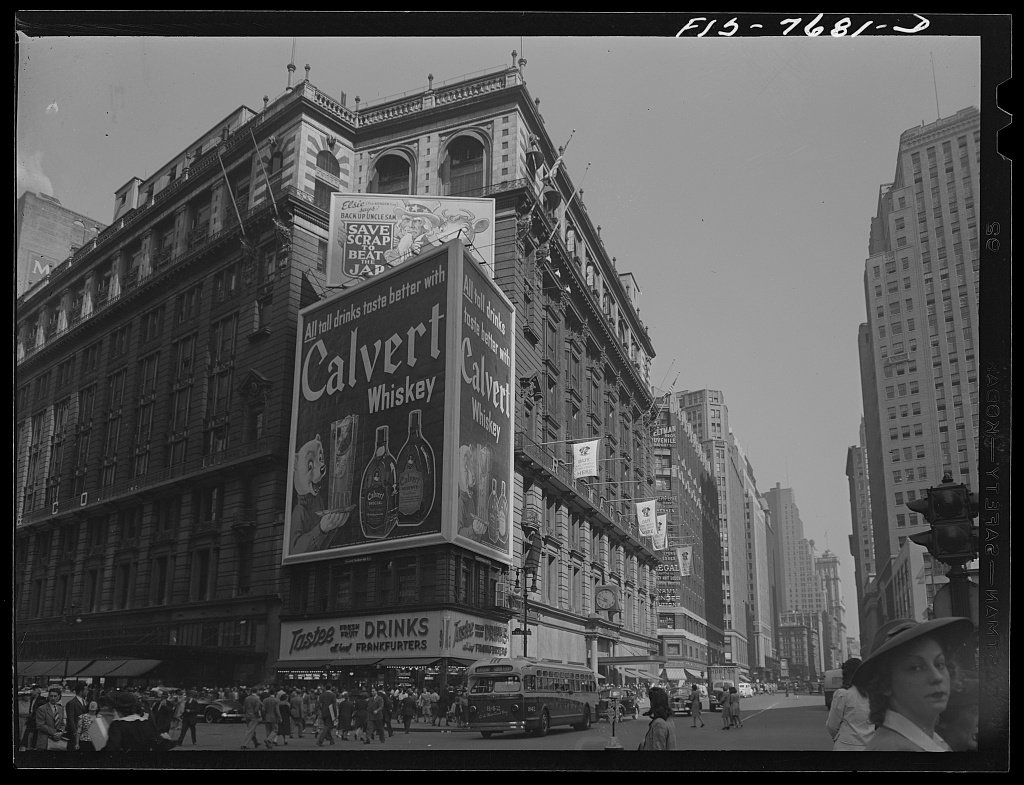
It took her a year to find work, as fashion publicity director at Macy’s, at $40 a week. There she worked with the store’s chief copywriter, Priscilla P., whom she may already have known, and who may have helped her get the job. Marty brought her into AA around 1943, and by then they were in love. Slowly, other women came: Bobby B., sent to a meeting from a mental hospital, whom Marty had written off at first sight and who in 1942 became AA’s national secretary at its New York headquarters; Ila P., a dancer; Priscilla; and in 1943 Felicia G., the sixth woman in New York AA. Bill W. sent her to Marty and Priscilla’s apartment. Marty, Felicia wrote later, “was like the friends I had once had.”
Image to comeMacy’s, Herald Square, New York, 1942
It’s 1939, in New York. Marty M. is sober, and nearly everyone in AA is a man.
In her first year she tries to help at least a hundred women. Women aren’t alcoholics, the men tell her.
Just before Christmas she starts drinking again. Days later Bill W. is standing at her mailboxes, in a navy pea jacket too small for him.
She tells him she’s drinking. He says, I know that. Can I come up?
He has a note from Lois, and a pocketful of ones and fives the New York members have raised to put her in a hospital. She can’t take their money. She goes with Bill instead, to a freezing house in the country, where you can see daylight through the walls.
She slips twice more. Christmas 1940 is the date she’ll give for her lasting sobriety.
And slowly, the women are beginning to come.
One card per woman
Who was first?
AA’s own books have called Marty M. the first woman to stay sober in AA. She wasn’t the first to try. Here are six early women the sources name, what each source claims, and what came next.
Three labels. AA’s books: the histories AA published, from 1957 to 1984. Her own story: in her own words, in the Big Book. Biographers: Marty’s biographers, Sally and David R. Brown (2001), from interviews and papers.
AA’s books
“Lil,” Akron, 1935
The claim
She was “the first woman to seek help.” Bill W., in the 1950s, guessed she was “absolutely the first woman we ever dealt with.”
Who says so
Dr. Bob and the Good Oldtimers (1980), from Akron old-timers, and from Bill’s words in a conversation in the 1950s with Dr. Bob’s daughter Sue. “Lil” isn’t her real name.
What happened next
She didn’t stay; after two or three days her family took her home. Bill thought she never made it. Sue said she straightened out a few years later, but not in AA.
AA’s books
Florence R., New York, 1937
The claim
“There had been another earlier woman pioneer, Florence R., who had come among us in 1937.” While the book’s title was being chosen, in 1938 and early 1939, she was, Pass It On says, “at that time the only female member.”
Who says so
Bill W., in AA Comes of Age (1957); Pass It On (1984). She objected to calling the Big Book One Hundred Men, and her own story, “A Feminine Victory,” is in its first edition.
What happened next
She went to Washington to help start a group there, and drank again. She died, Bill wrote, of alcoholism. Part 4 tells how Marty read her story at Blythewood.
AA’s books
Jane S., Cleveland, 1937
The claim
She is said to have been “the first woman in the area to have attained any length of sobriety—meaning a few months.”
Who says so
Dr. Bob and the Good Oldtimers (1980), which reports it as something said of her. Bob E., who started going to meetings at the same time, remembered her making the trip in 1937.
What happened next
She made the 35-mile trip to the meeting in Akron. The book says no more about how long she stayed sober.
Biographers
Mary C., New York, before 1939
The claim
She came to AA before Marty, and visited her at Blythewood in 1939. Without one relapse, she would have had the longest sobriety of any woman in AA.
Who says so
Sally and David R. Brown (2001). AA’s books don’t name her.
What happened next
She drank again in 1944, then stayed sober until her death in the 1990s.
AA’s books
Marty M., New York, 1939
The claim
Bill W., 1957: “one of the first women to try A.A.,” and she “holds the longest sobriety record in A.A. for her sex.” Pass It On, 1984: “the first woman to achieve lasting sobriety in Alcoholics Anonymous.”
Who says so
AA’s books, written while she was alive or soon after. Lois W., in her memoir of 1979, published by Al-Anon, put it more carefully: Marty was “not the first woman to enter A.A.”
What happened next
Three slips in her first two years, then sobriety she dated from Christmas 1940. Part 7 tells what her friends kept quiet.
Her own story
Sylvia K., Chicago, 1939
The claim
After visiting the groups in Akron and Cleveland she went home to Chicago, and “By the latter part of September 1939, we had a nucleus of six and held our first official group meeting.”
Who says so
Her own story, “The Keys of the Kingdom,” in the Big Book since its second edition (1955). Marty’s biographers call her the founder of AA in Chicago.
What happened next
Marty met her in Chicago that fall, on the trip that took her to Cleveland. Her story is still in the Big Book.
Kept coming back
She wasn’t the first woman to try AA, and her own record had slips in it. What set her apart was that she kept coming back, and kept bringing other women in.
For a closer look
Go deeper
The first slip, the woman she lived with for nearly forty years, and the sixth woman in New York AA.
Christmas 1939
“I know that. Can I come up?”
Bill W., when she told him she was drinking, as her biographers give it.
She came home from Cleveland into a deep depression. Her sister Chris was engaged, Marty felt like a fifth wheel in the apartment they shared, and she still had no job. Just before Christmas she began drinking, and hid out for a week with drinking friends in Harlem until they sent her home in a cab. AA friends got her into Bellevue, this time on the alcoholic ward, where patients lay on mattresses in the hall. She sneaked out and went on drinking.
Going out for more liquor, she passed her own building, and there was Bill W., stooped over the mailboxes, in shabby trousers and a pea jacket with sleeves too short. He came up, and asked if she wanted to go on drinking. “Of course not.” He put his arms around her: “you and I have a long way to go together.” He had a note from Lois: “We want you up here because we love you.” Then he pulled out rumpled ones and fives that the New York members, none of them with much money, had raised at Christmas to send her to Towns Hospital. She couldn’t take their money. She went with him to the country, where he and Lois, with no home of their own that winter, were staying: a borrowed summer cottage in the Poconos, her biographers say, though Lois remembered taking her in at Bog Hollow, a members’ house in Monsey, New York, always full of drunks drying out. It took Bill three days to taper her off.
One night at about three, Lois came to her room, hugged her, and said with tears in her eyes, “Oh, Marty, I wish you could get a little love in your heart.” It puzzled her for days. Slowly she saw that she had always waited to be loved first, and then measured out love with an eyedropper. It took her a month, for shame, to go back to AA. A year later, at AA’s first Christmas party: “Many of us were single. We had a Christmas tree. I looked around that room and I was overwhelmed by a rush of love for all these people. And I realized that it didn’t matter whether they loved me. What mattered was that I could, and did, love them.”
Priscilla
Priscilla P. was three years younger than Marty, born in Brooklyn in 1907: a writer, a painter and a pianist, who had studied English at Adelphi College. She was Macy’s chief copywriter when Marty came to work there, and they may already have known each other from Cherry Grove, on Fire Island. By 1943 they were in love, and they moved in together, partly to save rent. They stayed together for nearly forty years, until their deaths.
They spoke of each other as friends, the usual word among gay people then, and most people, even many who worked closely with Marty, never knew they were a couple. The Mrs. Marty had kept after her divorce helped; it blurred things, and on the road it gave her a protection that Miss did not.
In 1943 they bought a summer house at Cherry Grove, where they could walk on the beach hand in hand. Friends in trouble there learned to say “Call Marty!” She started the first AA group at Cherry Grove, which was still meeting in the firehouse when her biographers wrote. Priscilla went on to Vogue, where she became art editor.
Felicia
Felicia G. came from an even richer family than Marty’s, and had sunk as low. In 1943 her therapist gave her the Big Book, and she was put off by “all the God stuff,” but she went to the little AA office anyway. Bill W. asked her gently, “Do you think you are one of us?” She nodded. He telephoned Marty: “I’ve got a dame here with a name I can’t pronounce”.
Priscilla opened the door; the shelves, Felicia noticed, held many of the books she owned herself. Then Marty came in and told her own story, and Felicia couldn’t get a word in. “A load weighing a thousand pounds came off my back. I wasn’t insane.”
Marty became sponsor to both Felicia and Priscilla. When Felicia called her from a bar that first year, drinking again, Marty said, “Well, Honey, what can I do about it?” Later calls from bars got “Call me when you’re ready to stop,” and the phone hung up. On the fourth morning Felicia called and said, “Help!” Marty came over before work and nursed her through. In 1998 Felicia celebrated fifty-five years in AA, and she died in February 1999.
The three of them used to “hold long discussions as to why it was so difficult to help women, why they couldn’t stay sober, couldn’t make the program work.”
Sources
Sally Brown and David R. Brown, A Biography of Mrs. Marty Mann. Hazelden, 2001. Chapters 12–15 and 18. Its unattributed quotes of her come from fifty-one tapes of her talks or from her writings. It quotes Felicia G.’s story “Stars Don’t Fall” from the Big Book’s third edition (1976), and her own manuscripts.
Dr. Bob and the Good Oldtimers. AA World Services, 1980. Chapters VIII and X.
Alcoholics Anonymous Comes of Age. AA World Services, 1957. “When A.A. Came of Age” (Florence R. and Marty) and “Service: The Third Legacy” (Nona W. and High Watch).
Pass It On. AA World Services, 1984. Chapters 11 and 12.
Lois Remembers. Al-Anon Family Groups, 1979. Chapter 11, “The Clinton Street Boys.”
Alcoholics Anonymous, first edition. Works Publishing, 1939. “A Feminine Victory.”
“The Keys of the Kingdom,” in Alcoholics Anonymous (the Big Book), second edition, 1955; quoted from the fourth edition, 2001.