Watch The Kitchen Table
Illustration · The meeting hall of a rescue mission after the night’s meeting, about 1930: hard wooden benches with hymnals in their racks, a piano and a lectern on a low platform, and an open door to a lit stair going up to the beds. Not drawn from a photograph of the Calvary Mission.

Gramercy Park, New York · 1925–1934

Calvary House

In New York the Group made its home in Sam Shoemaker’s parish, with a mission for the down-and-out half a mile away.

“I have been a pious fraud, pretending to serve God but actually keeping all the trump cards in my own hands.”

Sam Shoemaker to Frank Buchman in Peking, during Buchman’s visit of 1917–18 · as told in Garth Lean, Frank Buchman: A Life, 1985

An old church downtown

Sam Shoemaker finished at Princeton in 1916 and went to China to teach at a business school Princeton ran in Peking. When Buchman came through, Shoemaker asked him to help with the young men in his Bible class. Buchman asked why he didn’t get through to one of them himself. The next day Shoemaker came back with the confession above, then told the student the same thing. For Shoemaker, Lean writes, it was “the beginning of a twenty-year association with Buchman.”

Ordained an Episcopal priest in 1921, he was traveling with Buchman in Cairo late in 1924 when Calvary Church on Gramercy Park in New York asked him to be its rector. He said no, then said yes to a second cable in January 1925. “I have an uneasy feeling that this decision of yours will lead to trouble,” Buchman told him. Shoemaker was thirty-one. Calvary was, as he described it, “an old, downtown church in the middle of New York City,” a brownstone at Fourth Avenue and 21st Street.

He made the parish a working center of Buchman’s movement. In January 1926 he started a Thursday evening meeting where parishioners learned to bring others to faith, and by 1929, on clear Sunday nights, the clergy and a robed choir marched out to Madison Square to preach in the open air. He wrote up the changed lives of his parish in books, Children of the Second Birth in 1927 and Twice-Born Ministers in 1929.

He also asked himself, he wrote later, “what was happening to men in the Gas House district to the east of us?” The parish owned a chapel on East 23rd Street that it hardly used. Harry Hadley, whose father had run the Water Street Mission downtown, wanted to start rescue work there. The vestry took it up in December 1925, and Calvary Mission opened on February 1, 1926. Men began to be changed, Shoemaker wrote, and, “as Harry Hadley used to say, to ‘stick.’”

It grew into a meeting every night of the year, a floor of beds for homeless men who stayed after it, free meals, and a floor of twelve beds for “the most tried and trusted of the men,” who called themselves the brotherhood and helped run the place. By 1936, Shoemaker counted, the meetings had been attended 210,403 times, and beds had been given 147,896 times.

In 1928 the parish dug the foundations for Calvary House, beside the church, with apartments for the clergy and staff, rooms for guests, offices and a hall. It opened that autumn. “Calvary House was an expression of something already created,” Shoemaker wrote, “a new life pulsing all through the parish.” It became, in Lean’s words, “the home and office of Buchman’s work in America.”

Not every drunk the Group took in did as well as the mission’s men. Bill W. later told of alcoholics put up at or near Calvary House, one of whom threw a shoe through a stained-glass window of the church. Late in 1934 Ebby T. was living at the mission, and one evening an old drinking friend came in off the street to see what went on there. His name was Bill W.

Listen Calvary House About 1 minute

On the map

Half a mile

The Group’s work in New York ran between two ends of the same neighborhood: the church and its new house on Gramercy Park, and the mission out toward the gas tanks and the river. Here they are, with the places around them that turn up in the story.

A diagram, not to scale, with the streets simplified. The mission’s number is Shoemaker’s own; AA’s books give another (see Go deeper).

Diagram of the streets of Manhattan’s East Side from Madison Square to the East River, with seven numbered placesA grid of streets, with uptown at the top. At the left is Madison Square, a park between Fifth and Madison Avenues north of 23rd Street. On Fourth Avenue at 21st Street stand Calvary Church and, beside it, Calvary House, facing the small fenced Gramercy Park. A dashed line runs from Calvary House up to 23rd Street and east along it, about half a mile, to the Calvary Mission between Second and First Avenues. East of First Avenue are round gas tanks, and at the right edge is the East River. The numbered list beside the diagram describes each place.about half a mile5TH AVE.4TH AVE.3RD AVE.2ND AVE.1ST AVE.MADISON AVE.LEXINGTONIRVING PL.E. 26TH ST.E. 23RD ST.E. 22ND ST.E. 21ST ST.E. 20TH ST.E. 18TH ST.EAST RIVERUPTOWN1234567
A diagram, not a street map. Each place is shown where it helps tell what happened there.
  1. 1

    Calvary Church

    Fourth Avenue, now Park Avenue South, at 21st Street. Built in 1846 and 1847; Sam Shoemaker was its rector from 1925 to 1952.

  2. 2

    Calvary House

    Opened beside the church in the autumn of 1928, with clergy apartments, guest rooms, offices and a hall. Buchman’s American base until he and Shoemaker parted in 1941.

  3. 3

    Gramercy Park

    “A little residential oasis to the east of us,” Shoemaker wrote in 1927.

  4. 4

    Madison Square

    On clear Sunday nights the clergy and a robed choir marched out to hold services here in the open air.

  5. 5

    Calvary Mission

    346 East 23rd Street, in a chapel the parish owned. It opened on February 1, 1926: a meeting every night, then beds upstairs.

  6. 6

    The Gas House district

    Tenements and gas tanks toward the East River, where Shoemaker saw men “who stand about idle or drunken or quarreling or bewildered.”

  7. 7

    Fourth Avenue and 23rd Street

    Where Bill W. got off the subway one day in December 1934, Ebby’s biographer writes, stopping at a number of bars on his way to the mission.

Two congregations

Shoemaker wanted his parish to reach people “of sufficient privilege to find their way into the rectory and church,” and the men at the far end of 23rd Street. Ebby T. found the mission first. Bill W. came in through its door, and a few weeks later through Calvary House’s.

For a closer look

Go deeper

The man who ran the mission; a shoe and a window, as Bill W. told it; and where the mission stood.

Harry Hadley

Henry Harrison Hadley II was the son of S. H. Hadley, who ran Jerry McAuley’s Water Street Mission and whose own rescue from drink William James told in The Varieties of Religious Experience. The son had his own conversion three days after his father died in 1906, Shoemaker wrote, and had been traveling in Christian work before he settled at Calvary.

The parish had done rescue work on 23rd Street before. Its Galilee Mission began in 1884, “antecedent of the present Calvary Mission,” Shoemaker wrote. Mrs. Hadley played the piano at the meetings and kept house in the parish house. By 1936 the superintendent was the Rev. J. Harvie A. Zuckerman, on the staff since April 1926. In December 1934, as Bill W. and the assistant superintendent remembered it, the man in charge day to day was Tex Francisco, an ex-drunk.

The shoe
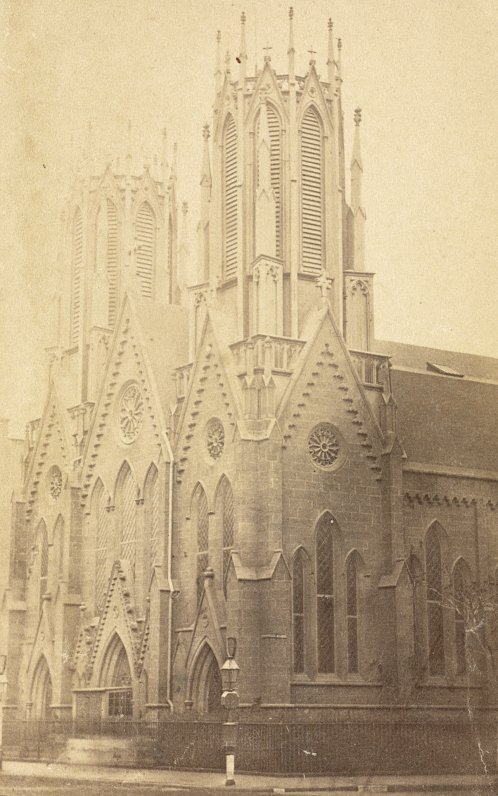
Calvary Church in New York, a Gothic Revival stone church with tall pinnacled towers and pointed windows, in an old photograph.
Calvary Church, at Fourth Avenue and 21st Street, in a photograph published by George Stacy in 1863. Calvary House went up beside it in 1928.Prints and Photographs Division, Library of Congress

Bill W. told the story of a shoe and a stained-glass window more than once, and it changed a little each time:

  • 1953. In the Grapevine: the Groupers had been working with a batch of alcoholics, and one of them, “it was rumored,” threw his shoe through a window “of an Episcopal church across the alley from O.G. headquarters.”
  • 1954. In his recorded memories, as Ebby’s biographer quotes them: the drunks were lodged “in the upstairs bedrooms of Calvary House,” and one threw his shoe from his bedroom across the alley into a window of Calvary Church.
  • 1957. In AA Comes of Age: Shoemaker “had housed a batch of drunks in an apartment near his church,” and one had “peevishly thrown a shoe through a fine stained-glass window in Sam’s church.”

None names the man or the window. All three put it just before Bill came, which is why, he said, his Oxford Group friends thought he “had better forget about alcoholics.”

246 or 346?

Where the mission stood depends on whom you read. Pass It On (1984) and Ebby’s biographer (1998) put it at 246 East 23rd Street, “near the southwest corner of Second Avenue.” Shoemaker gave 346 twice: in a footnote in 1928, and in his 1936 history of the parish, which speaks of “the practically unused chapel at 346 East 23rd Street, which we owned.” That would put it between First and Second Avenues, in the same row as the houses at 340 to 344 where the parish’s Galilee Mission had worked since the 1880s. The diagram follows Shoemaker.

The counts differ too. Pass It On says that between 1926 and 1936 “more than 200,000 men are said to have visited the mission.” Shoemaker’s own figures, set down in 1936, count attendances, not men: 210,403 at the meetings, 147,896 nights’ lodging and 228,657 meals.

Sources
  • Samuel M. Shoemaker Jr., Calvary Church Yesterday and Today: A Centennial History. New York, 1936 (the Galilee Mission; the Calvary Mission, pp. 247–248; Calvary House, pp. 257–260; the Thursday evening meeting). Free at the Internet Archive.
  • Samuel M. Shoemaker Jr., Children of the Second Birth, 1927 (the parish; Gramercy Park). Free at the Internet Archive.
  • Samuel M. Shoemaker Jr., Religion That Works, 1928 (the mission’s address, in a footnote). Free at the Internet Archive.
  • Samuel M. Shoemaker Jr., Twice-Born Ministers, 1929 (the Sunday night services in Madison Square). Free at the Internet Archive.
  • Garth Lean, Frank Buchman: A Life. Constable, 1985. Chapters 6 (Peking), 11 (the call to Calvary) and 26 (Calvary House as Buchman’s base, and the break in 1941). Free to read at frankbuchman.info.
  • Pass It On. AA World Services, 1984. Chapter 5 (the mission at 246 East 23rd Street; the brotherhood; Tex Francisco).
  • Mel B., Ebby: The Man Who Sponsored Bill W. Hazelden, 1998. Chapter 7 (Calvary House and the mission; Bill’s 1954 telling of the shoe; Billy D.’s letter).
  • Bill W., “A Fragment of History: Origin of the Twelve Steps,” AA Grapevine, July 1953; in The Language of the Heart. AA Grapevine, 1988 (the shoe, 1953).
  • Alcoholics Anonymous Comes of Age. Alcoholics Anonymous Publishing, 1957 (the shoe; Tex Francisco; Bill W. on what AA owed Sam Shoemaker).
  • “Calvary Church, Fourth Avenue and Twenty-First Street,” photograph by George Stacy, 1863. Prints and Photographs Division, Library of Congress. No known restrictions on publication.