“I have been a pious fraud, pretending to serve God but actually keeping all the trump cards in my own hands.”
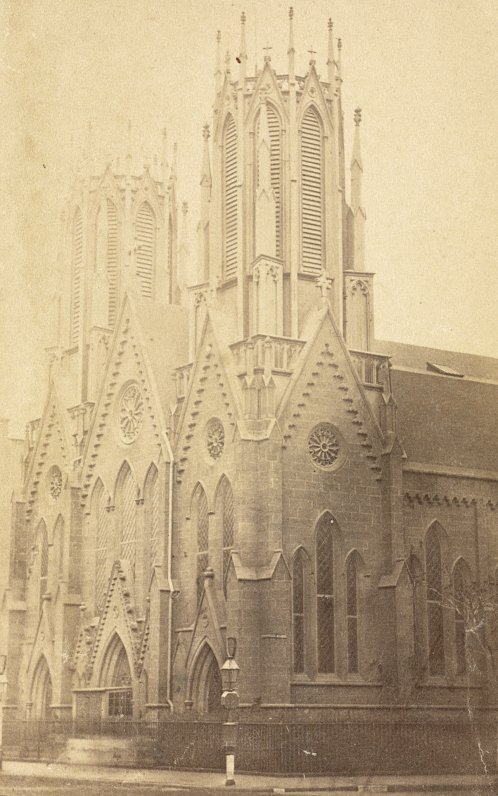
An old church downtown
Sam Shoemaker finished at Princeton in 1916 and went to China to teach at a business school Princeton ran in Peking. When Buchman came through, Shoemaker asked him to help with the young men in his Bible class. Buchman asked why he didn’t get through to one of them himself. The next day Shoemaker came back with the confession above, then told the student the same thing. For Shoemaker, Lean writes, it was “the beginning of a twenty-year association with Buchman.”
Ordained an Episcopal priest in 1921, he was traveling with Buchman in Cairo late in 1924 when Calvary Church on Gramercy Park in New York asked him to be its rector. He said no, then said yes to a second cable in January 1925. “I have an uneasy feeling that this decision of yours will lead to trouble,” Buchman told him. Shoemaker was thirty-one. Calvary was, as he described it, “an old, downtown church in the middle of New York City,” a brownstone at Fourth Avenue and 21st Street.
He made the parish a working center of Buchman’s movement. In January 1926 he started a Thursday evening meeting where parishioners learned to bring others to faith, and by 1929, on clear Sunday nights, the clergy and a robed choir marched out to Madison Square to preach in the open air. He wrote up the changed lives of his parish in books, Children of the Second Birth in 1927 and Twice-Born Ministers in 1929.
He also asked himself, he wrote later, “what was happening to men in the Gas House district to the east of us?” The parish owned a chapel on East 23rd Street that it hardly used. Harry Hadley, whose father had run the Water Street Mission downtown, wanted to start rescue work there. The vestry took it up in December 1925, and Calvary Mission opened on February 1, 1926. Men began to be changed, Shoemaker wrote, and, “as Harry Hadley used to say, to ‘stick.’”
It grew into a meeting every night of the year, a floor of beds for homeless men who stayed after it, free meals, and a floor of twelve beds for “the most tried and trusted of the men,” who called themselves the brotherhood and helped run the place. By 1936, Shoemaker counted, the meetings had been attended 210,403 times, and beds had been given 147,896 times.
In 1928 the parish dug the foundations for Calvary House, beside the church, with apartments for the clergy and staff, rooms for guests, offices and a hall. It opened that autumn. “Calvary House was an expression of something already created,” Shoemaker wrote, “a new life pulsing all through the parish.” It became, in Lean’s words, “the home and office of Buchman’s work in America.”
Not every drunk the Group took in did as well as the mission’s men. Bill W. later told of alcoholics put up at or near Calvary House, one of whom threw a shoe through a stained-glass window of the church. Late in 1934 Ebby T. was living at the mission, and one evening an old drinking friend came in off the street to see what went on there. His name was Bill W.
It’s the first of February 1926, on East 23rd Street in Manhattan. Calvary Church owns an old chapel here that it hardly uses, and tonight it opens as a rescue mission for the men of the Gas House district, the homeless and the drunk. Calvary’s young rector, Sam Shoemaker, is Frank Buchman’s leading man in America.
Before long there’s a meeting every night of the year, beds upstairs for the men who stay after it, and a floor for a dozen of the steadiest, who call themselves the brotherhood. Two years later, half a mile away beside the church, the parish opens Calvary House, with offices, guest rooms and a hall. It becomes the Group’s home in America.
Late in 1934 one of the men living at the mission is Ebby T. One evening an old drinking friend of his turns up, drunk, to see what goes on there. His name is Bill W.