1939
The papersA year after
“…to sell Buchmanism under its newest name, ‘Moral Re-Armament.’”
Two months later the same magazine said the Groupers in Europe had “borne the label MRA since last summer.”
TIME, March 20 and May 22, 1939.
London, New York and Hollywood · 1938–1941
The Group turned to statesmen and nations under a new name. AA’s book left it unnamed, and Cleveland and Akron left.
“The crisis is fundamentally a moral one. The nations must rearm morally…”
In the spring of 1938, with Europe arming for war, Buchman spent a few quiet days in the Black Forest. Walking one afternoon, Lean writes, a phrase came back to him “with unusual force”: “Moral and spiritual re-armament.” A few days later, at East Ham Town Hall in London, before a meeting of 3,000 hosted by local mayors, he launched Moral Re-Armament. That August the first Moral Re-Armament Assembly met at Visby in Sweden, in the ruins of a medieval church, because “there was no building large enough.” In September, at Interlaken in Switzerland, he told another: “The choice is guidance or guns.”
Meanwhile the old name was in trouble. A friend had left the Oxford Group £500, and a London court ruled the legacy invalid; TIME reported it in March 1939: “Grounds: lack of proof that the Group existed.” The Group had applied to be incorporated under its name, and Oxford University’s governing council opposed it. The Board of Trade decided for the Group on June 4, 1939.
By then Buchman was in America. He had sailed on March 4, planning to be back in three months; it was seven years before he saw Britain again. America got Moral Re-Armament as mass meetings: Madison Square Garden in May; Constitution Hall in Washington in June, where Senator Harry Truman read out a message from President Roosevelt; and on July 19 the Hollywood Bowl, where four great searchlights stood for the four absolutes and, by Lean’s count, 15,000 people were turned away. Not everyone was sure what it was for. “Sure, I’m for Moral Re-Armament, whatever that is,” Joseph W. Martin Jr., the House Republican leader, told TIME. “It’s just like being against Sin.”
The alcoholics were going the other way. Their book, Alcoholics Anonymous, came out that April and never named the Oxford Group or its four absolutes. In May the Cleveland members stopped coming down to the Akron meeting at T. Henry Williams’s house and started their own. Many were Catholics, and Clarence S. remembered the Group’s testimony as something that “seemed like open confession to them.” Late in 1939 the Akron alcoholics left too. On January 2, 1940, Dr. Bob wrote Bill: “Have definitely shaken off the shackles of the Oxford Group.”
Bill explained the silence in a letter in 1940. There was, he wrote, “a vast and sometimes unreasoning prejudice” across the country “against the O.G. and its successor M.R.A.,” and to thank the Group in public might tie AA to it. In November 1941 the Group lost its American home. Sam Shoemaker announced that he was ending his association with Buchman over “certain policies and points of view” in Moral Re-Armament, and asked him to move his people and papers out of Calvary House.
It’s 1938, and Europe is arming for war. Frank Buchman answers with a new phrase: moral re-armament. The crisis, he says, is a moral one. Within a year the newspapers call his whole movement by the new name. In America there are mass meetings: Madison Square Garden, Constitution Hall in Washington, and the Hollywood Bowl, where four searchlights stand for the four absolutes and thousands are turned away at the gate.
The alcoholics are going the other way. Their book comes out in April 1939 and never names the Oxford Group. Cleveland’s members start a meeting of their own that spring, and by the end of the year Akron’s have left too.
In 1941 Sam Shoemaker breaks with Buchman and asks him to move out of Calvary House. Buchman says he made an idol of Calvary.
Compare the accounts
AA’s own histories say Oxford University made the Group give up its name. Here are six accounts, from the papers in 1939 to the charity itself, in the order they were set down.
Quotations are short excerpts, shown side by side for comparison. The years under each card count from the launch of Moral Re-Armament in 1938.
A year after
“…to sell Buchmanism under its newest name, ‘Moral Re-Armament.’”
Two months later the same magazine said the Groupers in Europe had “borne the label MRA since last summer.”
TIME, March 20 and May 22, 1939.
41 years after
“…sometime during 1938, Oxford University demanded the name be changed.”
The new name, she adds, was chosen by the Group itself.
Lois W., Lois Remembers (1979).
42 years after
“(In 1939, he changed the name to Moral Rearmament.)”
It gives no reason. 1939 is the year the campaign reached America.
Dr. Bob and the Good Oldtimers (1980), chapter V.
46 years after
“In 1938, after Oxford University requested that the group, because of the controversy, no longer use its name, it took the name Moral Rearmament…”
The controversy is Buchman’s 1936 interview about Hitler, told just before.
Pass It On (1984), chapter 9.
47 years after
“In Britain, the name ‘Oxford Group’ remains the official name of the incorporated body.”
The University opposed the name’s legal use and lost. The new phrase took over, he writes, because the campaign had grown “so well known across the world.”
Garth Lean, Frank Buchman: A Life (1985), a sympathetic biography by one of Buchman’s followers.
79 years after
“The Oxford Group was incorporated as a company limited by guarantee on 15 August 1939…”
It adds that it is “a registered charity in England and Wales.” It works under the name Initiatives of Change.
The Oxford Group, Annual Report 2017, Directors’ Report.
Both names
Oxford University did object, but to the name’s legal use, and it lost: the Group was incorporated as the Oxford Group in 1939. Moral Re-Armament began as the name of a campaign launched in 1938, and within a year it was what the papers called the whole movement.
For a closer look
How many came to the meetings of 1939; how the name was fought over in court and in Parliament; and why Buchman had to leave Calvary House.
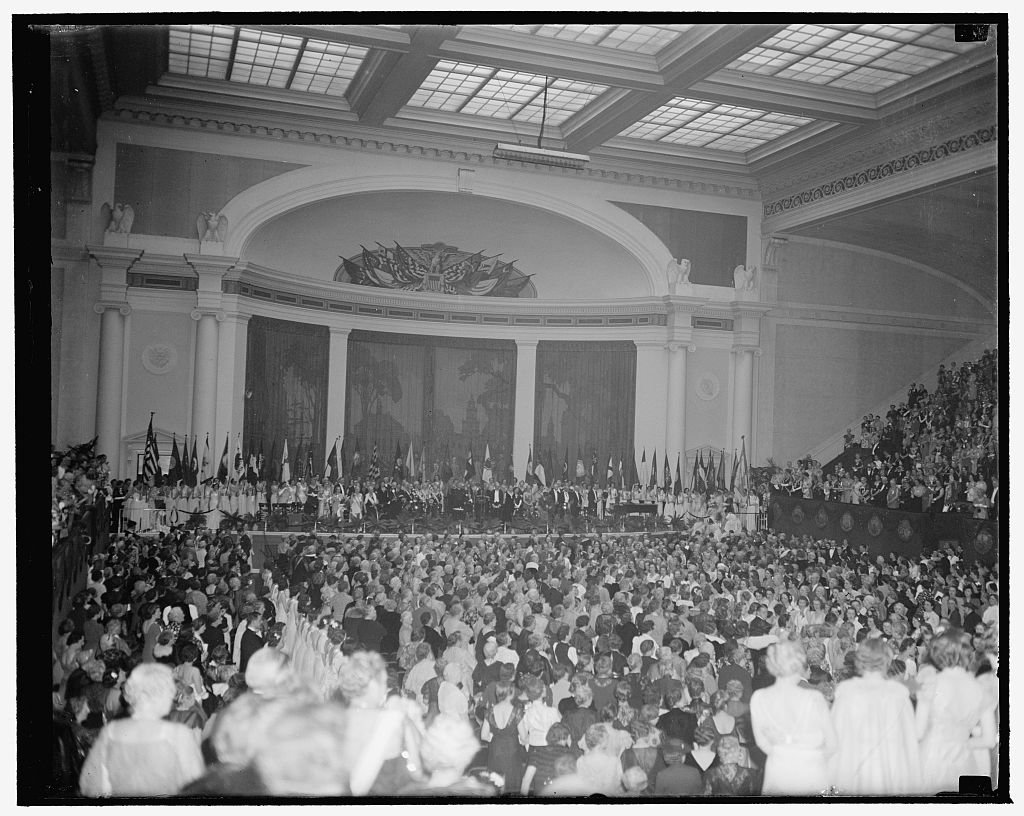
Buchman’s biographer and TIME’s reporters didn’t count the same crowds:
From Hollywood Buchman went on to Del Monte, on the California coast, to open a “World Assembly” that TIME said was attended by “2,000 delegates from 25 nations.”
The legacy was £500, left to the Oxford Group in 1937. When it came to court, Lean writes, the judge ruled that the bequest failed because there was no body definable at law as “the Oxford Group.” Asked whether anything happened when someone joined, the Group’s counsel answered, by TIME’s account, “No, I think it is as invisible as joining the Church of England.”
A legal body was needed, and the Group asked to be incorporated under the name. Oxford University’s governing body, the Hebdomadal Council, opposed it, and A. P. Herbert, the University’s member of Parliament, took the fight to the House of Commons on March 17, 1939. Only fifty members signed his motion; a contrary motion had 84, and 232 MPs then petitioned the minister in the Group’s support. On June 4 the President of the Board of Trade, Oliver Stanley, decided in the Group’s favor, and it was incorporated that August.
Herbert didn’t let it go. He vowed to “pursue the pirates until they haul down the noble flag they have stolen,” and once, in the Commons, called Buchman and his colleagues “canting cheats,” for which the Speaker rebuked him.
For fifteen years, Lean writes, Calvary House had been “the home and office of Buchman’s work in America.” Shoemaker’s statement of November 1941 gave no details of the “policies and points of view” he objected to. When the Oxford Group had been, in its own words, “a movement of vital personal religion working within the churches,” he said, they had fully identified themselves with it. TIME reported that Shoemaker quit “after careful thought and prayer,” and that many of Buchman’s followers, Shoemaker among them, now believed Buchman wanted to form an independent sect.
Lean’s view was that neither side’s statement told the whole truth: “a world action was difficult to run from a parish house, and a parish difficult to run from what had become a world centre.” Buchman, he writes, seems to have felt that part of the blame was his own.