Watch The Kitchen Table
Illustration · A bedside table in a hospital at Arusha in early 1928: an open Bible, a small prayer book, a letter, a glass of water and a hurricane lamp, beside an iron hospital bed, with a mountain and acacia trees through the window. Not drawn from a photograph.

Arusha, Nairobi and London · 1927–1928

A new cycle

A safari, a fever in Arusha, a Bible read in the solitude, and a hotel in London.

“It seems as if a miracle has happened to Roy!”

His aunt Caroline, writing to Leonard Bacon, March 2, 1928 · quoted in Cora Finch, Stellar Fire, 2006–07

In the solitude

Rowland H. came home from Zurich in the summer of 1926 well enough to take his children to camp and to spend time with his mother and aunt in California. In 1927 he left his New York investment firm, and that summer he planned a safari. Helen had told him she would be filing for divorce. In September his uncle Irving Fisher, the Yale economist and a leading Prohibitionist, wrote to his own daughter Carol, then in analysis in London, and asked whether Jung had “weakened Roy’s self reliance.”

On September 21 he sailed for Europe. The checks he wrote to hotels place him in London on October 6, Paris on October 17 and Naples on October 21, and from there he took the usual route to East Africa, by way of the Suez Canal. In November a letter reached his aunt Caroline from the Red Sea. She was struck by its gratitude and insight. Roy wrote that he had begun a “new cycle.”

He was hunting with a party from Chicago led by George F. Getz, a Chicago coal man and amateur zoologist, which went inland into Tanganyika with 250 porters. In mid-December he was in a hospital in Arusha with amebic dysentery and possibly typhoid, illnesses that sometimes killed travelers then. Around January 20 he was well enough to be moved to Nairobi; Leonard Bacon put it at “a hundred and fifty miles in an ambulance,” and Finch at about 200. There he had a setback, and the doctors found something wrong with his liver. Cora Finch, who traced the trip, suspects they wondered whether drink had a part in it.

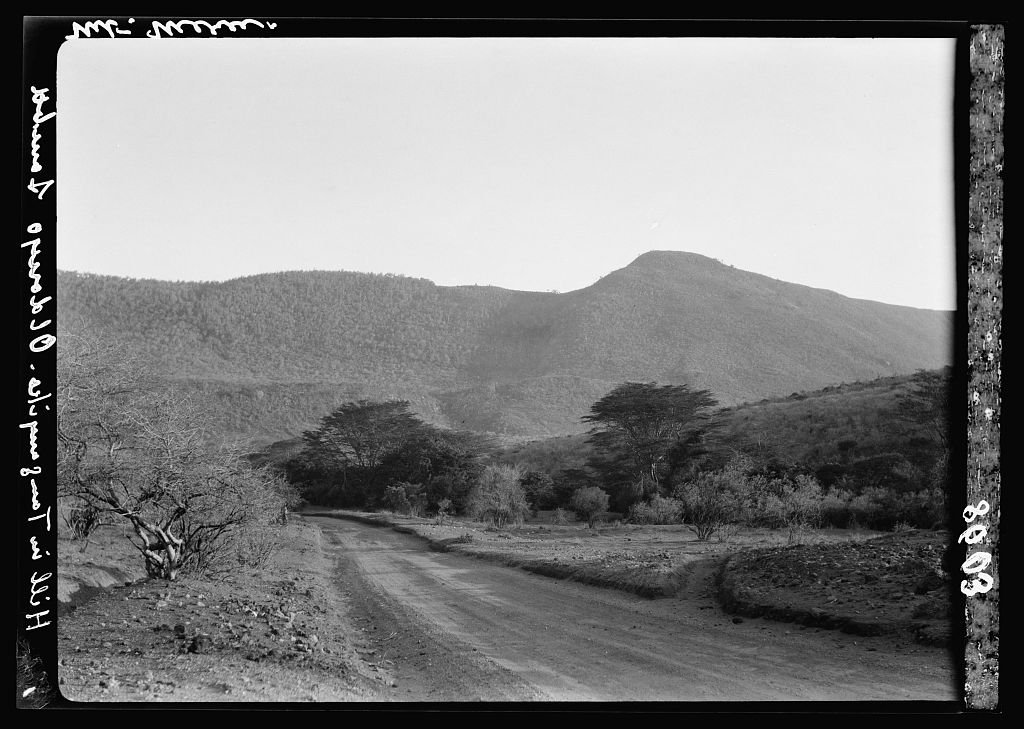
Mount Meru, a broad volcanic peak, rising over open country on the road to Arusha.
Mount Meru from the west, on the road to Arusha, photographed in 1936. Arusha lies at its foot.Photo: Matson Photo Service, G. Eric and Edith Matson Photograph Collection, Library of Congress

Then a long letter came home to his mother. In the solitude, Rowland wrote, he had come to see that it was “want of faith which had been the trouble with him.” He had been reading a Bible a friend had given him for the trip and the prayer book from his mother, and now he could say, “I know that my Redeemer liveth.” He felt his wickedness had been taken from him.

His brother Thomas, whom the family called Pierre, made the long trip to Nairobi to join him. In March the brothers sailed for France, met Leonard Bacon and Pierre’s wife in Paris, and went on to London at the end of the month. Pierre left for home. Rowland stayed at the Cavendish Hotel in Jermyn Street, and in London it went wrong. Leonard tried to get him to go back to Zurich, apparently without success. On April 13 Rowland paid his hotel bill, and the next day the Berengaria sailed from Southampton with him aboard.

Listen A new cycle About 1 minute

Follow the trip

Four letters

Cora Finch traced the trip through Rowland’s checks to hotels, the family’s telegrams, and the letters his relatives wrote to Leonard Bacon, the cousin who had sent him to Jung. First the route, then four of the letters: before, during and after.

Dates and letters from Cora Finch’s and Amy Colwell Bluhm’s accounts of the family’s papers at Yale and in Providence. Quotations are short excerpts.

Aug 1927

Susan Keith

Before he sailed · his cousin

“…what he needs isn’t chasing off to Africa or some other interesting place but to get a new state of mind, in other words some kind of renascence.”

She and her husband had joined Frank Buchman’s movement. Jung, she wrote, had “not entirely” given it to him.

Susan Keith to Leonard Bacon, August 10, 1927, as Cora Finch quotes it.

Mar 1928

His aunt

From East Africa · passing on his letter

“It seems like a real regeneration!”

Two books Susan had sent him, Caroline added, “played an important part.” The letter doesn’t name them.

Caroline to Leonard Bacon, March 2, 1928, as Cora Finch quotes it.

Mar 1928

His uncle

A week later · Irving Fisher

“I suspect that Roy’s change of heart is largely due to the gradual elimination from his brain of alcoholic poison.”

He feared that, shown to Roy, the letter might “reach him the wrong way.” His wife’s note of love to Roy, sent with it for Leonard to hand over, is still with it at Yale, so it probably never reached him.

Irving Fisher to Leonard Bacon, March 9, 1928, as Amy Colwell Bluhm quotes it.

Apr 1928

Leonard Bacon

Five weeks later · his cousin

“I gave up Roy in London. Unless he saves himself everything is lost as far as he is concerned.”

Twelve days earlier he had written that Roy was worse than ever and that “drink is the least part of it.”

Leonard Bacon to his wife, Patty, April 2 and April 14, 1928, as Cora Finch quotes them.

Which came first?

In AA’s telling, Rowland relapsed after Jung, Jung gave up on him, and religion came after. In 1928 the family’s letters tell it the other way round: a religious awakening in a hospital bed, then, weeks later in London, worse than ever. Even the awakening was read two ways: a miracle to his aunt, the drink leaving his brain to his uncle.

For a closer look

Go deeper

The hunting party, the books from his cousin Susan, and a hotel keeper in London.

The Getz party

On January 20, 1928, while Rowland lay in the hospital, the Chicago Tribune reported the party’s return to Naples. Six men, led by George F. Getz, had gone about 1,200 miles inland toward Lake Victoria and shot elephants, lions, rhinoceroses and hippopotami. The last name on the list was “Roland Hazard of New York.”

Getz had promoted the second Dempsey–Tunney boxing match, the famous “long count” fight in Chicago, just before he left. He kept a private zoo in Holland, Michigan, and shipped home live animals from the trip, among them six giraffes and six zebras.

Susan’s books

Susan Keith, Leonard Bacon’s sister, and her husband, Elmer, were followers of Frank Buchman, whose movement was then called the First Century Christian Fellowship. In a few years it would be the Oxford Group. As early as April 1926, in the crisis after Bermuda, Elmer had written to Leonard suggesting the fellowship might help Roy, and sent a book about Buchman’s men, Harold Begbie’s Life-Changers.

Nobody knows which two books Susan sent to Africa. Cora Finch notes the pattern: the collapse in London came straight after an awakening brought on partly by reading Susan sent, and Leonard may never have liked the idea of his cousin putting his faith in an evangelical fellowship.

The Cavendish

The Cavendish Hotel was managed by Rosa Lewis, who seemed to know everyone in London worth knowing; a biographer called her a nanny to her stylish and self-indulgent guests. In his memoir Leonard Bacon wrote that “troubles not my own” took him to Europe that spring, and that Rosa, over a bottle of champagne, gave him sensible advice about them. He didn’t say whose troubles.

Then he went on alone to Zurich, where Jung had a camp on the lake. Leonard spent several days there with him, for the first time as a friend rather than a patient. After that April, Finch found, Rowland is rarely mentioned in letters to or from Leonard, and his life is harder to follow without them.

Sources