Illustration · A tile works in a New Mexico canyon on a late afternoon around 1930: red roof tiles drying in rows, an adobe workshop, a tile-roofed adobe building, a domed brick kiln with smoke rising, and the mountains behind. Not drawn from a photograph.
Spinal taps in New York, a thousand acres in New Mexico, a divorce, and a wedding to the same woman.
“…as many ideas as he had dollars.”
A thousand acres
Back in New York in the spring of 1928, Rowland H. went to Dr. Edward S. Cowles, who believed alcoholism was an allergy that irritated the membranes of the brain and spinal cord. His cure was to draw off spinal fluid, again and again. Judging by Rowland’s check ledger, Cora Finch writes, he had frequent treatments from late May through July. By the fall he was back on the road, the drinking apparently in remission, and seeing Peter Baynes, an English associate of Jung’s who had a practice in northern California that year.
He and Helen had lived apart since he came home from Africa. The divorce came in February 1929.
Late in 1928 he drove west to Santa Barbara, where his mother and his aunt Caroline spent part of each year. Local tellings say it was car trouble that first stopped him at La Luz, a village where a canyon comes down out of the Sacramento Mountains in southern New Mexico, looking west across the Tularosa Basin toward the White Sands. Early in 1929 he bought land there, “something like a thousand acres … of absolutely wild land with one or two springs upon it, but no water development,” as his aunt described it.
He began building a house in La Luz Canyon and wanted good tiles for its roof. The clay in the canyon turned out to be excellent, and he started a business on it, the La Luz Clay Products Company, with an office in New York, a manager from the New York State College of Ceramics and a chief potter from Guadalajara. He bought the old inn in the village and roofed it with his own red tile. The composer Carl Ruggles, a friend from Vermont, spent the winter of 1929–30 at the ranch with his family.
In March 1930 his mother wrote, “I think Roy has had a spiritual awakening,” and worried that it left him ready to do anything he felt he owed, even a sacrifice she thought was not for the best. Richard Dubiel, the historian who read the letter in the family’s papers, took it to be about Helen. Nobody knows what the awakening was. It came before any Oxford Group meeting the family’s papers record.
He and Helen kept trying. On April 27, 1931, they were married again in the chapel of St. Bartholomew’s Church in New York. Eight people were there, the lawyers from both sides of the divorce among them. That summer they toured Europe with all four children. In September the Providence Sunday Journal wrote up his success with New Mexico clay. By the family’s papers, he was neither drinking nor depressed that summer: 1931, the year AA’s books would give for his time with Jung.
ListenLa LuzAbout 1 minute
It’s 1929, in La Luz, a village at the foot of the Sacramento Mountains in southern New Mexico. Rowland H. has just bought about a thousand acres of wild land here, with a spring or two and no water brought in.
Last year, back from Africa, he paid a New York doctor to cure his drinking by drawing off his spinal fluid.
Now he’s building a house in the canyon. He wants good roof tiles, finds the clay here is excellent, and starts a pottery to make them.
His marriage has ended in divorce. But he and his wife keep trying, and in April 1931 they marry each other again. That summer the whole family tours Europe.
By the family’s papers, he’s neither drinking nor depressed that summer. It’s the year AA’s books will give for his time with Jung.
Test the sentence
From one sanitarium to another
The Big Book says of him, “For years he had floundered from one sanitarium to another. He had consulted the best known American psychiatrists.” Here is what the family’s papers show, cure by cure, and how long each one held.
From Cora Finch’s account of the family’s papers, including his bank and check ledgers, and the Big Book, 1939. Quotations are short excerpts.
Stockbridge · 1925
A sanitarium
Dr. Austen Riggs, who worked by retraining a patient’s habits and surroundings and was opposed to psychoanalysis. Rowland stayed the summer and saw him monthly to the end of the year.
Held until March 1926 and the binge in Bermuda.
Finch, chapter 3 and note 27, from his bank ledger.
Zurich · 1926
An analyst
Carl Jung, for about two months, working from his dreams and drawings, with Helen seeing Jung’s assistant.
Home well by August. A year later his cousin thought Jung had “not entirely” given him what he needed.
Finch, chapter 3 and note 46. Part 2 tells it.
Arusha and Nairobi · 1928
An awakening
In a hospital bed, the Bible and the prayer book, and two books from a cousin who followed Frank Buchman.
Gone by early April, in London.
Finch, chapter 5. Part 3 tells it.
New York · 1928
A spinal cure
Dr. Edward S. Cowles, who drew off spinal fluid to cure what he called an allergy to alcohol. Frequent treatments from late May through July.
By fall, back on the road, the drinking apparently in remission.
Finch, chapter 6, from his check ledger.
California · 1928–1929
Another analyst
Peter Baynes, Jung’s English associate, then practicing in northern California. Rowland saw him on and off.
How it went isn’t recorded.
Finch, chapters 5 and 6.
New Mexico · 1929–1931
No doctor at all
A thousand acres, a house, a pottery, and a marriage put back together.
In February 1932 he was in a hospital for alcoholism.
Finch, chapter 6, from Richard Dubiel’s research.
The sentence holds
A sanitarium, two analysts, an awakening and a spinal cure in four years, and most of them helped for a while. The religious fellowship that AA’s story credits with his recovery, the Oxford Group, was still years away.
For a closer look
Go deeper
Dr. Cowles’s allergy, a composer at the ranch, and the tiles that rang like a bell.
The allergy
Dr. Edward S. Cowles believed that drawing off spinal fluid would lower its pressure and its protein, and with them the craving for alcohol. Cora Finch calls his methods “unorthodox and controversial, even by the standards of the time.”
He had a churchly side too. As a young doctor at Harvard, in 1907–09, he had worked with the Emmanuel Movement, a Boston church’s classes for people with nervous troubles, drink among them, and from 1922 he ran a “Body and Soul Clinic” on the same pattern at St. Mark’s-in-the-Bowerie in New York. Part 5 brings the Emmanuel Movement back into Rowland’s life.
Nine years after Rowland’s spinal taps, Dr. William D. Silkworth of Towns Hospital published his own, different theory that alcoholism was an allergy. The papers, in The Little Doctor, tells it; two years later Silkworth’s letter opened the Big Book.
A composer at the ranch
“…high up on a mountain looking for miles into the distance.”
The painter Henry Schnakenberg, writing home from the ranch, March 1930.
Rowland had come to know the composer Carl Ruggles in Vermont. Ruggles, his wife, Charlotte, and their son, Micah, spent the winter of 1929–30 at the ranch outside Alamogordo, in one of the guest houses near Rowland’s own. The painter Henry Schnakenberg came in March.
Ruggles remembered that everyone spoke Spanish and that the cowboys taught Micah to ride. There were dinners at the ranch house, and Rowland arranged sight-seeing trips where Ruggles could paint, among them three days at the Carlsbad Caverns, guided by his overseer, the state geologist of New Mexico.
The pottery
The La Luz Clay Products Company made roof tiles first, and they went onto Mission Revival buildings around New Mexico. A ceramic engineer told Rowland the tiles gave out a tone like a bell when struck. The company’s catalog described clay of “an individual coloring of warm pink” that changed with the weather, “now deepening, now paling.”
By the mid-1930s it was making floor tiles, urns and pots, the biggest of them strawberry pots up to six feet tall. The Albuquerque Journal said in 1955 that Rowland opened display rooms in New York, Florida and on the West Coast, and that by then he had put $300,000 into La Luz. In 2006 the Tularosa Basin Historical Society showed the pottery in its museum.
Richard M. Dubiel, The Road to Fellowship. iUniverse, 2004, as excerpted by Glenn C. in AA History Lovers message 1822, May 2004, on his mother’s letter of March 9, 1930; not yet checked against the book.
“La Luz Pottery,” from a newspaper article on the Tularosa Basin Historical Society’s exhibit, transcribed by Ted Harrington in AA History Lovers message 3636, August 2006.
Mel B., Ebby: The Man Who Sponsored Bill W. Hazelden, 1998. Chapter 6, on the Providence Sunday Journal of September 20, 1931.
Alcoholics Anonymous. Works Publishing, 1939. “There Is a Solution.”
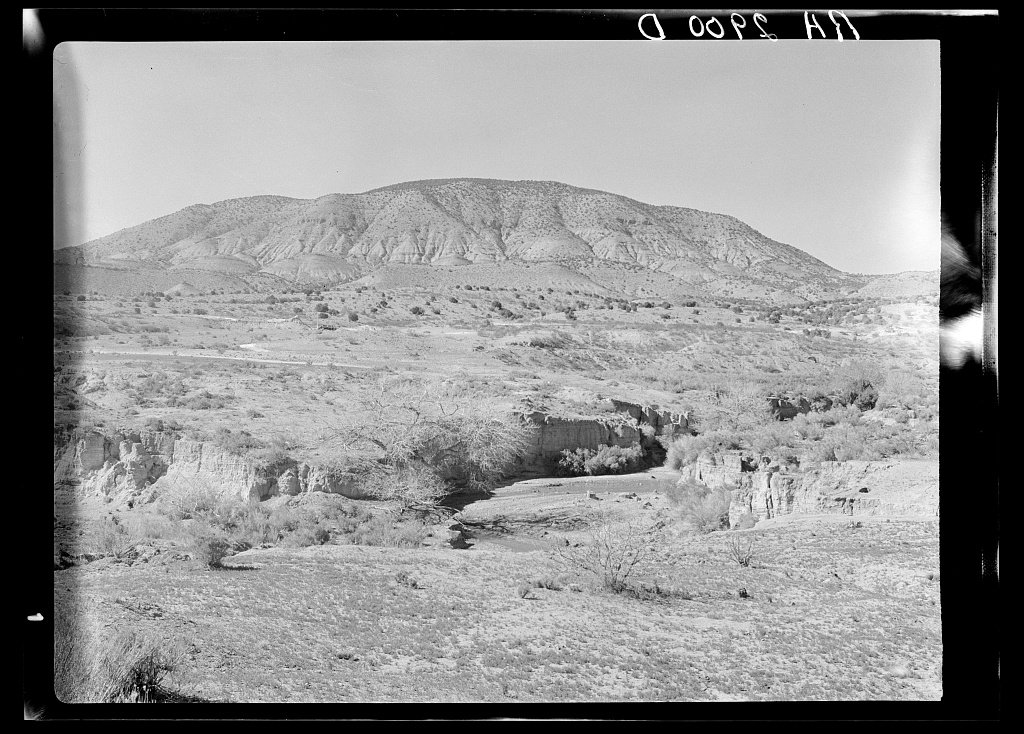
Canyon and mesa. Otero County, New Mexico (photograph, April 1936), Arthur Rothstein, Farm Security Administration–Office of War Information, Library of Congress. No known restrictions.