Watch The Kitchen Table
Illustration · An imagined table by a window at first light, set for a morning quiet time: a Bible, a writing pad and pencil, reading glasses and a cup of coffee. Not drawn from a photograph.

Akron · 1933–1935

Quiet time

Anne took her husband to the Oxford Group, and took up its morning habit for good.

“Be willing to live a day at a time, an hour at a time.”

Anne S., in her Oxford Group notebook · quoted in Mary C. Darrah, Sister Ignatia: Angel of Alcoholics Anonymous, 1992

Two and a half years

Early in 1933 the Oxford Group came to Akron. It was a Christian movement that aimed at absolute honesty, unselfishness, purity and love, and its members confessed their faults to one another, made restitution and listened for God’s guidance. Anne was the one who talked Dr. Bob into going. He was drawn, he wrote later, by the members’ “seeming poise, health, and happiness.”

They went every Thursday night to the West Hill group. “My good wife became deeply interested,” Dr. Bob wrote in 1939, “and it was her interest that sustained mine.” For two and a half years he read the Bible and the lives of the saints, prayed, and got drunk every night. (Secret drinker, in I Just Work Here, tells his side.) By 1934 and 1935, Good Oldtimers says, the family was getting by on very little, living “in a shambles of broken promises, given in all sincerity.”

Anne took up the Group’s ways for good, above all the morning quiet time. As Henrietta D., a wife Anne later telephoned every morning, described it, you sat by yourself with a pad and pencil, listened, and wrote down whatever came into your mind. She also began a notebook of readings and ideas, in 1933 as her daughter, Sue, remembered it, and kept it up until 1939. It survives in AA’s archives in New York.

Speaking up about her own troubles came harder. Once, when Anne talked at a meeting about a situation in the third person, Henrietta Seiberling, a friend in the Group, asked her to put it “in the first person singular.” Anne burst into tears. “First-person sharing was costly to her pride,” Henrietta said. “But she knew me well enough to know my motive, and she trusted it.”

In the spring of 1935 Henrietta set up a meeting with Bob in mind. “I warned Anne that I was going to have this meeting,” she remembered. “I didn’t tell her it was for Bob, but I said, ‘Come prepared to mean business.’” That night Dr. Bob told the group he was a secret drinker and couldn’t stop. A few weeks later, on a Saturday in May, Henrietta’s telephone rang.

Listen Quiet time About 1 minute

Then and later

From her corner to the book

In the summer of 1935 Bill W. lived with Bob and Anne and sat in on Anne’s mornings. Four years later a morning meditation went into the Big Book. Here they are side by side.

The 1935 column is from Bill W.’s and Dr. Bob’s memories, in The Language of the Heart (1988), AA Comes of Age (1957) and Pass It On (1984), from Henrietta D. in Dr. Bob and the Good Oldtimers (1980), from Bill’s 1952 memorial talk for Dr. Bob, as Mary C. Darrah quotes it (1992), and from Anne’s notebook, as Dick B. prints it (1994). The 1939 column is from the Big Book’s chapters “How It Works” and “Into Action.” Quotations are short excerpts.

The hour

Her living room, 1935

“Each morning there was devotion,” Bill remembered. Her notebook is firmer: “Not a day should be missed. The early morning hours are best.”

The Big Book, 1939

“On awakening let us think about the twenty-four hours ahead.”

Listening

Her living room, 1935

They would “huddle together in stillness, awaiting inspiration and guidance,” Bill wrote.

The Big Book, 1939

“Here we ask God for inspiration, an intuitive thought or a decision. We relax and take it easy.”

The reading

Her living room, 1935

Anne read aloud from the Bible in her chair in the corner. Dr. Bob named the parts they found “absolutely essential”: the Sermon on the Mount, the thirteenth chapter of First Corinthians and the Book of James. She often ended with James: “Faith without works is dead.”

The Big Book, 1939

No Bible by name. “There are many helpful books also,” and a priest, minister or rabbi can suggest some.

Pad and pencil

Her living room, 1935

Anne telephoned Henrietta D. every morning about her quiet time. You sat alone with a pad and pencil, Henrietta remembered, and “put down anything that came into your mind. Later in the day, it might come to you why.”

The Big Book, 1939

The morning meditation has no pad or pencil. The book saves the writing for the inventory, where resentments and fears go down on paper.

Who sat in

Her living room, 1935

Anne, Dr. Bob, Bill, and, as Bill put it later, “the two or three drunks who were hanging on.”

The Big Book, 1939

“If circumstances warrant, we ask our wives or friends to join us in morning meditation.”

One clause

The book kept the morning and the asking. It dropped the Bible’s name and the pad and pencil. And the wife who read to them in Akron became an invitation, extended if circumstances warrant.

For a closer look

Go deeper

How the Oxford Group came to Akron, what Anne wrote in her notebook, and what Dr. Bob wrote about her.

The Oxford Group
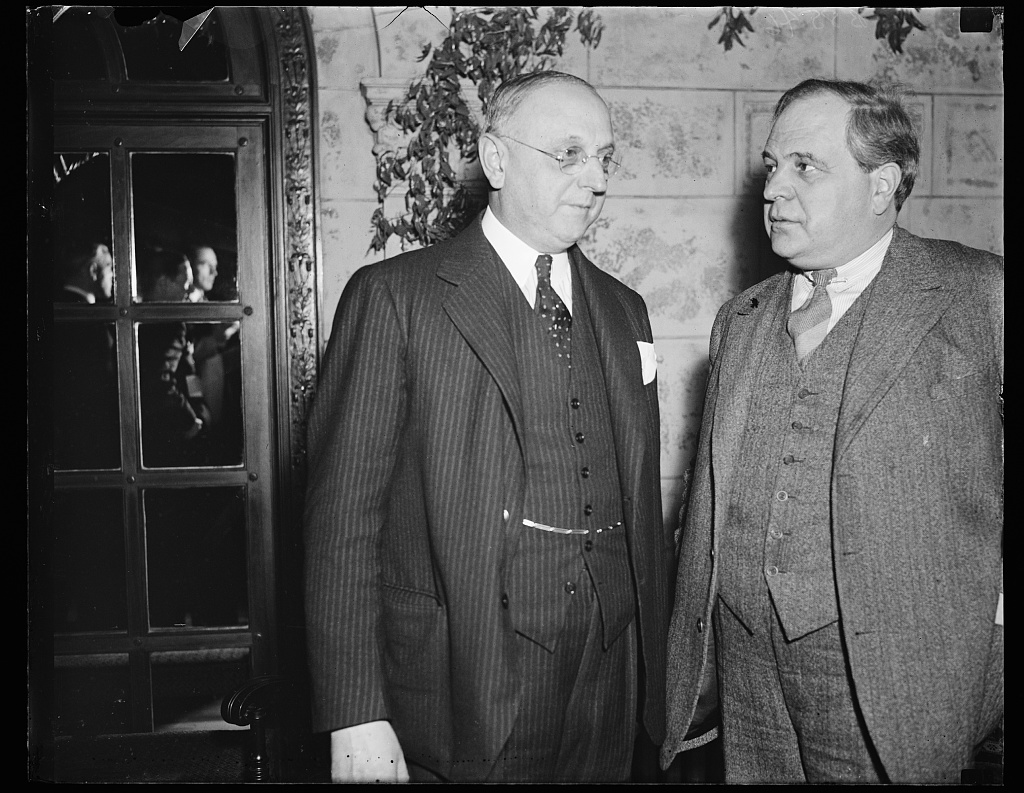
A press photograph of two men in suits talking; Frank Buchman, in round glasses, is at the left.
Frank Buchman (left), founder of the Oxford Group, with Carl J. Hambro, president of Norway’s parliament, in Washington on November 7, 1935.Harris & Ewing Collection, Library of Congress

Frank Buchman, a Lutheran minister from Pennsylvania, started the movement, which sought, in Good Oldtimers’ words, “to recapture the power of first-century Christianity in the modern world.” In 1938 he relaunched it as Moral Re-Armament. (Good Oldtimers says 1939, the year it was launched in the United States.)

It reached Akron through a rubber-company president whose son the Group had helped to sober up. In thanks, he invited about sixty of its people to town for a ten-day “house party,” by Good Oldtimers’ count. (Arthur S.’s timeline says about thirty, for a weekend.) Afterward small groups met around the city, in homes and at the Mayflower Hotel, never in a church. That suited Dr. Bob, who had sworn off churches as a boy.

Her notebook

Anne’s notebook mixes readings with her own notes on Oxford Group ideas: sharing, surrender, and the Group’s five C’s for changing a life, which were confidence, confession, conviction, conversion and continuance. On continuance she wrote: “Stay with the newly surrendered person until he grows up and becomes a life-changer. Laugh him out of his growing pains.” Once he is one, it goes on, “we need not fear for him,” because other people’s needs will drive him “back on God,” in Darrah’s printing, or “back to God,” in Dick B.’s.

Mary C. Darrah, Sister Ignatia’s biographer, read it in AA’s archives and found in it much of what AA would later practice, including some of its best advice on sponsorship. Once the house on Ardmore Avenue filled with drunks, Darrah writes, Anne read to them from the notebook as well as from the Bible.

In 1991, at Sue’s request, AA’s archives sent copies to her and to Dick B., an AA member writing about the movement’s Christian roots, and the next year he printed much of it in a book. The copy runs to sixty-four pages. Most of it is in Sue’s typing, done in 1937 or 1938 while she was at business college; a few parts are in Anne’s hand, and Sue believed some pages were missing.

Its advice is often plain. Thoughts can come from three places, it says, the subconscious, the devil and God: “Your job to be a good signal man and know the difference between red and green lights.” Dick B. found in its pages the ideas behind all twelve of AA’s Steps and thought it a likely source for them, though, he wrote, no AA history he had read showed that Bill W. ever read it.

The world’s finest women

When Dr. Bob wrote his story for the Big Book in 1939, he gave Anne a paragraph. It was her interest in the group, he wrote, that had kept his own going, and it was her faith and courage that had kept him alive at all.

Then he went on: “For some reason, we alcoholics seem to have the gift of picking out the world’s finest women. Why they should be subjected to the tortures we inflicted upon them, I cannot explain.”

Sources
  • Dr. Bob and the Good Oldtimers. AA World Services, 1980. Chapter V, “The alcoholic in the Oxford Group” (the movement; Anne persuades him; the West Hill group; Henrietta Seiberling on Anne; the meeting), and chapter VII, “A.A. number three arrives” (Henrietta D. on quiet time).
  • Alcoholics Anonymous (the Big Book), first edition. Works Publishing, 1939. Chapter 5, “How It Works” (the written inventory), chapter 6, “Into Action” (morning meditation), and Dr. Bob’s story, “The Doctor’s Nightmare.”
  • The Language of the Heart. AA Grapevine, 1988. Bill W., “Dr. Bob: A Tribute” (January 1951), first printed in the AA Grapevine.
  • Alcoholics Anonymous Comes of Age. Alcoholics Anonymous Publishing, 1957. “Recovery: The First Legacy.”
  • Pass It On. AA World Services, 1984. Chapter Seven (Dr. Bob on the Bible).
  • Mary C. Darrah, Sister Ignatia: Angel of Alcoholics Anonymous. Loyola University Press, 1992. Chapter 4, “Akron’s Magic Blend” (Anne’s Oxford Group notebook, in AA’s archives; Bill W.’s memorial talk for Dr. Bob, November 16, 1952). Quotations are from the scanned text, checked against the page images. Darrah dates their first Oxford Group meetings to 1932; Good Oldtimers and the house party put them in early 1933.
  • Dick B., Anne Smith’s Journal, 1933–1939: A.A.’s Principles of Success. Revised edition, Paradise Research Publications, 1994; first published in 1992. Chapter 1, “A Lady of Faith, Courage, and Love” (the notebook, its copies, Sue’s typing, and that no AA history shows Bill W. read it), and chapter 2, “The Elements of the Twelve Steps” (pages 4, 14 and 47 of the notebook, cited by the page numbers of AA’s copy). Quotations are from the scanned text.
  • Arthur S., A Narrative Timeline of AA History (the Oxford Group’s visit to Akron, January 1933).
  • Frank Buchman and Carl J. Hambro, Washington, November 7, 1935, Harris & Ewing Collection, Library of Congress. No known restrictions on publication.