Illustration · An empty subway car at night in the 1930s: a rattan bench, hanging straps, and a newspaper left on the seat. Not drawn from a photograph.
Towns Hospital, Akron and Clinton Street · 1934–1939
The voice on the subway
Sober, broke and sure God wanted him to take a paid job, he told his friends at the Tuesday meeting, and they said no.
“The group was right and I was wrong; the voice on the subway was not the voice of God.”
A houseful of drunks
Bill came out of Towns Hospital in December 1934 sober, and sure he could sober up every drunk in New York. He talked to them at Towns and at the Oxford Group’s Calvary Mission, and later admitted what was driving him: “one part of genuine spirituality and one part of my old desire to be a Number One man.” It didn’t work. “At the end of six months nobody had sobered up.” Then, in Akron in May 1935, he met Dr. Bob S. The film and the site’s other pieces tell the founding; the list beside this story points to them.
Back in Brooklyn, the Burnham house at 182 Clinton Street filled up with drunks who paid no board. Ebby moved in, for the first of several times. From the fall of 1935 there was a meeting in the parlor every Tuesday night. Lois worked at Loeser’s department store and did the cooking. “All of us were living rent-free, food-free, everything-free in Clinton Street, and Lois was doing all the work,” one of the men remembered. When Lois’s father died in September 1936, the mortgage company let them stay on for a small rent.
One day in 1937 Charlie Towns, who owned the hospital, called Bill into his office. He showed him how much money the place used to make, and offered him an office there as a lay therapist, with “a decent drawing account, and a very healthy slice of the profits.” Bill was broke and still owed money from his Wall Street days. On the subway back to Brooklyn, a line from the Bible kept running through his head: “The laborer is worthy of his hire.” By the time he got home, Pass It On says, “he was convinced that it was his divine destiny to become a paid therapist.”
It was meeting night. The sober members and their wives crowded into the parlor, and Bill told them the news. “I never shall forget their impassive faces and the steady gazes they focused on me,” he said later. Then one of them spoke for the rest. They knew how hard up he was, but Bill could never become a professional. “Why should we do for nothing what you’d be getting paid for? We’d all be drunk in no time.” Bill turned Charlie Towns down.
Later that year, in Akron, he and Dr. Bob counted everyone who seemed to have stayed sober in New York and Ohio. There were more than 40. “Bill, who turned 42 that year, was jobless,” Pass It On notes. Then came the Big Book. It was published in April 1939, and that same month Bill and Lois lost the house on Clinton Street.
ListenThe voice on the subwayAbout 1 minute
It’s 1937, on the subway home to Brooklyn. Bill W. has been sober for more than two years. He’s broke, and Lois is cooking for a houseful of drunks who pay no board.
That day Charlie Towns, who owns the hospital where Bill got sober, offered him an office, a steady income and a share of the profits to treat alcoholics there.
As the train rattles along, a line from the Bible keeps running through his head: the laborer is worthy of his hire. By the time he gets home, he’s sure it’s God’s will.
That night, at the weekly meeting, he tells the others. They stare back at him. Then one of them speaks for all. Bill can never be a professional. If he’s paid for what the rest of them do for nothing, they’ll all be drunk in no time.
Bill turns the offer down. The voice on the subway, he decided, was not the voice of God.
1937, side by side
The offer and the answer
What Charlie Towns offered Bill in his office, and what Bill’s friends said to him that night, paired on the same three questions.
All from Bill’s telling in AA Comes of Age (1957), in the talk on the second of AA’s three legacies, unity. Pass It On gives the member’s words a little differently; see Go deeper.
The offer
Charlie Towns, and the subway
The money
“I’ll give you an office, a decent drawing account, and a very healthy slice of the profits.”Charlie Towns, as Bill told it
Is it right?
“What I propose is perfectly ethical.”Charlie Towns
Whose voice?
“The laborer is worthy of his hire,”The line that ran through Bill’s head on the subway (Luke 10:7)
The answer
The Tuesday meeting
The money
“We know how hard up you are, Bill,” he said. “It bothers us a lot.”A member, speaking for the meeting, as Bill told it
Is it right?
“Sure, it’s ethical. But what we’ve got won’t run on ethics only; it has to be better.”The same member
Whose voice?
“Thus spoke the group conscience.”Bill, looking back
Never a professional
Bill counted the night among the first lessons of AA’s traditions: “A.A. cannot have a class of professional therapists.” Today it’s the Eighth Tradition. Both he and Lois, Pass It On says, remembered it as “an early example of the group conscience in action.”
For a closer look
Go deeper
How the two books tell the answer, the Oxford Group’s coolness and its apology, and what the houseful of drunks cost.
Two tellings of the answer
Bill told the story himself in 1955, and it was printed in AA Comes of Age in 1957. Pass It On told it again in 1984, and the member’s speech comes out differently. Only Bill’s telling has “Sure, it’s ethical.” Only Pass It On has the line about the leader: “Don’t you see that for you, our leader, to take money for passing on our magnificent message, while the rest of us try to do the same thing without pay, would soon discourage us all?”
They disagree about Lois, too. Bill remembered that in 1937 “Lois was still in the department store and her pay was just about all the money we had.” Pass It On says he had talked her into quitting her job at Loeser’s that March.
Both agree that she wasn’t swept away by the news. In Bill’s words, “She looked interested, but not as excited as I thought she should be.”
The Oxford Group cools
“I am heartily sorry and ashamed.”
The Rev. Sam Shoemaker, writing to Bill years later, as Pass It On quotes him.
Bill and Lois went to the Oxford Group’s meetings at Calvary Church in Manhattan from late 1934 until about 1937. Its leaders didn’t like his separate meetings for drunks at Clinton Street, and called his work “narrow and divisive.” Near the end of 1935 the alcoholics living at the group’s Calvary Mission were told not to go to them. “This not only hurt us but left us disappointed in the group’s leadership,” Lois remembered.
Sam Shoemaker, Calvary’s rector, broke with the Oxford Group himself in 1941. Later he wrote to Bill: “we were coached in the feeling that you were off on your own spur, trying to do something by yourself, and out of the mainstream of the work.” For his part in it, he said, “I am heartily sorry and ashamed.”
Bill and Lois had a theory, Pass It On says, that alcoholics felt unloved, so they would “love them into sobriety.” It rarely worked. One guest drank down a whiskey bottle full of Vermont maple syrup, a Christmas present, before he found out what it was. In the summer of 1936, while Bill and Lois were away, a man who had lived with them for nearly a year took his own life in the house. Bill later called it “killing people with kindness.”
One of the men who stayed there couldn’t remember any of the others sobering up while they lived at Clinton Street. Lois pointed out that many of them got sober later. By 1939 the Big Book was advising caution: “We seldom allow an alcoholic to live in our homes for long at a time.”
Sources
Pass It On. AA World Services, 1984. Chapters 6 to 9, quoting Bill’s recollections, Lois and the men who lived at Clinton Street.
Alcoholics Anonymous Comes of Age. AA World Services, 1957. “Unity: The Second Legacy,” Bill’s talk at St. Louis, 1955.
Alcoholics Anonymous. Works Publishing, 1939. “Working with Others.”
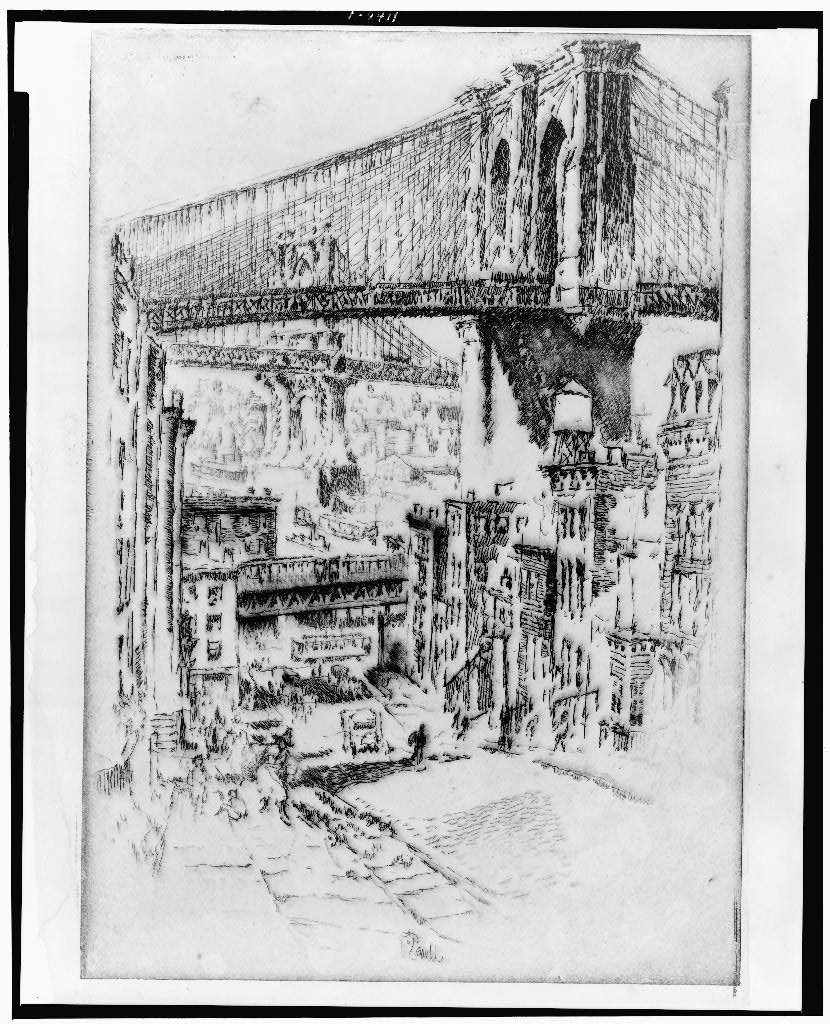
[The bridges from Brooklyn] (etching, 1921), Joseph Pennell, Pennell Collection, Library of Congress. No known restrictions on publication.