Watch The Kitchen Table
Illustration · An iron gate standing ajar at dawn, with the path beyond it lit gold. Not drawn from a photograph.

1966 and after

Legacy

His obituary never mentioned AA. Bill wrote that he had pushed the gate open.

“He had pushed ajar that great gate through which all in AA have since passed to find their freedom under God.”

Bill W., in the AA Grapevine, June 1966, reprinted in The Language of the Heart · quoted in Mel B., Ebby: The Man Who Sponsored Bill W., 1998

After

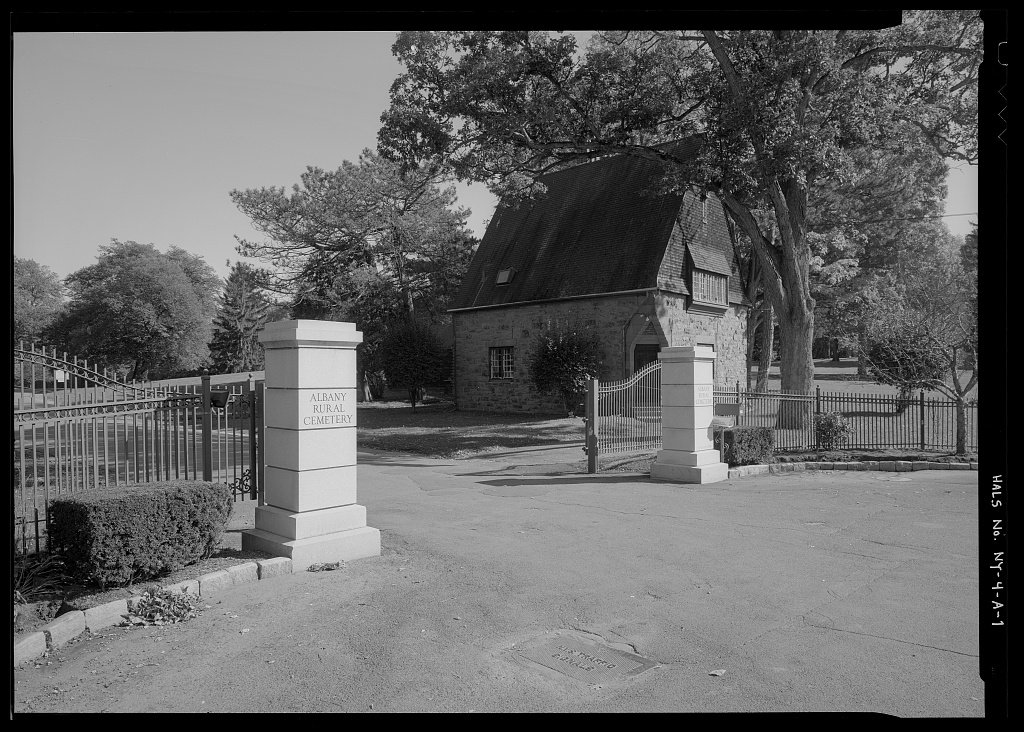
Bill and Lois were in Mexico when Ebby died. They came back for the wake and the funeral, which a few friends and family attended. He was buried beside his brother Ken in the family plot at Albany Rural Cemetery, just north of the city, near his parents and his grandfather.

The stone and iron south entrance of a large rural cemetery, with trees beyond.
The south entrance to Albany Rural Cemetery, photographed for the Historic American Landscapes Survey in 2007. Ebby is buried in his family’s plot there.Photo: Clayton B. Fraser, Historic American Landscapes Survey, Library of Congress

The newspaper obituary was short. It called him the brother of a former mayor of Albany and said he had done clerical work in Texas and New York. It said nothing about AA.

In June, Bill wrote about him in the AA Grapevine. Ebby, he wrote, had brought him “the gift of grace because he could reach me at depth through the language of the heart.” The tribute is reprinted in The Language of the Heart, the collection of Bill’s Grapevine writings.

From Texas, thirty-eight members of the group in Highlands signed a letter to Margaret and Mickey McPike, thanking them for “the loving care you gave Ebby in the last years of his life.” He “would be the last person who would want a lot of fanfare, praise, or belated recognition,” they wrote.

His part lives on in “Bill’s Story,” the first chapter of the Big Book. It never names him. It tells of “an old school friend” who telephoned, came over, and stood in the doorway “fresh-skinned and glowing.”

Listen Legacy About 1 minute

Five answers

Why did he slip?

He carried the message to Bill and couldn’t keep it himself. The people who knew him explained it in different ways.

Each card gives one person’s view, in their own words where they were recorded. None of them is the whole answer.

Lois W.

Bill’s wife

“Or maybe he couldn’t want it with his whole soul, because he was too ill.”

Her first thought was that Bill had wanted sobriety with “his whole soul,” and Ebby perhaps only to stay out of trouble.

Lois Remembers (1979), quoted in Mel B., Ebby: The Man Who Sponsored Bill W., ch. 10.

Bob D.

A friend in Texas

“…Ebby held a deep resentment for Bill, Dr. Bob, et al., because he felt he was more the founder of what became AA than anyone else.”

He went on: “This could really account for his repeated ‘slips’ in the program.”

Letter to Nell Wing, August 28, 1981, quoted in Mel B., Ebby: The Man Who Sponsored Bill W., ch. 10.

Friends

The Wilsons too

“…in part he is doing this in the ancient hope of finding the right girl and the right job…”

His friends thought he believed he needed the right woman and the right job to stay sober, Mel B. writes. Bill wrote this line about Ebby in Texas in 1954.

Bill W. to Russ R., July 27, 1954; Mel B., Ebby: The Man Who Sponsored Bill W., chs. 8 and 10.

Tom B.

His boss in Dallas

“He kind of thought the world owed him a living, to a certain extent.”

Tom also doubted that Ebby ever “bought the AA program 100 percent.”

Recollections, 1981, quoted in Mel B., Ebby: The Man Who Sponsored Bill W., chs. 10 and 11.

Ebby

In 1961

“I’ve often thought about it, for many years, when I started drinking again, why I couldn’t recapture that feeling I had then.”

He meant the feeling that came over him in the summer of 1934, when he couldn’t bring himself to drink the ale in the cellar. He called it his “pink cloud.”

Quoted in Mel B., Ebby: The Man Who Sponsored Bill W., ch. 6.

Taking his inventory

Mel B. warns that explaining Ebby’s slips this way is “taking his inventory,” something AA members try not to do. His last word on it: “Whatever troubles Ebby had, he carried the right message to the right person at the right time.”

For a closer look

Go deeper

Bill’s tribute, what became of the three men who came to Manchester, and others who carried the message and couldn’t keep it.

The language of the heart

Bill’s tribute ran in the Grapevine three months after Ebby’s death. It is reprinted in The Language of the Heart, the Grapevine’s 1988 collection of everything Bill wrote for the magazine, and it’s worth reading whole there.

Mel B. quotes only its closing lines. In them Bill goes back to the kitchen table: Ebby had been able to bring him “the gift of grace,” and “had pushed ajar that great gate through which all in AA have since passed to find their freedom under God.”

The three who came to Manchester

Three Oxford Group men helped Ebby in the summer of 1934; their story is in 3 · The ale in the cellar.

Rowland H., who stood up for him in court and took him to New York, stayed with the Oxford Group for the rest of his life. He died in 1945.

Shep C., the stockbroker, became a colonel in the Second World War and later a high executive of a company in Milwaukee.

Cebra G., the judge’s son, moved to France and lived there until his death in 1979. In 1953, in Paris, he heard that Ebby was in trouble and started the chain that took him to Texas.

Others like him

Ebby wasn’t the only one. In AA Comes of Age, Bill remembered Paddy, who started AA in Boston: “Its founder could never get sober himself and he finally died of alcoholism.” Slip after slip, Paddy came back to carry the message, and he left behind “a great group and a triple-A rating for valor.”

Mel B. ends his book with the people who keep trying: “we should give special applause to the person who has trouble and is making it back into the world of sobriety.”

Sources
  • Mel B., Ebby: The Man Who Sponsored Bill W. Hazelden, 1998. Chapters 6, 8 and 10–13, quoting Bill W.’s Grapevine tribute of June 1966, Lois Remembers, and the letters and recollections of Bob D., Tom B. and the Highlands, Texas, group.
  • Bill W., The Language of the Heart. AA Grapevine, 1988. Bill’s tribute to Ebby, from the Grapevine of June 1966.
  • Alcoholics Anonymous Comes of Age. AA World Services, 1957. “Unity: The Second Legacy.”
  • Alcoholics Anonymous. Works Publishing, 1939. “Bill’s Story.”
  • Albany Rural Cemetery, south entrance, photograph by Clayton B. Fraser, 2007. Historic American Landscapes Survey, Library of Congress. No known restrictions.