Illustration · A tall window in an old hospital ward at dusk, early in 1938: an empty chair pulled up to face it, and beyond the glass the river and the city, with its lights coming on. Not drawn from a photograph.
New York, Bellevue and Greenwich · 1937–1938
The glass box
Home from London, she drank her way through a year in New York, saw eight doctors, and spent about six months on a hospital ward before a psychiatrist told her that people like her couldn’t drink at all.
“You know, people like you can’t drink at all.” “Look, I don’t like people who don’t drink!”
The valley of the shadow
Her mother put her straight into a hospital, then went home to Chicago. When Marty came out, she moved in with her sister Chris, who shared a two-room apartment in New York with a divorced friend and the friend’s small son. 1937 would be what Marty called her “valley of the shadow.” Old friends who didn’t know welcomed her home with drinks and parties. Two weeks after she landed she ran into her ex-husband, John, and he became a drinking companion for the year.
She held jobs for a while, at a travel company and selling photo murals on commission, and lost them. In her early thirties she looked as if she were in her fifties. Then there was no work at all. By then, drinking in cheap Second Avenue bars, she had learned, as she put it, “that a woman needs to finance only that first drink. The rest I cadged like an expert.” At a bar on the Bowery the old Irish bartender would stand her a drink when she was broke. One night he asked her to a drinking party, and she told him she wouldn’t fit in. “Shure, ye’ll fit. Anyone can look at ye an see a drinkin’ woman.” “That hurt.”
She broke five pairs of glasses falling down areaways, and blackouts could last ten days. Chris, at the end of her patience, told her to go. Marty moved from friend to friend, and lay in bed for days with the shakes. She felt as if she were in a glass box, where she could see and be seen but couldn’t reach anyone: the “most ghastly feeling” imaginable. She was sure she was going insane.
After a week in Doctors Hospital she tried the country, with friends in Stockbridge, Massachusetts. She hid bottles behind the books and under the bushes. Her host told her she was using her willpower to drink, and should use it not to. Alcoholics, she said later, are “people who have lots of will power but use it in the wrong way for the wrong purpose.” In November she wrote to an old friend, Leopold Mannes, setting out the choices she had left. One of them was the state asylum.
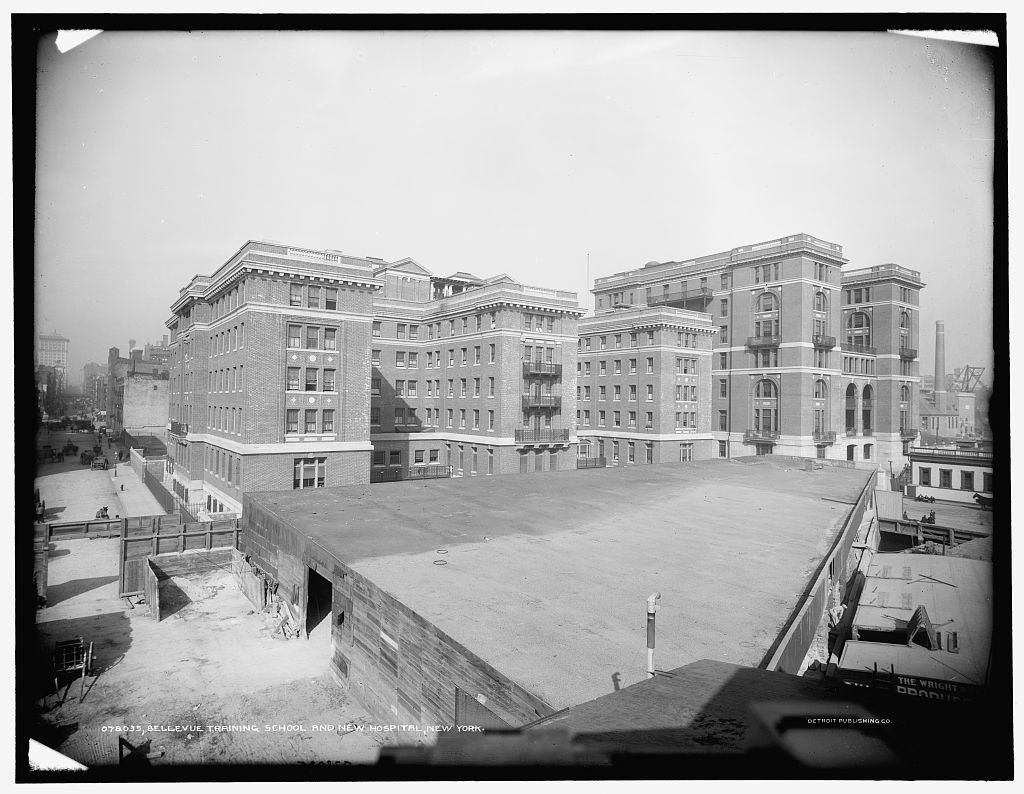
A neighbor in Stockbridge, an heiress whose drinking was even worse than hers, gave her a Christmas present: an appointment with Dr. Robert Foster Kennedy, head of neurology at Bellevue, New York’s huge city hospital. Marty had been sober for six weeks. He was the eighth doctor she had seen that year. On January 2, 1938, he took her onto his ward, thirty-four beds in the old part of the hospital. Her clothes were taken away, and there was no way to get a drink.
Image to comeBellevue Hospital, New York, 1910–1920
She stayed about six months, sober and getting little treatment. Whenever Kennedy asked if she was ready to leave, she panicked and said no. She sat at a window and watched the people outside, and longed to reach them: “You’re lost. You’re lost. You’re in a vacuum. You’re nothing.” A young psychiatrist decided she needed long-term care in a hospital, and Kennedy looked for one that would take a charity patient. At the end of June 1938 she walked into Blythewood, a private sanitarium in Greenwich, Connecticut, sober, with one suitcase of secondhand clothes.
ListenThe glass boxAbout 1 minute
It’s 1937, in New York. Marty M. is drinking around the clock. She cadges drinks in Second Avenue bars, and a Bowery bartender tells her that anyone can see she’s a drinking woman.
She feels as if she’s inside a glass box. She can see people, and they can see her, but she can’t reach anyone.
She sees more than half a dozen psychiatrists. They find nothing wrong with her mind, and each one says he doesn’t know what to do with people like you.
In January 1938 she goes into a ward at Bellevue, where she can’t get a drink, and stays about six months, sitting by a window.
Then a psychiatrist from a sanitarium in Greenwich tells her that people like her can’t drink at all.
She tells him she doesn’t like people who don’t drink.
One doctor after another
What the doctors said
From London to Bellevue, here is what the people she went to for help told her, and what came of it.
From her biographers’ account, which draws on her talks and letters. Most of her doctors aren’t named.
London · 1932–1936
Her London doctors
They told her she wasn’t crazy. The best they could offer was an anxiety neurosis or a character disorder. Some proposed a mental hospital; others told her to take a holiday and cut down for a while. Years later, some of them admitted, “We just didn’t know what to do with people like you.”
Two rest cures in the country, and more drinking.
Brown and Brown, chapter 9
New York · 1937
More than half a dozen psychiatrists
None could find anything wrong with her mind, and none would take her on. Each told her he didn’t know what to do with “people like you.” She hated the phrase. It didn’t say what was wrong with her, so it offered no way to treat it.
She went on drinking, and looking.
Brown and Brown, chapter 11
New York · 1937
William Seabrook
Not a doctor but a writer, and an old drinking companion, whose book Asylum she had read in Scotland. Sober for the moment, he told her to look for a private psychiatric hospital that would take her as a charity patient.
She looked into two sanitariums that might take her free.
Brown and Brown, chapters 10 and 11
New York · December 1937
Dr. Robert Foster Kennedy
First: “the trouble with you, Marty, is you need a job.” Then, after a full physical that found nothing seriously wrong: “people like you have one chance in a hundred of recovering from uncontrolled drinking. You may be that one person.”
January 2, 1938: a bed on his ward at Bellevue.
Brown and Brown, chapter 11
Bellevue · 1938
Kennedy, on the ward
“You know, Marty, you’ve not yet made a decision not to drink anymore. When you make that decision, you will become whole.” A young psychiatrist who talked with her several times said she needed long-term care in a hospital.
Kennedy went looking for a place that would take a charity patient.
Brown and Brown, chapter 11
Bellevue · 1938
Dr. Harry Tiebout
The medical director of Blythewood, a private sanitarium in Greenwich, Connecticut, who came to Bellevue each week to see possible patients. He told her that people like her couldn’t drink at all. She told him she didn’t like people who didn’t drink.
He took her anyway, free. She arrived at the end of June 1938.
None of them could tell her what she had, and at Blythewood, for months, no one could either. She would often say later: “It’s terrible to have a disease and not know what it is, and just be called ‘people like you.’”
For a closer look
Go deeper
The book that sent her home, the ward at Bellevue, and the friend who stood by her.
Asylum
William Seabrook was a popular writer of sensational stories, and one of the crowd Marty had drunk with on the Riviera. In 1935 he published Asylum, about his stay in a mental hospital outside New York, the Westchester Division of New York Hospital. He came out, he believed, able to drink normally.
She found the book in the village library in Scotland and read it over and over. Back in New York, as she told it in her Big Book story, she went through the telephone book every night, her sister told her, looking for his name, meaning to ask him to get her into the hospital he had written about.
When she found him he was sober, and he told her to look for a hospital that would take her free. He didn’t stay sober himself. He drank again, and died in 1945.
Thirty-four beds
“I found that plenty of blue blood ran in the test tubes there.”
Marty M., on Bellevue, as her biographers quote her.
Bellevue was the city’s hospital, serving New York’s poor. All Marty knew about it, she said, was “that was where they took people they picked up off the streets.” She found people from her own circle there too, and she was grateful later for the good care she got.
Kennedy’s neurological ward, in the old nineteenth-century part of the hospital, had thirty-four beds. Several of the women had alcoholic neuritis, nerve damage from drinking, and two of them, in wheelchairs, were paralyzed from the waist down. They frightened her, but she was still sure her own trouble was insanity.
Patients didn’t usually stay long. The nurses and social workers knew she didn’t belong there and tried more than once to have her discharged. Kennedy overruled them, and sent her to his own dentist.
Leopold Mannes
He was a pianist from a family of musicians and, with a school friend, Leopold Godowsky Jr., the inventor of Kodachrome color film. He and Marty had been close since the late 1920s, and he stayed her friend for life.
In November 1937 she wrote to him from Stockbridge, setting out five choices: two private sanitariums that might take her free, the state asylum, an outpatient clinic in New York she couldn’t pay for, or staying on with friends whose plans didn’t include her. He wrote back from Europe against the asylum, and offered what help he could.
At Blythewood, though she was a charity patient, he sent her money. “I’m back of you to the limit—at least to my limit—and that goes a lot further than October—or than any definite date in sight.”
Sources
Sally Brown and David R. Brown, A Biography of Mrs. Marty Mann. Hazelden, 2001. Chapters 8–12. Its unattributed quotes of her come from fifty-one tapes of her talks or from her writings; it quotes Leopold Mannes’s letters to her from the archives of the National Council on Alcoholism and Drug Dependence.
“Women Suffer Too,” in Alcoholics Anonymous (the Big Book), second edition, 1955; quoted from the fourth edition, 2001.