Illustration · A big assembly tent on a lawn in the Berkshire hills on a June evening in 1936, its front rolled up on rows of chairs facing a platform and a radio microphone, with a colony of small tents beyond. Not drawn from a photograph.
Thousands came to the Berkshires for the Group’s national assembly, Bill and Lois among them, and that August Buchman gave an interview he never lived down.
“A house party was a cross between a convention and a retreat.”
America Awake
By 1936 the Oxford Group was, as Pass It On puts it, at the height of its popularity. That spring Buchman called a National Assembly at Stockbridge, in the Berkshire hills of western Massachusetts, under the title “America Awake.” It ran from May 29 to June 8.
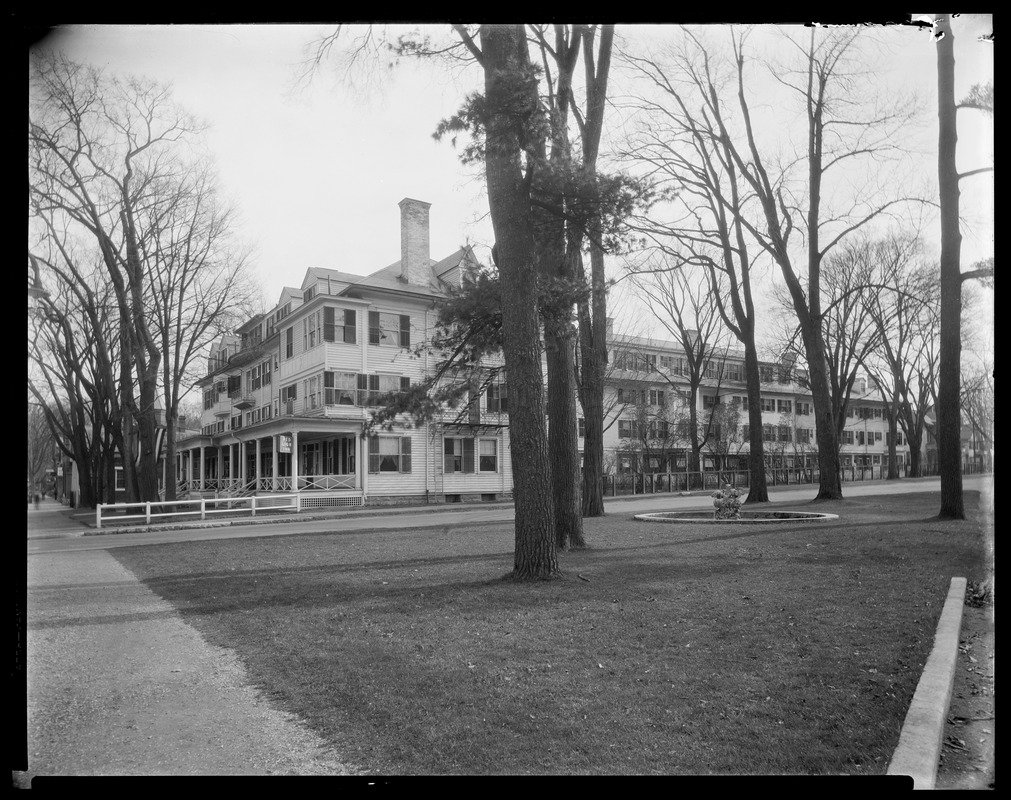
TIME counted a team of 800 Groupers “from all over the world,” with some 2,000 paying guests behind them. They stayed at the Red Lion Inn and Heaton Hall, both owned by the local congressman, or in a tent colony for $1.50, and they met in an assembly tent “which had done circus duty.” Clara Ford, Henry Ford’s wife, arrived in a private railway car. The New York Times ran a column a day, Lean writes, and the newsreel companies reckoned their films of it reached 40 million people.
On Memorial Day the Groupers paraded with the town’s American Legion post, carrying the flags of 48 states and 18 nations, “including Germany’s swastika.” When people objected, TIME reported, the answer was that this was how the Oxford Group brought nations together.
Bill W. and Lois W. came in June. Bill had been to his first house party, in Richmond, Virginia, the December before, and the two of them went to two more that winter. They met Buchman, but when Bill was asked later whether he had known him, he said he had only “shook hands” with him.
In August Buchman was in Berlin for the Olympic Games. A German friend got him invited to a lunch with Heinrich Himmler, head of the SS, through whom he hoped to reach Hitler. By his colleagues’ account Himmler gave a talk on Nazism and left, and Buchman never met Hitler.
He sailed for New York on August 19 and met the press at Calvary House. The reporter from the New York World-Telegram, an afternoon paper, William A. H. Birnie, came late and asked for an interview of his own, with Buchman’s colleagues in the room. On August 25 it ran across the paper’s front page: “I thank heaven for a man like Adolf Hitler, who built a front line of defense against the anti-Christ of Communism.” In the same paragraphs he was quoted as saying, “Of course, I don’t condone everything the Nazis do. Anti-Semitism? Bad, naturally. I suppose Hitler sees a Karl Marx in every Jew.”
TIME took it up two weeks later and printed more of it, and a Methodist weekly answered, “God-controlled Fascism! The terms are mutually exclusive.” The theologian Reinhold Niebuhr wrote an essay called “Hitler and Buchman.” Buchman refused, Lean writes, to comment further, believing it would only endanger his friends in Germany, and he never denounced Hitler in public. In 1943 TIME was still calling the words “never retracted.”
ListenStockbridgeAbout 1 minute
It’s the end of May 1936, in Stockbridge, a small town in the Berkshire hills of Massachusetts. The Oxford Group has called a national assembly. Its people stay at the Red Lion Inn and in a colony of tents, and the meetings are held in a tent that once housed a circus. Newsreels film it, and the New York Times sends a man to write a column a day. Bill W. and Lois come in June.
In August Frank Buchman is in Berlin for the Olympic Games. When he gets back to New York, a young reporter asks him about Germany. The next afternoon his answer is on the front page: “I thank heaven for a man like Adolf Hitler, who built a front line of defense against the anti-Christ of Communism.”
A colleague who was in the room calls it a throwaway line. Buchman never explains it in public, and never takes it back. It follows him for the rest of his life.
Compare the readings
What did he mean?
The words are on the record; what they meant has been argued ever since. Here are six readings, from the papers that week to Buchman’s biographer, in the order they were set down.
Quotations are short excerpts, shown side by side for comparison. The interview’s words are as TIME printed them in 1936 and Garth Lean reprinted them in 1985; the two texts differ a little (see Go deeper).
1936
The papers
That week and the next
“Or Mussolini. Or any dictator. Through such a man God could control a nation overnight and solve every last, bewildering problem.”
The World-Telegram’s headline: “Hitler or any Fascist leader controlled by God could cure all ills of world, Buchman believes.” A Methodist weekly answered, “God-controlled Fascism! The terms are mutually exclusive.”
Buchman as quoted in TIME, September 7, 1936, which printed more of the interview than the opening lines; the headline as Lean reprints it.
1940
Buchman, in private
4 years after
“Hitler fooled me. I thought it would be a bulwark against Communism.”
In public he never commented again, and never denounced Hitler.
Noted by his secretary in a diary, March 7, 1940, as words Buchman said to a group of friends; quoted in Lean (1985).
1964
A reviewer
28 years after · Buchman had died in 1961
“Top People thought well of Hitler at the time; so did Frank.”
He found that Tom Driberg, in a hostile book on the movement, “would plainly like to tar Frank with the Nazi brush.”
John Mander, reviewing Driberg’s The Mystery of Moral Re-Armament in The Spectator, September 18, 1964.
c.1966
The reporter
About 30 years after
“My memory of our talk is that he was not endorsing or condemning Hitler.”
He was always “proud of his interviewee,” he said, for not haggling over the story as printed.
William A. H. Birnie, by then a senior editor of the Reader’s Digest, to a visitor; quoted in Lean (1985).
1984
AA’s biography of Bill W.
48 years after
“…most discussions of the incident, even by Buchman’s critics, have since vindicated him…”
It calls the article one “charging that he was pro-Nazi,” and says it “brought the group into public controversy.”
Pass It On (1984), AA’s biography of Bill W.
1985
A colleague in the room
49 years after
“It was a throw-away line. No eulogy of Hitler at all.”
Garrett Stearly remembered Buchman being asked about Germany and saying Hitler had been a bulwark against Communism there, “and you could at least thank heaven for that.”
In Garth Lean’s Frank Buchman: A Life (1985), a sympathetic biography by one of Buchman’s followers.
Never taken back
Nobody disputes that the sentence was printed, or that Buchman never took it back in public. By 1941, Pass It On says, his remarks were one reason Bill W. wanted AA’s story told without the Group in it.
For a closer look
Go deeper
How many came to Stockbridge; which words the paper printed; and what happened in Berlin.
How many came
Image to comeThe Red Lion Inn, Stockbridge, about 1925–1933
The accounts don’t agree on the size of the crowd:
1936.TIME, during the assembly: a team of 800 Groupers and “some 2,000 paying guests.”
1984.Pass It On: “10,000 people flocked to the Berkshires.”
1985. Lean: “five thousand people came.”
Neither book says how it counted. TIME’s is the only figure set down at the time. Good Housekeeping wrote the assembly up that October as “The Oxford Group Challenges America.”
Which words?
The interview survives in more than one text, and they differ. Lean reprints the headline and the opening paragraphs, through “surrendered to the control of God,” then sums up the rest, twenty-two more paragraphs. TIME printed lines Lean doesn’t quote, among them “Or Mussolini. Or any dictator,” and a sentence saying the world’s problems “could be solved through a God-controlled Fascist dictatorship.”Pass It On condenses them: “Through such a man, God could control a nation and solve every problem.”
Small words differ too: Buchman’s London barber told him Hitler had “saved Europe” in Lean’s text and “saved all Europe” in TIME’s. The phrase most often repeated since, “Thank God for Hitler,” Lean writes, “was not Buchman’s nor printed in the article.” Lean’s note dates the article August 25, 1936; some later timelines give the 26th.
Berlin
“Here are devilish forces at work. We can’t do anything here.”
Buchman, just after meeting Himmler in 1936, as his colleagues remembered it.
Buchman’s hope that summer, Lean writes, was to reach Hitler through Himmler. A Danish journalist in Berlin, Jacob Kronika, remembered their talk as “a complete fiasco,” and Buchman never tried again. Within three months the Gestapo issued its first warning against the Oxford Group, calling it “a new and dangerous opponent of National Socialism.” A later report, circulated in 1942, called it “the pace-maker of Anglo-American diplomacy,” and that year the German army forbade its officers to have anything to do with it.
Some of the Group’s German members, Lean says, “joined the active opposition.” Of the Nazi documents’ wilder claims about the Group he wrote: “The exaggeration is considerable, but the hostility undoubted.” Lean was a follower of Buchman, and these are the records his defenders point to.
Sources
“Religion: Groupers in Stockbridge,” TIME, June 15, 1936. At time.com.
“Religion: God-Controlled Dictatorship,” TIME, September 7, 1936. At time.com.
“Buchman’s Kampf,” TIME, January 18, 1943. At time.com.
Garth Lean, Frank Buchman: A Life. Constable, 1985. Chapters 21, “Hitler and the Gestapo Clamp-Down” (Berlin, the interview, what followed and the Gestapo’s reports), and 22, “Awakening Democracies” (Stockbridge). Free to read at frankbuchman.info.
Lois W., Lois Remembers. Al-Anon Family Groups, 1979. Chapter 9, “The Group Conscience” (the house parties at Stockbridge, the Poconos and West Point).
Pass It On. AA World Services, 1984. Chapters 9 (Stockbridge and the interview) and 14 (keeping the Group out of AA’s story in 1941).
Twelve Steps and Twelve Traditions. AA Grapevine and Alcoholics Anonymous Publishing, 1953. Tradition Ten, for the note on what AA kept.
John Mander, “Frank’s Men,” The Spectator, September 18, 1964, a review of Tom Driberg, The Mystery of Moral Re-Armament (1964). At The Spectator Archive.
Reinhold Niebuhr, “Hitler and Buchman,” The Christian Century, October 7, 1936; reprinted in his Christianity and Power Politics. Scribner, 1940.
“The Oxford Group. A National Assembly,” program, Stockbridge, May 29–June 8, 1936. Frederic Lawrence and Kenaston Twitchell Oxford Group Manuscript Collection, Princeton Theological Seminary Library (the dates).
Red Lion Inn: exterior, Stockbridge, about 1925–1933, photograph by Edwin Hale Lincoln. Lenox Library Association, via Digital Commonwealth. No known copyright restrictions.