Watch The Kitchen Table
Illustration · An office desk in Waterbury, Connecticut, on a December evening in 1945: a round-chart recording instrument, a telephone, a letter on a blotter and a lit desk lamp, with factory chimneys and falling snow through the window. Not drawn from a photograph.

New Mexico, New York and Waterbury · 1936–1945

Fifty times

A relapse after AA had begun, a story Jung told in London, two sons lost in the war, and a desk in Waterbury.

“…when he had repeated his story twenty, or it may have been fifty, times, he got sick of it and took to drink again.”

Dr. Carl Jung, of an Oxford Group alcoholic, to the Guild of Pastoral Psychology in London, April 5, 1939 · from his Collected Works, vol. 18, as quoted in Cora Finch, Stellar Fire, 2006–07

The only dark spot

In 1936 Rowland H. joined the Episcopal Church. That summer he was at the ranch in New Mexico, and in August, Richard Dubiel found in his brother Pierre’s papers, he had “a serious drinking bout.” The family paid to bring him back east, and that month he was in a hospital in New York. One letter proposed asking his friend Shep C. of the Oxford Group to help.

By then Bill W. had been sober for nearly two years and Dr. Bob for more than one, and the drunks they had found still met inside the Oxford Group. On August 30 Jung himself landed in New York for a lecture tour. Nobody knows whether he and Rowland met.

Rowland went back to work. He left the brokerage in 1938 for Lockwood Greene, an engineering firm, and by 1940, Yale’s record says, he was executive vice-president of The Bristol Company of Waterbury, Connecticut, a maker of precision instruments. He was a vestryman of Calvary Church in New York, Sam Shoemaker’s parish and the Oxford Group’s American home, and of St. Peter’s-by-the-Sea at Narragansett. When the Group renamed itself Moral Re-Armament in 1938, he stayed with it. Lois W. remembered him as “an ardent Oxford Grouper until his death.” He never joined AA.

The war came into the family. His eldest son, Rowland, Princeton class of 1941, was killed in service in April 1944. Peter, who had been at Harvard, was lost in action at Okinawa in March 1945.

On December 20, 1945, Rowland died of a coronary occlusion in Waterbury, at his office desk. He was 64. He was buried at Peace Dale, and Helen died the next October. Nobody has found a record of his drinking after 1936. His daughter-in-law said in 1995 that, as far as the family knew, he never took another drink after he got sober.

Listen Fifty times About 1 minute

Compare the accounts

The same April

In April 1939, the month the Big Book came out in New York, Jung told a London audience about an alcoholic he had turned away. He never said who the man was. Cora Finch thinks he was likely Rowland. Here are the two stories side by side.

From Jung’s remarks to the Guild of Pastoral Psychology, London, April 5, 1939, printed in his Collected Works, vol. 18, as Cora Finch quotes them, and “There Is a Solution” in Alcoholics Anonymous, 1939. Quotations are short excerpts.

1939

Jung, in London

April 5 · no name

“A hysterical alcoholic was cured by this Group movement, and they used him as a sort of model…”

When he drank again, Jung said, the Group sent him to a doctor, and Jung refused the case: “I sent the man back to these people…”

Jung, The Symbolic Life, Collected Works, vol. 18, paragraphs 620–21, as Cora Finch quotes it.

1939

The Big Book

April · no name, no year

“But this man still lives, and is a free man.”

After his treatment he was drunk in a short time, the book says, and the doctor called him “utterly hopeless,” then told him of the rare alcoholics who had had “vital spiritual experiences.”

“There Is a Solution,” in Alcoholics Anonymous (1939), the Big Book. Bill W. wrote the chapter.

Where they differ

The man

  • Jung“A hysterical alcoholic”
  • Book“A certain American business man”

What came first

  • JungThe Group cured him and toured him round Europe to tell it.
  • BookA celebrated physician in Europe treated him.

Then

  • JungHe tired of telling it and drank, and the Group sent him to the doctor.
  • BookHe drank again and went back to the doctor.

The doctor

  • JungRefused him and sent him back to the Group.
  • BookCalled him hopeless, except for a vital spiritual experience.

How it ends

  • JungSent back to the Group: “…you don’t suppose that I can do it better than Jesus?”
  • BookSober and free.

If it was Rowland

Jung’s story runs the other way from AA’s: the Group first, then the drink, then the doctor. If his alcoholic was Rowland, Cora Finch argues, the talk AA remembers may have come in 1936, after the Group’s tour of Europe, perhaps that August, when Jung was in America. Either way, the Big Book’s free man had been drunk less than three years before it went to press.

For a closer look

Go deeper

Jung’s second telling, the instrument company in Waterbury, and two sons.

Jung’s second telling

In a later talk, also printed in volume 18 of his Collected Works, Jung told what seems to be the same story. This time the alcoholic had come under “the laudable influence of a certain religious movement” and was held up as a witness to divine grace, and when he drank again the movement decided he was “pathological” and put him in a clinic.

Cora Finch found the London remarks through Dr. Robert Winer, a psychiatrist and Jungian analyst, who pointed out that Jung had told his own version of a patient who was very likely Rowland. Jung’s point, she writes, is less about hopelessness than about consistency: if a man’s faith has cured him once, that is where he should look again.

The Bristol Company
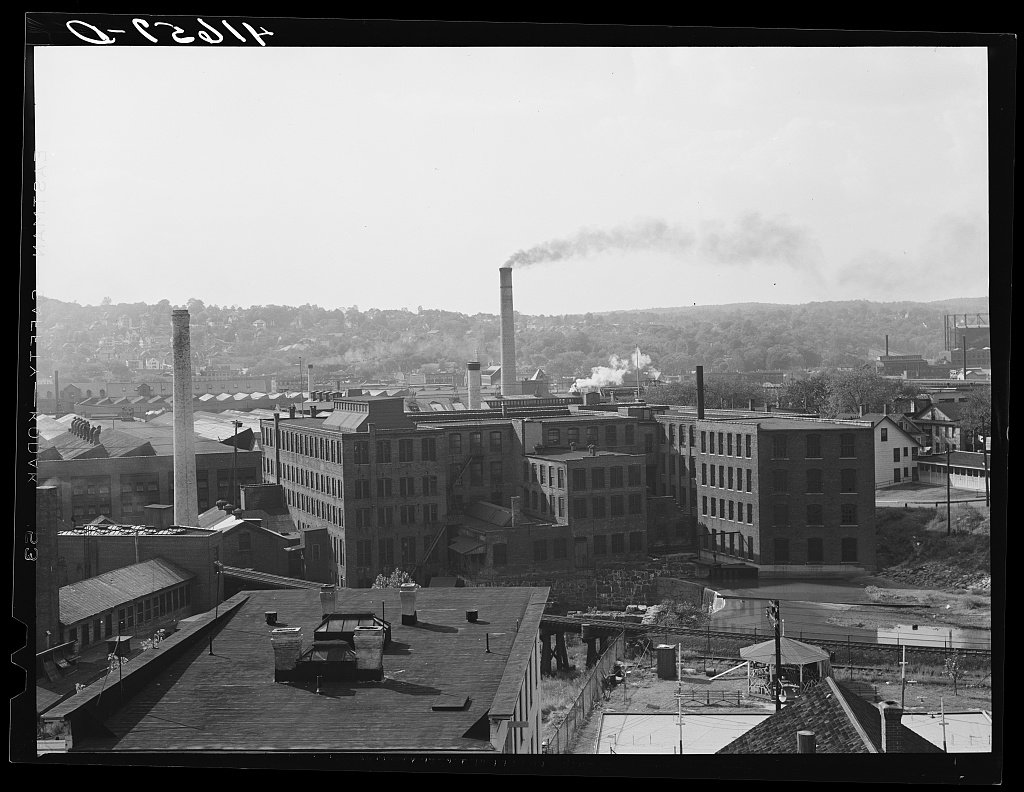
Brick factory buildings and smokestacks crowded along a valley in an industrial city.
Factories and mills in Waterbury, Connecticut, in September 1940, the year Rowland went to work there. The picture doesn’t name the Bristol plant.Photo: Jack Delano, Farm Security Administration, Library of Congress

Waterbury was a factory city, and The Bristol Company made precision instruments there. Rowland had run chemical and coke businesses, a woolen mill and a pottery, and in 1940–41 he also worked in New York as an independent consultant in engineering and industrial management.

When he died, the Scientific Apparatus Makers of America sent the family a memorial. It is in his papers at the Rhode Island Historical Society.

Two sons

Rowland Gibson, called Rowley in the family, was born in 1917, went to Princeton with the class of 1941 and died in service on April 29, 1944. Peter Hamilton, born in 1918, was at Harvard from 1937 to 1941. He died on March 27, 1945, at Okinawa, and was still listed as missing in action when his father died.

Mel B., citing a book called The Little Giants, wrote that Peter was a Navy pilot, killed chasing a Japanese plane through flak from American guns. Ron R., in his Grapevine profile, tells it a little differently. A snapshot of Rowland with Peter in a naval officer’s uniform, in front of the house at Peace Dale, survives from 1943 or 1944.

Of the four children only Charles, the youngest, lived long. He died in 1995.
Sources
  • Cora Finch, “Remarks from Dr. Jung,” in “Stellar Fire: Carl Jung, a New England Family, and the Risks of Anecdote”, stellarfire.org, 2006–07 (archived copy), quoting C. G. Jung, The Symbolic Life, Collected Works, vol. 18, paragraphs 620–21 and page 242; and Richard Dubiel, The Road to Fellowship, page 162.
  • Richard M. Dubiel, The Road to Fellowship. iUniverse, 2004, notes to chapter 4, as quoted in AA History Lovers message 4355, 2007; not yet checked against the book.
  • Alcoholics Anonymous. Works Publishing, 1939. “There Is a Solution.”
  • Lois Remembers. Al-Anon Family Groups, 1979. Chapter 8, “Damn Your Old Meetings.”
  • Obituary Record of Graduates of Yale University, 1945–1946 (January 1947), the entry for Rowland Hazard, class of 1903.
  • Rhode Island Historical Society, Rowland Hazard III Papers, finding aid, on his church, his children and the memorial.
  • Ron R., “What We Were Like,” AA Grapevine, May 1995, and his notes in AA History Lovers message 2741, 2005, quoting a telephone conversation with Edith Hazard, May 7, 1995.
  • Mel B., in AA History Lovers message 3904, 2006, on Peter Hazard and the snapshot.
  • Factory and mills in the industrial city of Waterbury, Connecticut (photograph, September 1940), Jack Delano, Farm Security Administration–Office of War Information, Library of Congress. No known restrictions.