Watch The Kitchen Table
Illustration · The patio of a ranch house in southern New Mexico at dusk in the summer of 1935: a ring of ten empty chairs around a small table with a lamp and a Bible, under a porch roof on log beams. Not drawn from a photograph.

Vermont, New York and New Mexico · 1934–1935

Honesty with yourself

A drunk in a Vermont courtroom, a meeting on a ranch-house patio, and a team bound for Geneva.

“…honesty with yourself, honesty with your fellow man, honesty with God.”

Ebby T., on what Rowland H. taught him, in his 1954 recollections · Mel B., Ebby, 1998

A project

In the summer of 1934 Rowland H. was in Vermont, doing what the Oxford Group asked of its members and carrying its message to others. One day he picked up Cebra G., a young Bennington lawyer who had walked out of his father’s office after a fight and was heading south on foot. Rowland drove him to the house of an Oxford Group friend, Philip Marshall Brown, and the two of them all but promised him, as Cebra remembered it, that if he took up the Group’s principles, “this burden of drink” would be lifted from him. Cebra joined.

Later that summer Cebra was at Rowland’s with Shep C., a New York stockbroker in the Group. Swimming in the pool, they talked about doing some missionary work, and Cebra thought of Ebby T., an old friend from Manchester who was drinking himself into trouble. Rowland didn’t go on the first call. Then Ebby was arrested and brought before Cebra’s father in Bennington, and Rowland told the court he would be responsible for him. My Sponsor, Ebby, 3 · The ale in the cellar, tells it from Ebby’s side.

Rowland did more than speak up in court. “The first day he came to see me, he helped me clean up the place,” Ebby remembered. Ebby shut up his family’s house in Manchester, spent a week or so with Rowland at Shaftsbury, and that fall Rowland drove him to New York, where he stayed with Shep and then at the Calvary Mission.

On their trips together, Ebby said, they got up early and, “before we even had any coffee,” sat down to clear their minds and listen for the day’s guidance. Rowland pressed on him the Group’s four absolutes, honesty, purity, unselfishness and love, and honesty most of all. “These things he followed himself,” Ebby said.

In November Ebby carried what he had been given to Bill W., at the kitchen table in Brooklyn. That month the Winnipeg Free Press found Rowland at a gathering of the Group in Winnipeg, telling it that business was “awakening to the spiritual needs of the times.”

In 1935 he went back into business, as a general partner in a New York brokerage, Tailer & Robinson. In February he gave his testimony in Frederick, Maryland. In the summer he took Ebby, sober and living at the Calvary Mission, on a two-week trip to the ranch in New Mexico, where ten or twelve neighbors came to a Group meeting on his patio. His letters that summer with H. Alexander Smith, which survive among his papers at Princeton, show that his mentors in the Group thought him ready for a bigger part, Cora Finch writes, and in September he went to Europe with the Group’s international team, bound for Geneva.

Listen Honesty with yourself About 1 minute

Follow the messenger

Fourteen months

From Vermont in the summer of 1934 to Geneva in the fall of 1935, here is where Ebby’s memories, the newspapers and the Group’s own letters put Rowland as he carried its message.

From Mel B.’s Ebby (Ebby’s 1954 recollections), Cora Finch’s account (the Winnipeg Free Press, November 28, 1934; the Daily News, Frederick, February 23, 1935; H. Alexander Smith’s papers), and Sam Shoemaker’s history of Calvary Church, 1936. Quotations are short excerpts.

Where Rowland H. carried the message, 1934 to 1935A map of the United States east of the Rockies and southern Canada, with numbered pins at Shaftsbury, Vermont (1), New York (2), Winnipeg (3), Frederick, Maryland (4) and La Luz, New Mexico (5), and an arrow leaving the east coast across the Atlantic toward Geneva (6).CANADAUNITED STATESGeneva6to GenevaAtlanticShaftsbury, Vermont1New York2Winnipeg3Frederick, Maryland4La Luz, New Mexico5
Outlines from the U.S. Census Bureau and Natural Earth, as on the Where page.
  1. 1

    Vermont · summer 1934

    He gives Cebra G. a ride and talks him into the Group, then stands up for Ebby T. before Cebra’s father and takes him home to Shaftsbury.

  2. 2

    New York · fall 1934

    He drives Ebby down to New York and the Calvary Mission. By the end of November Ebby has been to Bill W.’s kitchen table.

  3. 3

    Winnipeg · November 1934

    At a gathering of the Group he says his job is to see that there is “a place for God in all director’s meetings.”

  4. 4

    Frederick, Maryland · February 1935

    He tells a Group meeting he had made “a fizzle” of his life because he had “left God out of it.”

  5. 5

    La Luz, New Mexico · summer 1935

    With Ebby along, ten or twelve neighbors from the farms and ranches come to a Group meeting on his patio.

  6. 6

    Geneva · September 1935

    He goes to Europe with the Group’s international team, six hundred strong at Geneva, where the League of Nations is meeting.

From patient to messenger

Through most of 1933 and 1934, Richard Dubiel found, Rowland could barely run his own affairs. Within a year he was one of the Group’s traveling witnesses, from Winnipeg to Geneva.

For a closer look

Go deeper

Who went to the magistrate, a meeting on the patio, and the Group at Geneva.

The magistrate

Ebby remembered Rowland alone speaking up for him in court. Cebra’s own story, which Bill W. recorded in 1954, has two men. As the historian Jared Lobdell sums up the tape, Cebra and Rowland went to Cebra’s father beforehand, explained the Oxford Group to him and asked him not to send Ebby away, and the father apparently said he would hold both of them responsible.

Lois W. told it with two men as well: Cebra and Rowland “convinced the judge that they could help Ebby through the Oxford Group.” Researchers who talked with Cebra’s brother, Van, in 2006 came away with differing accounts of who sat on the bench and whether there was a formal hearing at all, and the court in Bennington has no record of it. Two men, or one?, in My Sponsor, Ebby, sets the AA accounts side by side.

Ten or twelve neighbors

In the summer of 1935 Rowland took Ebby, sober now for about a year, “down through Texas and New Mexico,” and they spent a couple of weeks at the ranch.

Ebby told the story at the Texas state AA conference in 1954. Rowland held a small Oxford Group meeting on the patio of his ranch house, and ten or twelve people came from the neighboring farms and ranches. Ebby didn’t think they sobered anybody up or converted anybody. Mel B. thinks it was probably the first meeting of its kind in the Southwest.

Later, after he had gone to New York, Ebby went back to Vermont with other Group members and spoke at a junior college, two churches and a town meeting hall, all in two afternoons and two nights.

Geneva
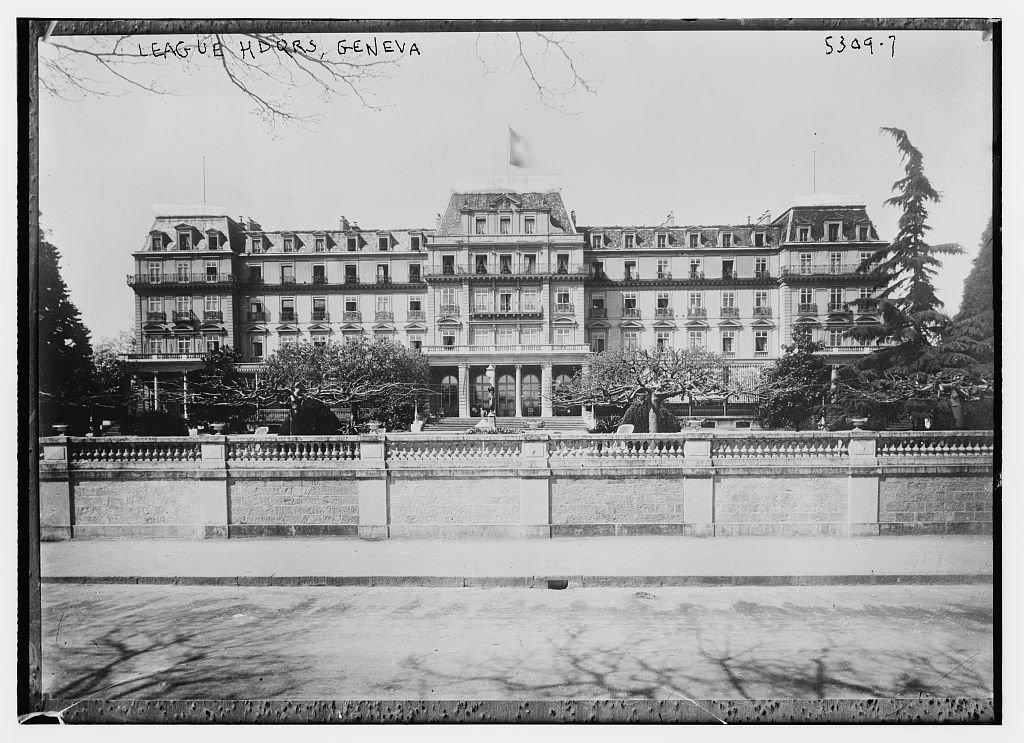
A large hotel-like building with rows of balconies on the lake front at Geneva, with trees and a promenade in front.
The League of Nations’ headquarters on the lake front at Geneva, about 1920.Photo: Bain News Service, Library of Congress

In the fall of 1935, Sam Shoemaker wrote the next year, “a team of six hundred came together in Geneva, from thirty nations,” while the League of Nations was in session. They stayed in hotels across the city, met every day for training and guidance, and held public meetings in the evenings in the Salle de la Réformation, the hall where the League had first sat. The president of the League’s Assembly invited its members to a luncheon to hear the Group’s message.

Rowland was on that team. Four years later Jung told a story about an alcoholic the Oxford Group “sent him all round Europe.” Part 7 tells it.

Sources
  • Mel B., Ebby: The Man Who Sponsored Bill W. Hazelden, 1998. Chapter 6, quoting Ebby’s 1954 recollections and his 1961 talk in San Jose, and Cebra G.’s 1954 recollections.
  • Cora Finch, “Stellar Fire: Carl Jung, a New England Family, and the Risks of Anecdote”, stellarfire.org, 2006–07 (archived copy). Chapter 6, quoting the Daily News, Frederick, Maryland, February 23, 1935; and “Remarks from Dr. Jung” and “Loose Ends,” on the international team (from H. Alexander Smith’s papers, Princeton) and quoting the Winnipeg Free Press, November 28, 1934.
  • Jared Lobdell, Culture, Alcohol and Society Quarterly 3, no. 2 (January–March 2007), Brown University Library, on Cebra G.’s 1954 conversation with Bill W.
  • AA History Lovers, messages 5243 to 5251, 2008, on Cebra’s father, his brother Van and the Bennington court.
  • Lois Remembers. Al-Anon Family Groups, 1979. Chapter 8, “Damn Your Old Meetings.”
  • Samuel M. Shoemaker Jr., Calvary Church Yesterday and Today: A Centennial History. New York, 1936 (the Oxford Group at Geneva, pp. 277–278). Free at the Internet Archive.
  • Obituary Record of Graduates of Yale University, 1945–1946 (January 1947), the entry for Rowland Hazard, class of 1903.
  • League Hdqrs. Geneva (photograph, about 1915–1920), Bain News Service, George Grantham Bain Collection, Library of Congress. No known restrictions on publication.