1953
Twelve Steps and Twelve Traditions
The Traditions were “first published in 1946 and later confirmed at A.A.’s First International Convention, held at Cleveland in 1950.”
Confirmed
The foreword
The convention in Cleveland voted for the Traditions, but who would keep them once the founders were gone?
“In the future we could no longer depend upon the authority and influence of our pioneering people for A.A. unity.”
By the late 1940s AA’s services were in the hands of the Alcoholic Foundation, a small board of trustees in New York. “The Trustees had authority over our services; A.A. itself had no authority,” Bill W. said. “Not one A.A. in a thousand could name even half of them.” The link between the groups and New York was Dr. Bob, the office staff and Bill, and Dr. Bob was ill: after an operation in 1947, he learned in 1948 that he had cancer. What would become of AA “when its old-timers and founders had gone”?
Bill wanted a conference of delegates elected by the groups, to which the trustees would answer. From 1946 he pressed the nine trustees with memos. One ended with a sentence he later called astonishing: “When I was in law school, the largest book I studied was the one on Trusts. … it was mostly a long and melancholy account of the malfeasances and misfeasances of boards of trustees.” Most trustees were against it, and so were many of the oldest members in New York, Akron, Cleveland and Chicago (The quarter mile tells how the fight went for Bill). In February 1949 he wrote to Dr. Bob, “The stark fact is that you and I still head Alcoholics Anonymous.” In March Dr. Bob, very ill, wrote that he did “not have the feeling that this is a particularly guided thing to do now.”
Meanwhile a member in Houston proposed, in June 1949, an international convention. Bill liked the idea, but said no body yet existed that could speak for AA and approve it, and suggested not calling it “international.” Cleveland was chosen, 35 miles from Dr. Bob’s home in Akron, close enough for him to attend. The convention opened on Friday, July 28, 1950, with about 3,000 people at $1.50 a head. Meetings were held at the Carter, Hollenden and Cleveland hotels, with one in the Music Hall.
Saturday afternoon was set aside for the Traditions, now in their short form. In Bill’s account, several speakers presented them, and he summed them up and “asked the Convention for final approval”; a recording, he said, kept “the Convention’s unanimous voice of consent.” A member’s report, printed in Pass It On, adds that Bill asked for discussion and none came. Then “he suggested as there were no comments, we should adopt them officially for A.A. by standing vote. Everyone in the crowded room rose.” Bill declared them “adopted as part of our A.A. doctrine.” The next afternoon Dr. Bob gave his last talk (Legacy, in I Just Work Here, tells it).
A vote still left the Traditions without a keeper. Later that year, when Bill told Dr. Bob the trustees would probably agree to a conference, Dr. Bob gave his consent, and the trustees endorsed the plan. Bill set it out in a pamphlet, The Third Legacy, and the office shipped 50,000 copies to the groups. The first General Service Conference met in New York in April 1951.
It’s a Saturday afternoon in July 1950, at AA’s first International Convention, in Cleveland. About three thousand people have come.
For four years Bill W. has been pushing the Twelve Traditions, and arguing with AA’s trustees about who will look after AA when he and Dr. Bob are gone. Dr. Bob is dying of cancer. Cleveland was picked because it’s close to his home in Akron.
Now the Traditions are put to the convention. As one member remembered it, Bill asks for discussion, and nobody says a word. So he suggests a standing vote, and everyone in the crowded room rises.
The Traditions belong to the members now. Who will keep them is the next question. Bill’s answer is a conference of delegates elected by the groups. It meets for the first time the following April.
Compare the accounts
Six books, five of them AA’s and one Al-Anon’s, tell what the convention did with the Traditions. They use different words for it, and only one describes a standing vote.
In the order they were published.
1953
The Traditions were “first published in 1946 and later confirmed at A.A.’s First International Convention, held at Cleveland in 1950.”
Confirmed
The foreword
1955
They “had become so widely accepted by 1950 that they were confirmed by our first International Conference held at Cleveland.”
Confirmed
The foreword to the second edition. Only this account calls it a conference.
1957
Several speakers presented the Traditions; Bill “summed them up and asked the Convention for final approval.” A recording kept “the Convention’s unanimous voice of consent.”
Approved
Bill W., “Service: The Third Legacy.” Elsewhere the same book says “confirmation” and “adopted unanimously.”
1979
Lois W. writes that they got back from Europe that July, in time for Cleveland, “where the Twelve Traditions were adopted.”
Adopted
Chapter 15
1980
Its list of dates has Dr. Bob joining “other A.A.’s in approving Twelve Traditions.” Its text says only then did he agree “to confirm the Twelve Traditions.”
Approved, confirmed
Chapter XXVII and “Some significant dates”
1984
A member reported that Bill asked for discussion and got none, then suggested they “adopt them officially for A.A. by standing vote. Everyone in the crowded room rose.”
A standing vote
Chapter 20
For a closer look
Why Bill didn’t want the word “international”; who chaired the trustees; and an Akron oldtimer who changed his mind.
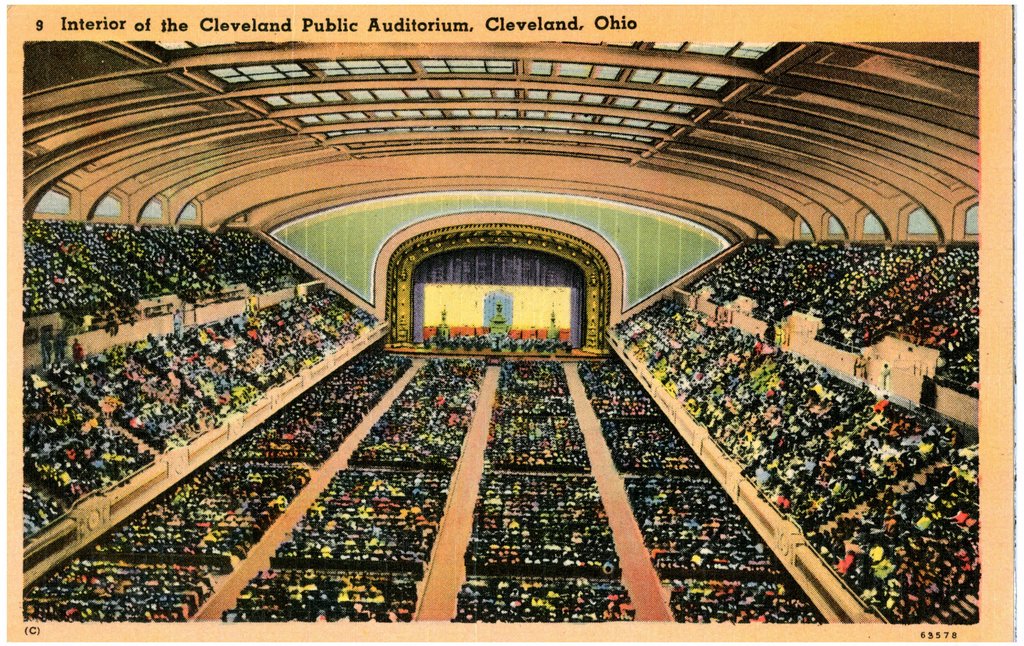
The idea of an international convention came from a Houston member in June 1949. Bill backed it without promising Houston, and warned that calling it “international” might look like an endorsement from headquarters. Cleveland, a big AA center, could be picked without upsetting other parts of the country.
Bill called it AA’s “coming of age” party. The name stuck to St. Louis instead, five years later. The Big Book’s foreword of 1955 calls the Cleveland meeting “our first International Conference.”
Bill credited the conference to Bernard Smith, a nonalcoholic trustee, a lawyer and businessman, whom he called “the architect of the General Service Conference.” As chairman of the trustees’ committee on the conference, he put the question to it after only two meetings. The committee said, “Let’s give the Conference a try.”
The books differ on his title. Pass It On calls him “the chairman” in those years and says he alone backed Bill. Bill’s own history calls Leonard V. Harrison the “longtime Chairman of the Foundation,” says Harrison made Bernard Smith chairman of the committee, and says Bill had “Mr. Bernard Smith and one or two of the others” on his side.
They differ on the cost too. Lois W. remembered four trustees offering to resign in 1948; Pass It On counts three resignations over the four years.
Bill D., AA number three, “the man on the bed” in Akron in 1935 (855 Ardmore tells it), was against the Traditions and the conference. Ed B. remembered him before the meeting: “Ed, I’m going to that meeting, and I’m just going to tell Bill what I think of him!”
Bill explained what the Traditions and the conference were for, and that he and Dr. Bob would not be around forever. Over lunch afterward Bill D. said, “Ed, you know, he’s got something.” He went on to be Ohio’s first delegate to the conference in 1951.
Not everyone came round. Chuck C. of Los Angeles recalled that members there were no more interested in the plan “than they were in a pig learning to speak.”