Illustration · The counter of a treatment room at a Keeley Institute in the 1890s, a few minutes before noon, with bottles of the “Double Chloride of Gold” cure, two hypodermic syringes and the clock. Not drawn from a photograph.
A century before AA, doctors called drunkenness a disease and built hospitals for it, and by 1920 nearly all of them were gone.
“This odious disease (for by that name it should be called)…”
Asylums and a gold cure
In the 1780s Dr. Benjamin Rush of Philadelphia, a signer of the Declaration of Independence, published a pamphlet on what strong drink did to the body and to society. It went through edition after edition, and in the enlarged ones, the first of them undated and the sixth printed in 1811, he called drunkenness a disease outright. It came back, he wrote, “like the paroxysms of many diseases, at certain periods,” and it resembled “certain hereditary, family, and contagious diseases.” In London in 1804 Thomas Trotter, once a physician to Britain’s Channel Fleet, published a whole book on it: “In medical language, I consider drunkenness, strictly speaking, to be a disease.”
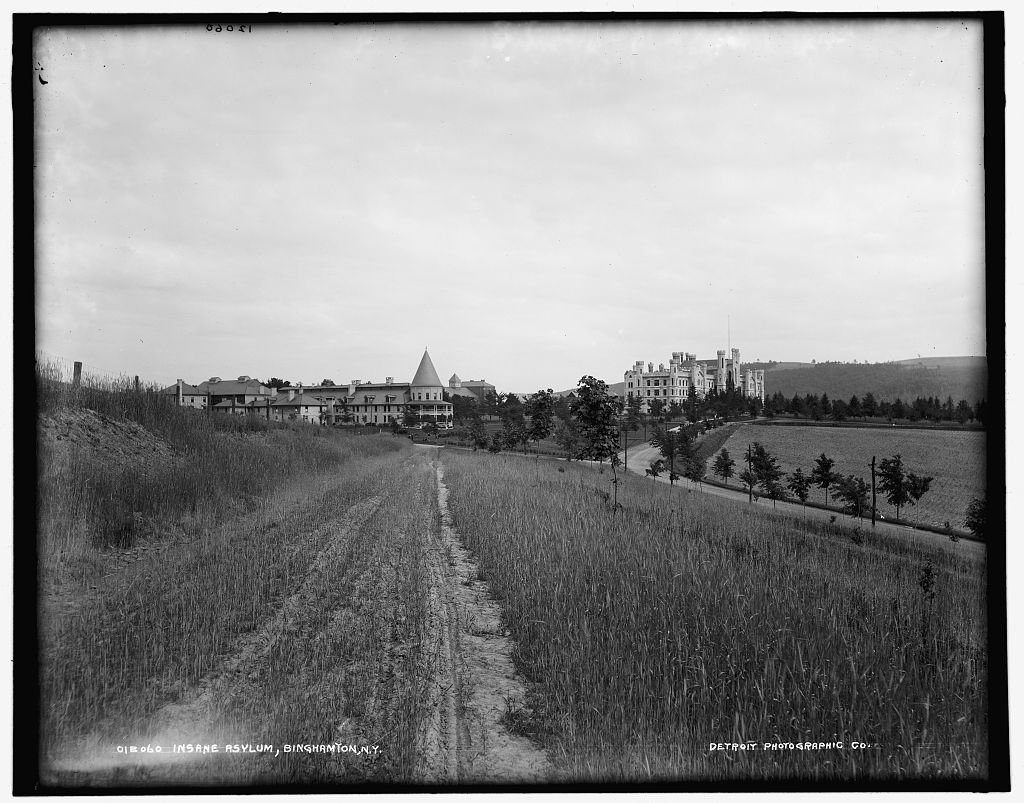
Then came buildings. In 1854 New York chartered an asylum for inebriates, the project of J. Edward Turner. Its cornerstone was laid at Binghamton in 1858, and it took its first patient on July 3, 1864, in what its landmark nomination calls “the first hospital in the United States that was designed and constructed for the treatment of alcoholism as a disease.” That September a fire gutted its north wing. Turner was forced to resign in 1867, and in 1879 the state turned the building into an asylum for the chronic insane.
Image to comeThe asylum at Binghamton, about 1890–1901
The old inebriate asylum at Binghamton, by then a state asylum for the insane, in a Detroit Publishing Co. photograph from between 1890 and 1901.Detroit Publishing Co., Library of Congress
In November 1870 the doctors running the new inebriate homes and asylums met in New York and formed the American Association for the Cure of Inebriates. From 1876 or 1877, by different accounts, it published a medical journal of its own, the Journal of Inebriety.
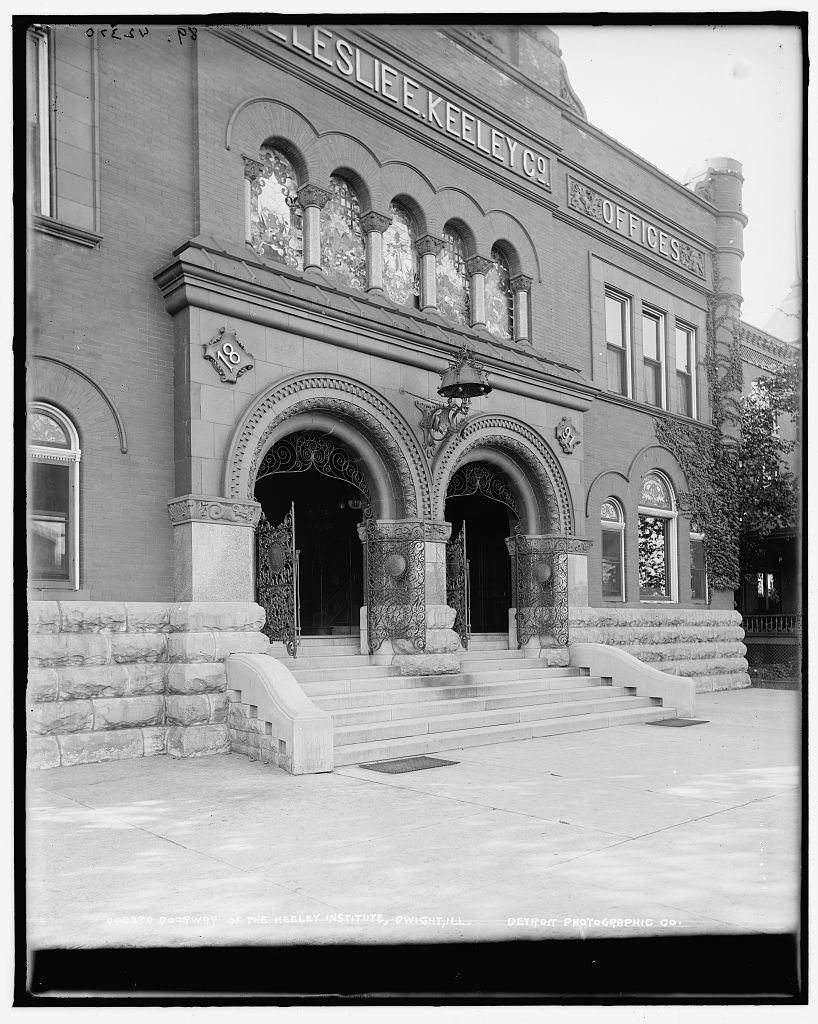
The best-known cure came from Dwight, Illinois, where Dr. Leslie Keeley opened his first institute in 1879. He sold a “Double Chloride of Gold” cure, given by needle and by tonic, and franchised, in the historian William White’s words, “more than 120 Keeley Institutes in North America and Europe.” In the early 1890s a graduate of the cure counted “about 1,000 self-convicted drunkards” in a village of some 2,000 people.
Then it fell away. The temperance movement turned on the saloon and the liquor trade, and the drunkard, the historian Harry Levine writes, “came to be viewed less and less as a victim, and more and more as simply a pest and menace.” By 1920, when national Prohibition began, most of the asylums and cure institutes had closed. (Inebriate ward, in The Little Doctor, follows one young doctor among New York’s drunks from 1896.)
ListenBy that nameAbout 1 minute
In the 1780s, a Philadelphia doctor named Benjamin Rush wrote a pamphlet about strong drink. In later editions he went further. Drunkenness, he wrote, was an odious disease, and by that name it should be called.
Within a century the idea had buildings. New York chartered an asylum for inebriates, and in 1864 it took its first patient, on a hill above Binghamton. Doctors who ran such places met in 1870 and declared that intemperance is a disease. In a small Illinois town, a gold cure drew men by the thousand, to line up for an injection four times a day.
By 1920, nearly all of it was gone. Most of the asylums and cure institutes had closed, and the drunkard was a nuisance again, not a patient.
In their words
Called a disease
Four voices from the century before AA, each calling drunkenness a disease, and what each asked for.
Quoted from the printings named on each card, read in scanned copies at the National Library of Medicine and the Wellcome Collection.
1811
Benjamin Rush
“This odious disease (for by that name it should be called)…”
He also urged laws for fewer taverns, duties on spirits, “a mark of disgrace” for anyone convicted of drunkenness, and trustees to manage a habitual drunkard’s property.
An Inquiry into the Effects of Ardent Spirits, sixth edition (New York, 1811); also in an undated fourth edition, which the National Library of Medicine dates 1805, and the eighth (1814).
1854
J. Edward Turner
“…a disease which is constitutional and often hereditary.”
That year New York chartered his asylum for inebriates. It opened at Binghamton ten years later.
His address to the asylum’s trustees, December 20, 1854, in his History of the First Inebriate Asylum in the World (1888).
1870
Asylum doctors
“Intemperance is a disease.”
The eighth of their principles: “The law should recognize intemperance as a disease, and provide other means for its management, than fines, station-houses and jails.”
Declaration of Principles of the American Association for the Cure of Inebriates, New York, November 1870, in its Minutes (1871).
1893
A Keeley graduate
“…the men with whom it has become a disease, the same as consumption is a disease…”
At Dwight every patient had to be “in line” four times a day, noon among the hours, “to receive the hypodermic injection of powerful medicine in the upper left arm.”
C. S. Clark, The Perfect Keeley Cure, third edition (Milwaukee, 1893).
Nearly all gone
By 1870 doctors had called it a disease, perhaps inherited, to be treated in hospitals rather than jails. Of the institutions built on the idea, William White writes, “few survived the first two decades of the twentieth century.”
For a closer look
Go deeper
When Rush and Trotter said what they’re quoted as saying, how the gold cure worked, and why the first era of treatment ended.
Which words, and when?
“…I consider drunkenness, strictly speaking, to be a disease.”
Thomas Trotter, 1804.
AA’s archives newsletter, Markings, says Rush’s paper came out in 1782 and that he “called alcoholism ‘a progressive and odious disease.’” Library catalogs date its first printing, in Philadelphia, to 1784 or 1786. The words “odious disease” are in the enlarged editions: an undated fourth, which the National Library of Medicine dates 1805, and the sixth, printed in 1811. The Boston printing of 1790 doesn’t have them, and none of the editions read for this page has “progressive.”
Trotter’s line in the first chapter of his Essay is the one above. The one most often quoted, “The habit of drunkenness is a disease of the mind,” is his summing up, set in italics, as Griffith Edwards and his co-authors point out in The Treatment of Drinking Problems (2003).
The gold cure
Image to comeThe Keeley Institute at Dwight, about 1900–1905
The cure was sold as the “Double Chloride of Gold.” At the institutes it came as hypodermic injections and as a tonic, and Keeley also sold it bottled, by mail. Between the four injections a day, Clark wrote, a patient took more medicine at his room or hotel “every two hours when not in slumber.” The graduates formed what White calls “patient-run support societies such as the Keeley Leagues,” and in June 1893 the women’s auxiliary of the Illinois league held its first state convention at Dwight.
Keeley died in 1900. The institute at Dwight stayed open until 1966.
Why it fell away
The drunkard went from patient to pest, and the hospitals built for him closed.
A paraphrase of Harry Levine and William White.
White counts six causes for what he calls “the virtual collapse” of this first era of treatment: exposés of abuses in the field’s business and clinical practices, splits within it, no scientific studies showing that treatment worked, the loss of its leaders to age and death, economic downturns that cut off its support, and “growing cultural pessimism about the prospects of permanent recovery from alcohol and other drug problems.”
Levine dates the idea’s return to the 1930s and 1940s, when AA and Yale’s Center of Alcohol Studies brought what he calls its “rediscovery.” A far safer term picks up AA’s own words.
Sources
Benjamin Rush, An Inquiry into the Effects of Ardent Spirits upon the Human Body and Mind: the fourth edition, with additions (Philadelphia: Thomas Dobson, dated 1805 by the library), at the National Library of Medicine; the sixth (New York: Cornelius Davis, 1811) and the eighth (Brookfield, Mass.: E. Merriam, 1814), at the Wellcome Collection (sixth, eighth). The Boston printing of 1790, An Inquiry into the Effects of Spirituous Liquors on the Human Body (Thomas and Andrews), at the Wellcome Collection.
Thomas Trotter, An Essay, Medical, Philosophical, and Chemical, on Drunkenness, and Its Effects on the Human Body. Longman and Rees, London, 1804. Chapter I. At the Wellcome Collection.
National Park Service, National Historic Landmark nomination, “New York State Inebriate Asylum” (npgallery.nps.gov).
J. Edward Turner, The History of the First Inebriate Asylum in the World, by Its Founder. New York, 1888. At the Wellcome Collection.
American Association for the Cure of Inebriates, Minutes (the proceedings of its first meeting, with the Declaration of Principles), 1871. At the Wellcome Collection.
William L. White, “Addiction Treatment in the United States: Early Pioneers and Institutions,” Addiction 97 (2002), pp. 1087–1092, from the author’s papers at chestnut.org.
William L. White, “History of Drug Problems and Drug Policies in America,” in R. Coombs, ed., Addiction Counseling Review (Lahaska Press, 2004), from the author’s papers at chestnut.org.
Harry G. Levine, “The Discovery of Addiction: Changing Conceptions of Habitual Drunkenness in America,” Journal of Studies on Alcohol 39 (1978), pp. 143–174, quoted from the copy at tomfeiling.com.
Griffith Edwards, E. Jane Marshall and Christopher C. H. Cook, The Treatment of Drinking Problems, fourth edition. Cambridge University Press, 2003. Chapter 1, on Trotter (sample chapter at loc.gov).
“First state convention, Women’s Auxiliary Keeley League of Illinois,” Dwight, June 27–28, 1893, photograph at the Library of Congress.
Markings, Summer 2016, “Treating the ‘Dreadful Havock’ of Alcoholism” (aa.org).
Myke Feinman, “Keeley Gold Cure for alcoholism was a boon for the business, Dwight,” Shaw Local, July 23, 2018.
“Binghamton University takes custody of the castle,” Pipe Dream, April 17, 2015; “Broome County Historian hosts presentation on NYS Inebriate Asylum,” WBNG, January 24, 2025.