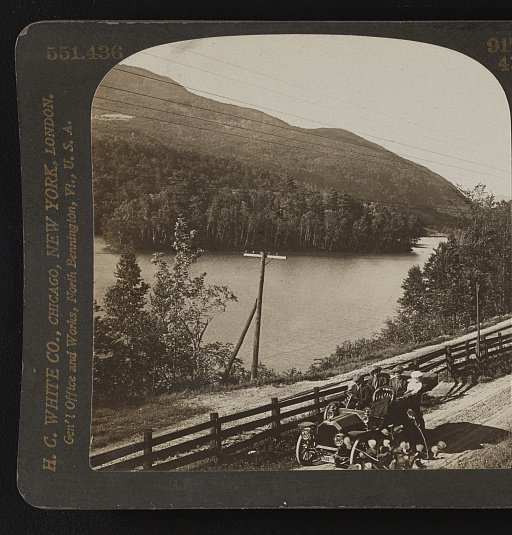
Illustration · Lois’s tea arbor at the north end of Emerald Lake in the summer of 1915: birch poles, a green-painted floor, wild strawberries, and a kerosene-lamp burner of the kind Bill was peddling. Drawn from Lois W.’s description, not from a photograph.
A tea arbor with few customers, a tall young man who stopped by many afternoons, a wedding in wartime, and a husband she was sure she could fix.
“I was only slightly unhappy about this drinking, because I felt confident I could persuade him to return to his former abstinence. I could ‘fix’ him.”
The finest man I knew
Her brother Rogers kept talking about his friend Bill, from East Dorset, three miles south of the family’s camp at Emerald Lake. When Lois finally met him, “the only impression he made on me was that he was tall and lanky.” She was twenty-two; he was a teenager, four years younger. In the summer of 1913 he camped at the other end of the lake, and with a sail rigged on a hired rowboat he almost beat her skiff. Bill’s side of these years is in Number One Man.
By the end of the next summer she thought him “the most interesting, the most knowledgeable, and the finest man I knew.” He was a “native,” she was one of the summer people, and the two didn’t mix easily. When he clowned and then pitched badly at a ball game in Bennington, and the summer people weren’t amused, she found that what hurt him hurt her too.
In 1915 she opened a tea arbor on the hill at the north end of the lake: birch poles, vines, maple chairs, a floor painted green. Few people found it. But Bill stopped by many afternoons after peddling burners for kerosene lamps in the villages around. “He didn’t sell many burners and I didn’t sell much tea; but we had wonderful visits.” Late that summer a young man from Canada asked her to marry him, and she said no. “Just as Norman stepped on the train for Montreal, Bill jumped off.” That evening Bill and Lois told each other of their love.
They were engaged for two and a half years. She wrote him at least a letter a day; his grandmother said there would soon be enough to wallpaper the kitchen. In January 1918, with rumors that his regiment would sail, they moved the wedding up a week and were married in Brooklyn on the 24th. He had been warned since childhood not to touch alcohol, and she had been proud of his willpower. Then, at a party in New Bedford, his Army friends dragged him home. “There I found him, dead to the world, with a bucket by his head.” In August his regiment left for overseas. “I didn’t cry until the train was out of sight.”
While he was gone she trained in occupational therapy, then a new profession, and worked in the shell-shock ward at Walter Reed Hospital in Washington. After the war she kept working, in the psychiatric wards of the Brooklyn Naval Hospital and then at Bellevue, while Bill went from job to job and studied law at night (her jobs and his). His drinking grew.
In the summer of 1922 she became pregnant. It was ectopic, growing in a fallopian tube, and her father nursed her through it at her parents’ house. Two more followed, the last in May 1923, and both meant operations. They would never have children of their own. “Bill was often too drunk, for days at a time, to come to see me in the hospital.” Yet “somehow I could not help feeling guilty,” and so how could she blame him for drinking more? Some years later they applied to adopt a child, and waited; Number One Man tells what she learned in 1974.
ListenEmerald LakeAbout 1 minute
It’s the summer of 1915, on the hill at the north end of Emerald Lake, in Vermont. Lois is twenty-four, and she has opened a tea arbor. Hardly anyone comes.
But a tall, lanky young man from East Dorset stops by many afternoons, after peddling burners for kerosene lamps. He doesn’t sell many burners. She doesn’t sell much tea. Before the summer is over, they are in love.
In 1918 they marry, and she finds out he drinks. It doesn’t worry her much. She’s sure she can fix him. Living with her will be inspiration enough.
Then come three pregnancies, all lost, and no children. Some days he is too drunk to visit her in the hospital. And somehow, she feels guilty.
Side by side
Her jobs, his jobs
From the summer they met to the motorcycle trip of 1925, here is what each of them did for a living.
From Lois Remembers (1979), which dates Bill’s law degree to 1924 in one place and has him finishing the course in 1921 in another. Pass It On, AA’s biography of Bill, says of her, “Unlike Bill, she never had any trouble holding a job.”
YearsLoisBill
1913–1916
Lois
A receptionist, then in the employment bureau, at the YWCA in Brooklyn; from 1915, girls’ work secretary at its Eastern District branch.
Bill
High school in Arlington, near Boston, in 1913–14, then from the fall of 1914 Norwich University, a military college in Vermont. He peddled kerosene-lamp burners in the summer of 1915, and on leave he surveyed for the telephone company and chopped wood.
1917–1918
Lois
Teaching at her Aunt Marian’s small school in Short Hills, New Jersey, from January 1917 until the wedding.
Bill
Officers’ training at Plattsburgh, and in August 1917 a second lieutenant in the Coast Artillery.
1918–1919
Lois
A two-month course in occupational therapy, then the shell-shock ward at Walter Reed Hospital in Washington.
Bill
Overseas with his battery. When they left France his men gave him a watch, chain and ring: “Wouldn’t have changed insignia with a brigadier general.”
1919–1920
Lois
Volunteer occupational therapy at Roosevelt Hospital; from February 1920, a paid Red Cross aide in the psychiatric wards of the Brooklyn Naval Hospital.
Bill
Jobs such as decoding cablegrams at $20 a week and laboring on the New York Central’s docks at 61 cents an hour, a few weeks each. Then a bookkeeping job with the railroad, until, as Lois put it, they agreed to part; Bill said he was fired. From the fall of 1920, law at night at Brooklyn Law School.
1921–1922
Lois
A better-paid job in the women’s psychiatric ward at Bellevue Hospital, from February 1921 to September 1922.
Bill
Still studying law at night. Thomas Edison offered him a job after one of his famous tests, but by then he was investigating fraud for a surety company.
1923–1925
Lois
After her operations, back at the Naval Hospital in October 1923, at a higher salary.
Bill
Still investigating, and more and more on Wall Street. He finished law school in 1924, as Lois tells it, and paid the $15 diploma fee, but the next day he was too drunk to go and get it.
Steady
She went where the work was and kept her jobs. In April 1925 they both gave them up: he to study companies from the road, she to get him away from New York and its bars (3 · Everlastingly trying).
For a closer look
Go deeper
The war work she was refused, the Thanksgiving they set Staten Island on fire, and their word for the joy of living.
Not considered Christians
With Bill overseas, Lois tried to get the YWCA, her employer for several years before Short Hills, to send her abroad as an aide to the wounded, so she could at least be on the same continent. Its national board turned her down because of her religion. Its letter said that Swedenborgians, the sect she belonged to, and Unitarians “were not considered Christians!”
When she objected, she was told she should have known. To her it seemed narrow and illogical: a “non-Christian” could teach children but couldn’t help wounded soldiers. Meanwhile she and the wife of one of Bill’s Army friends signed up for the first course in a new profession, occupational therapy.
Staten Island on fire
“Did you ever smell singed wool?”
Lois W., on the ride home, Lois Remembers, 1979.
Thanksgiving weekend, 1916. Bill was visiting Brooklyn, and they took the subway, a ferry, a bus and a trolley to a quiet spot on Staten Island for a cookout. After the steak, the wind changed and scattered the embers. “Staten Island was afire!” They beat at the flames with their coats and ran for help, and the fire department put it out.
That night her parents gave a reception to introduce their future son-in-law, and his only suit jacket had burned. Her father lent him his striped cutaway coat. Bill’s wrists stuck out six inches from the sleeves, but, she wrote, “the cutaway tails exactly covered his bottom.”
Brook-jumpers
On a month’s walk through Maine, New Hampshire and Vermont in the summer of 1919, Lois kept a diary, and one day Bill dictated an entry: a mock-solemn account of a lazy day and a find of blueberries. Under it she signed a note: “I disclaim all responsibility for the above and will not vouch for its authenticity.”
They got outdoors whenever they could: hiking in Van Cortlandt Park, sailing the Hudson in a rented rowboat with a bath towel for a sail, camping by a brook near Haledon, New Jersey. Their morning plunges there gave Bill a word, “brook-jumper,” which they used for the rest of their lives for the joy of living. To her, a weekend away also meant getting away from liquor, and Bill seemed just as happy in the open.
Sources
Lois Remembers. Al-Anon Family Groups, 1979. Chapter 1, “Childhood Memories” (her YWCA years and Short Hills); chapter 2, “Strawberries and Kerosene”; and chapter 3, “Maine Blueberries and Brook-Jumping.”
Pass It On. AA World Services, 1984. Chapter 2 (Bill’s schooling, the tea arbor, the engagement) and chapter 3 (the war and after).